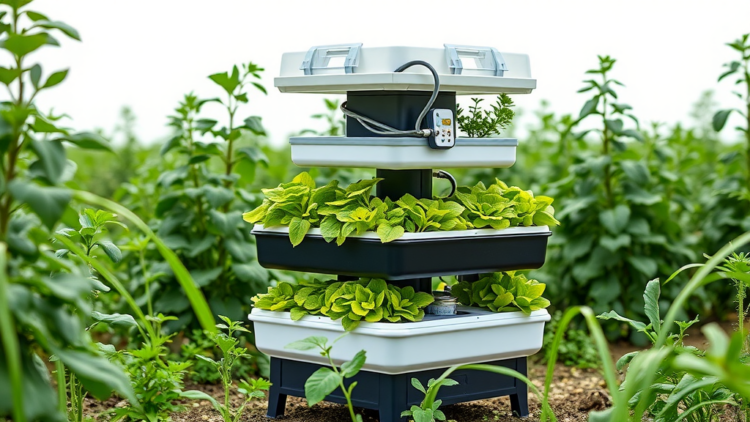
Researchers at the Centro de Investigaciones Biológicas del Noroeste (CIBNOR) in Mexico have unveiled TOTEM, a fully open-source, solar-powered aeroponic system that grows crops vertically with no connection to the electrical grid. Described in the journal HardwareX, the platform combines a 1.5-meter-tall cultivation tower, automated misting irrigation, embedded sensing, and photovoltaic energy storage in a compact cylindrical structure costing roughly $720 in materials. In a 55-day validation trial, the prototype cultivated 24 basil plants through two sequential harvests while running entirely on sunlight, offering a glimpse of how food production might be decoupled from both soil and fossil-fueled power supplies.
The timing of such a system is hardly accidental. Irrigated agriculture already accounts for approximately 70 percent of global freshwater withdrawals, while arable land continues to shrink under pressure from degradation and rapid urbanization. The Food and Agriculture Organization estimates that global agricultural production must increase by about 50 percent by 2050 relative to 2012 levels to feed a growing population. Controlled-environment agriculture, including vertical farming in urban buildings, has emerged as one strategy to raise productivity while cutting resource consumption, but its energy appetite has remained a persistent obstacle, with energy representing between 10 and 40 percent of total production costs in commercial greenhouses.
Among soilless cultivation techniques, aeroponics stands out for its extreme water efficiency. Unlike hydroponics, where roots sit submerged in nutrient solution, or aquaponics, which couples plant cultivation with fish farming, aeroponics suspends bare roots inside a closed chamber and sprays them with a fine nutrient mist. Reported water savings reach 90 to 98 percent compared with soil-based cultivation, while direct exposure to oxygen enhances root respiration and nutrient uptake. The technique also reduces exposure to soil-borne diseases, allows precise moisture control, and has even attracted attention from space agencies for food production under microgravity.
Yet aeroponics has a critical vulnerability: it depends on continuous electrical power. Because roots hang in air rather than water, a power outage can desiccate a crop within hours. Commercial vertical aeroponic towers, such as the Tower Garden FLEX, the Nutraponics Pro AeroTower, and the Agrotonomy Tower Farm system, all rely on grid electricity and proprietary designs, and none include integrated filtration to protect their misting nozzles. Prices range from $765 to $5,250 per unit, and academic prototypes published in the literature typically omit fabrication files, making them difficult or impossible to reproduce.
TOTEM was designed to close these gaps. The system stacks eight mechanically coupled modules, each housed in standard 20-centimeter-diameter PVC components: growth, reservoir, pump, filter, inlet-drainage, control, power, and solar. The growth module is a 1.5-meter PVC tower holding 24 net cups arranged in six staggered rows, with modified 45-degree elbow fittings angling each plant site to optimize light distribution. Inside the chamber, a vertical distribution pipe carries pressurized nutrient solution past 24 misting nozzles that atomize it into fine droplets directed at the suspended roots.
The hydraulic loop is deliberately simple and closed. A 12-volt DC diaphragm pump draws solution from the reservoir and pushes it through an AZUD Modular 100 mesh filter, which captures suspended particles before they can clog the nozzles, a failure mode that plagues many commercial systems. Filtered solution travels up the internal pipe, is atomized across the root zones, and the excess drains by gravity back into the reservoir for recirculation. During the basil trial, this closed loop required only about 54 liters of nutrient solution for 24 plants over the entire 55-day cycle, an estimated 0.041 liters per plant per day, far below reference values of roughly 0.6 liters per plant per day for protected agriculture and 12.6 liters for open-field cultivation.
At the system’s electronic core sits an ESP32-WROOM microcontroller mounted on a custom printed circuit board alongside an LM2596 voltage regulator, an FOD852 optocoupler, and an RAS1220M relay that switches the pump. A waterproof DS18B20 digital temperature sensor tracks conditions inside the growth chamber while a water-level sensor monitors the reservoir, enabling basic fault detection such as low-solution alerts. The microcontroller executes an intermittent irrigation schedule, in the validation trial running the pump for 0.5 minutes followed by 29.5 minutes of rest, equivalent to 48 activation cycles per day. Over Wi-Fi, the controller transmits data to a remote server that logs performance history and serves a web-based graphical user interface, allowing users to adjust irrigation parameters and monitor the system remotely, a capability none of the surveyed commercial towers offer.
Energy autonomy comes from a 50-watt polycrystalline solar panel mounted on a three-meter galvanized steel mast, angled at 24 degrees and oriented southward for maximum insolation. Power flows through a 40-amp MPPT charge controller into two 12-volt, 12-amp-hour rechargeable batteries wired in parallel, providing 288 watt-hours of nominal storage and roughly 122 watt-hours of usable energy at a conservative 50 percent depth of discharge. That corresponds to approximately 2.7 days of autonomous operation without any sunshine. The designers sized the array against the worst month of the year in La Paz, Baja California Sur, where December delivers only 3.9 peak sun hours per day; even with a photovoltaic derating factor of 0.70, the panel supplies an estimated 136.5 watt-hours daily, comfortably exceeding the calculated demand of 44.9 watt-hours after accounting for the pump’s 19.2 watt-hours, the continuously active microcontroller’s 19.0 watt-hours, and 85 percent system efficiency.
The validation experiment grew basil, a fast-growing crop prized in controlled-environment agriculture for its sensitivity to water availability, under uncontrolled shade-greenhouse conditions. After transplanting, formative pruning at 30 days promoted lateral branching, followed by a first harvest at 45 days and a final harvest at day 55. Sampled plants averaged 517.97 square centimeters of leaf area, 31.33 leaves, an 18.8-centimeter shoot length, and a mean relative water content of 82.18 percent, indicating that intermittent misting maintained adequate hydration throughout. Chamber temperatures fluctuated naturally between 14 and 38 degrees Celsius, and the system completed every programmed irrigation cycle without interruption across the full cultivation period.
The authors are candid about limitations. The final nutrient solution pH drifted to 7.39, above the mildly acidic range typically targeted in soilless production, and the team recommends adding calibrated pH and electrical conductivity sensors with closed-loop control in future iterations. The single-cycle trial demonstrated feasibility rather than long-term endurance, and the growth measurements from three plants provide descriptive data rather than statistically rigorous agronomic comparison. Still, the study’s principal contribution lies in its radical transparency: complete STEP CAD files for every module, circuit schematics, PCB layouts, ESP32 firmware in C++, and web interface code are released under CERN Open Hardware License v2-S and GNU General Public License v3, accompanied by an itemized bill of materials totaling $719.51. With a footprint of just 0.078 cubic meters, less than a ninth of comparable commercial towers, TOTEM makes off-grid aeroponic farming something a workshop, a school, or a resource-limited community can actually build, repair, and adapt for itself.
Subject of Research: An open-source, low-cost, solar-powered aeroponic vertical farming system for sustainable urban agriculture
Article Title: TOTEM: A low-cost solar-powered aeroponic system for vertical agriculture
Article References: Von Borstel, F. D., Villa-Medina, J. F., Nieto-Garibay, A., & Gutiérrez, J. (2026). TOTEM: A low-cost solar-powered aeroponic system for vertical agriculture. HardwareX, 28, Article e00838. https://doi.org/10.1016/j.ohx.2026.e00838
Image Credits: AI Generated
DOI: 10.1016/j.ohx.2026.e00838
Keywords: aeroponics, vertical farming, open-source hardware, solar power, urban agriculture, ESP32, water efficiency, controlled environment agriculture, basil cultivation, food security, IoT, sustainable agriculture
Cite Scienmag News
APA MLA Chicago
Dorothy Gentry. (September 23, 2026). Open-Source Solar-Powered Aeroponic Tower Grows Food Off the Grid for $720. Scienmag. https://scienmag.com/open-source-solar-powered-aeroponic-tower-grows-food-off-the-grid-for-720/
Dorothy Gentry. “Open-Source Solar-Powered Aeroponic Tower Grows Food Off the Grid for $720.” Scienmag, 23 September 2026, https://scienmag.com/open-source-solar-powered-aeroponic-tower-grows-food-off-the-grid-for-720/. Accessed 23 September 2026.
Dorothy Gentry. “Open-Source Solar-Powered Aeroponic Tower Grows Food Off the Grid for $720.” Scienmag. September 23, 2026. https://scienmag.com/open-source-solar-powered-aeroponic-tower-grows-food-off-the-grid-for-720/
Copy citation Download RIS
Tags: addressing global food security through innovative farmingaeroponicsautomated misting irrigation systemsbasil cultivationcontrolled environment agricultureembedded sensing for crop monitoringESP32Food securityIoTlow-cost aeroponic tower designoff-grid food cultivationopen-source hardwareopen-source vertical farming technologyphotovoltaic energy storage for farmingresource-efficient controlled-environment agriculturesoil-free crop production methodssolar energy in agriculturesolar powersolar-powered aeroponic systemsustainable agriculturesustainable urban farming solutionsurban agriculturevertical farmingwater efficiency