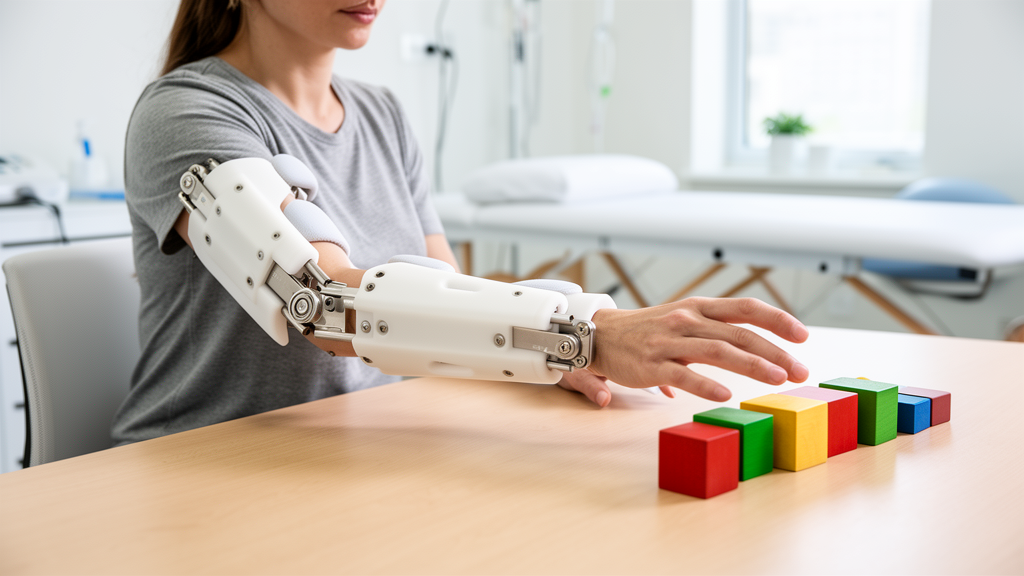
Robotics researchers have introduced ARM-01, an open-source, two-degree-of-freedom upper-limb rehabilitation robot engineered to provide passive range-of-motion exercises and predefined trajectory tracking for post-stroke physical therapy. Documented in the journal HardwareX, the design establishes an accessible robotic framework capable of operating across both the sagittal and transverse planes to guide the human shoulder and elbow joints. Built with a total replication expenditure of approximately 4,445 dollars, the platform provides an open hardware alternative to commercial systems that often cost tens or hundreds of thousands of dollars. The engineering team released the complete mechanical computer-aided design files, electrical schematics, bill of materials, and source code under a Creative Commons Attribution 4.0 International license. This open release enables academic laboratories, clinical research facilities, and independent developers to reproduce, customize, and evaluate the robotic arm without proprietary restrictions, addressing a longstanding accessibility barrier in automated motor therapy.
The clinical motivation underlying the development of ARM-01 stems from the staggering global burden of neurological trauma and vascular brain injuries. Annually, fifteen million people worldwide suffer a stroke, resulting in five million deaths and leaving another five million permanently disabled. Contralateral upper-limb hemiparesis represents the most prevalent functional impairment following a cerebrovascular accident, presenting in more than eighty percent of stroke survivors acutely and persisting in over forty percent chronically. Prolonged immobilization of the affected arm exacerbates secondary neural degeneration, whereas early, high-dose, repetitive robotic training promotes therapeutic neuroplasticity. However, commercial clinical platforms such as the multidimensional Yeecon A6 system carry sample listing prices reaching approximately 200,000 dollars, making widespread clinical adoption challenging. By focusing strictly on two actuated degrees of freedom targeting the shoulder and elbow, ARM-01 demonstrates a functional baseline designed specifically to lower capital costs for rehabilitation centers.
Structurally, ARM-01 is partitioned into four primary functional modules that decouple structural loads from the patient while enabling flexible clinical placement. A mobile base fabricated from a welded SUS304 stainless steel frame houses the central power supplies, electrical safety switchgear, and computing hardware, all resting upon four lockable leveling casters. By grounding the active robotic structure directly into this weighted mobile platform, the gravitational load of the heavy therapeutic arm and its driving motors is entirely supported by the chassis rather than the patient’s impaired arm. Rising vertically from the base is an electric linear lifting column featuring a 300-millimeter stroke and a 2,700-newton dynamic load rating. This motorized vertical column, combined with the planar mobility of the caster base, provides comprehensive macroscopic three-dimensional positioning. Clinicians can roll the system toward standard wheelchairs or clinical treatment chairs and align the rotational axis of the robotic shoulder actuator coaxially with the patient’s anatomical glenohumeral joint.
Operational safety and patient comfort guided the mechanical implementation of a comprehensive hollow-shaft internal cable routing architecture. In traditional robotic rehabilitation devices, exposed external wire harnesses introduce severe operational hazards, including mechanical snagging, parasitic friction during motion, electrical shock possibilities, and psychological apprehension for recovering patients. To eliminate these issues, ARM-01 encloses all high-voltage power conduits and low-level communication wiring within the structural chassis. A dynamic flexible conduit routes cables from the base cabinet along the vertical stroke of the lifting column. From that junction, the electrical harness passes through the interior of custom aluminum alloy passive arm casings and feeds directly through the central hollow bores of the joint actuators. By routing wiring through the rotational centers of the direct-drive CubeMars AK80-64 brushless motors, the machine avoids external wire loops and torsional tangling, yielding a streamlined, non-intimidating visual aesthetic that enhances user comfort during interaction.
To solve the financial and spatial inefficiency of purchasing separate, dedicated robotic systems for left- and right-arm therapy, ARM-01 integrates a hardware-software reversible mechanism that requires no external assembly tools. The mechanical reconfiguration relies on two upper passive horizontal links equipped with spring-loaded mechanical detents that lock solidly at orthogonal ninety-degree increments, allowing the entire upper arm assembly to swing across the workspace. Simultaneously, an L-shaped bracket located at the elbow joint rotates 180 degrees via a quick-release spring pin, pivoting the forearm link into the opposite orientation. Once the mechanical reconfiguration is complete, the clinician selects the target arm via a graphical user interface, prompting the control software to apply a mathematical reflection matrix across the sagittal plane. This software transformation inverts the relevant joint sign conventions, maintaining identical forward and inverse kinematic relationships without requiring tedious physical sensor recalibration or kinematic recalculation.
To accommodate variations in human body proportions without introducing excessive inertial bulk, the robotic arm incorporates dedicated anthropometric length adjustment mechanisms. Rather than employing extended universal sliding tracks that create protruding structural levers and dynamic inertia, ARM-01 tailors its dimensional adjustments specifically to the adult demographic of Southeast Asia, while noting that Asia bears over eighty percent of global stroke-related disability-adjusted life years. The upper arm and forearm links integrate lockable rack-and-pinion prismatic joints, featuring a five-millimeter pitch and fifteen teeth paired with SGR10 dual-axis linear guide rails. This manual slider provides a continuous sixty-millimeter adjustment range, enabling upper arm lengths from 275.5 to 335.5 millimeters and forearm lengths from 292 to 352 millimeters. This geometric span encompasses anthropometric body dimensions from the fifth percentile female to the ninety-fifth percentile male within the target regional population, preventing unwanted joint stress and hyperstatic loading.
The computing and electrical system of ARM-01 operates through a hierarchical architecture linking a graphical user interface, middleware, and motor controllers. High-level planning, patient records, and real-time three-dimensional skeletal visualization run within the Unity engine on an ASUS NUC 13 Pro mini PC powered by an Intel Core i5-1340P processor. The mini PC executes Ubuntu 22.04.5 LTS and the Robot Operating System 2 Humble Hawksbill distribution, communicating with the Unity interface through the ROS-TCP-Endpoint protocol over a local network socket. For actuator coordination, the system deploys a CANable USB-to-CAN transceiver operating at a high-speed bitrate of one megabit per second. The controller runs a joint-space position-control loop with a one-millisecond update cycle, reading digital feedback from the 14-bit absolute encoders integrated within each actuator. Clinicians interact with the system via a magnetically mounted 10.5-inch 2K touchscreen display, allowing mobile bedside adjustments through an extendable coiled signal cable.
System safety is enforced across three independent functional layers consisting of mechanical barriers, electromechanical hardware interlocks, and real-time algorithmic software routines. Layer one utilizes physical mechanical hard stops machined directly into the joint housings, establishing an absolute physical limit on joint travel that prevents hyperextension regardless of control signal failures. Layer two incorporates an external mushroom-style emergency stop push button wired to primary industrial contactors, which instantly sever the 48-volt direct current power lines supplying the motor drives when struck. Layer three features continuous software current monitoring within the ROS2 motor driver node. When sudden muscular spasticity or an involuntary patient spasm introduces elevated resistive torque, an abnormal rise in motor current triggers an active-compliance routine designed to reduce actuator torque output. Static mechanical analysis verified that the 48-newton-meter continuous and 120-newton-meter peak torque ratings of the actuators comfortably exceed the worst-case gravitational torque of 40.33 newton-meters calculated for full horizontal arm extension.
Operational validation of the ARM-01 prototype evaluated practical trajectory tracking performance using an end-effector commanded along a planar circular path with a radius of forty millimeters. The engineering team tested eleven combinations of path discretization points and command update intervals to examine how motion timing affects tracking accuracy. Across the evaluation matrix, the Cartesian root-mean-square tracking error ranged from 3.72 to 28.74 millimeters, while maximum instantaneous errors spanned from 8.04 to 60.36 millimeters. Short command update intervals of 200 milliseconds generated significant trajectory distortion because new setpoints were transmitted before the physical actuators could settle at previous coordinates. The researchers identified a favorable operating condition using 100 discretization points and a 500-millisecond update interval, which completed the circular motion in fifty seconds while achieving a root-mean-square error of 5.27 millimeters and a peak deviation of 10.39 millimeters.
Five consecutive experimental trials conducted under this selected operating setting demonstrated high mechanical repeatability, yielding a mean root-mean-square error of 5.21 ± 0.23 millimeters and a mean maximum error of 10.00 ± 0.39 millimeters. The authors noted that the observed ten-millimeter peak deviation reflects the open-loop nature of Cartesian tracking in the current prototype, which relies exclusively on joint-space encoder feedback rather than external Cartesian position sensors, alongside actuator gearbox backlash and network transmission latencies. Crucially, the operational demonstration was performed in a laboratory environment with an author serving as the participant to confirm engineering feasibility, rather than to measure clinical therapeutic outcomes. The research team emphasized that the active-compliance software safety routine requires formal empirical validation under simulated spasticity conditions, and noted that full institutional review board-approved clinical trials with recovering stroke survivors will be necessary to establish long-term clinical efficacy.
Subject of Research: Open-source reversible robotic platform for upper-limb post-stroke rehabilitation
Article Title: ARM-01: an open-source reversible 2-DOF upper-limb rehabilitation robot with internal cable routing and intrinsic safety
Article References: Vu, T.-L., Vu, C.-L., Nguyen, T.-D., Ly, H.-H., Nguyen, X.-T., Bui, D.-B., & Mac, T.-T. (2026). ARM-01: an open-source reversible 2-DOF upper-limb rehabilitation robot with internal cable routing and intrinsic safety. HardwareX, 28, Article e00856. https://doi.org/10.1016/j.ohx.2026.e00856
Image Credits: AI Generated
DOI: 10.1016/j.ohx.2026.e00856
Keywords: rehabilitation robotics, stroke recovery, open-source hardware, upper-limb therapy, biomechanical alignment, internal cable routing, reversible mechanism, kinematic modeling, ROS2 middleware, Unity HMI, direct-drive actuators, anthropometric adjustment, static load analysis, trajectory tracking, HardwareX, physical human-robot interaction
News Source: Denise Maddox. (November 12, 2026). Open-Source Reversible Robotic Arm Prototype Demonstrates Low-Cost Upper-Limb Rehabilitation. Scienmag.