Researchers at the University of Tasmania and the University of the Sunshine Coast have utilized geometric morphometrics to analyze the locomotor shape of 48 species of predatory mammals, revealing that hunting strategies are strongly associated with specific biomechanical patterns during high-performance gaits. The study, published in BMC Ecology and Evolution, groups these species into five distinct hunting-strategy clusters: Anteaters, Opportunistic Grapplers, Large Grapplers, Opportunistic Pouncers, and Social Hunters. By digitizing 115 side-view stride sequences, the team demonstrated that while phylogeny accounts for the largest share of locomotor variation in slower, symmetrical gaits, ecological specialization becomes most clearly expressed in asymmetrical gaits such as galloping and bounding. This approach allows for the inference of predation strategies in extinct species by comparing their locomotor shapes to extant carnivores.
The central finding of the research is that locomotor biomechanics are not merely products of evolutionary history but are also shaped by the ecological demands of predation. In symmetrical gaits, such as walking, the team observed relatively broad overlap among hunting groups, with Social Hunters tending to use more upright limb postures and Grappling species adopting more crouched and extended forelimb configurations. However, in asymmetrical gaits, differences among hunting strategies were significantly stronger. Social Hunters exhibited larger limb and spinal excursions, whereas Opportunistic Pouncers occupied a more restricted region of locomotor space. This suggests that ecological specialization is most evident in high-performance behaviors like acceleration and prey capture, rather than in the economical mechanics of walking.
To categorize the species, the researchers employed hierarchical cluster analysis based on six explicitly defined dimensions of hunting ecology. These dimensions included the distance of active pursuit, the speed of gap-closing, the ability for grappling with prey, the degree of sociality during hunting, the proportion of relatively large prey items in the diet, and the relative athleticism of prey species. Each species was scored independently by four assessors, and the values were averaged to reduce subjectivity. This method allowed for the mathematical sorting of species into clusters, avoiding the issues associated with strict, a priori ecological categories. The resulting clusters were interpreted from the average criterion scores, providing a robust framework for comparing locomotor shapes across diverse carnivores.
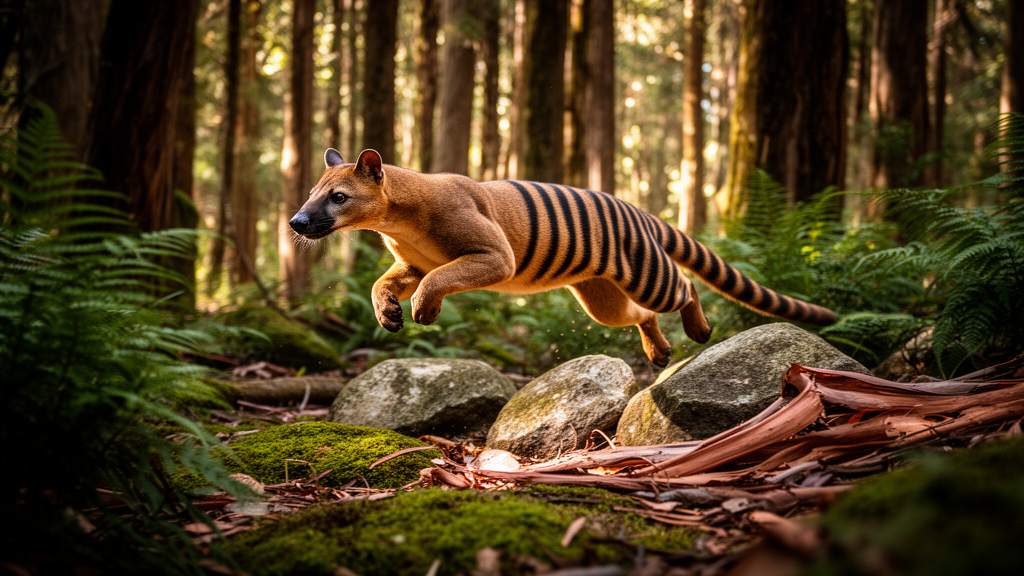
The study specifically applied this framework to the extinct thylacine, Thylacinus cynocephalus, using archival footage of its walking gait. The thylacine was a large marsupial carnivore native to mainland Australia, Tasmania, and New Guinea, which was extirpated from the mainland and New Guinea approximately 3,500 years ago and from Tasmania in the 1930s. Previous morphological studies had suggested that the thylacine functioned as either a dog-like or cat-like predator, leading to conflicting interpretations of its hunting strategy. By analyzing the spatiotemporal characteristics of its gait, the researchers aimed to provide a more comprehensive assessment of its ecomorphology, as gait is an emergent property of body shape, posture, and motion that directly affects predator fitness.
The analysis of the thylacine’s symmetrical gait revealed that its species-level centroid was predominantly associated with the Opportunistic Pouncer cluster across various classifiers. Using Euclidean distance and k-nearest neighbor classification, the thylacine was assigned to the Opportunistic Pouncer group, while direct Mahalanobis distance placed it nearest to the Anteater cluster. However, stratified centroid bootstraps supported Opportunistic Pouncer as the most frequent winner under both distance metrics. This indicates that the thylacine’s walking locomotion was most consistent with that of opportunistic pouncing species, which typically hunt smaller, less athletic prey and may utilize sensory advantages to capture vulnerable targets.
The technical approach involved digitizing 19 landmarks on the shape of each individual for every frame within a stride, capturing the dynamic changes in body position throughout the gait cycle. These landmarks were then aligned using Procrustes alignment to remove the effect of size, and principal component analysis was performed on the shape coordinates. The first principal component explained 59.3% of the variation in gait shape during symmetrical gaits and 82.8% during asymmetrical gaits, describing the dominant pattern of postural variation. The second principal component, which explained 30.8% of variance in symmetrical gaits, was largely associated with a crouched-to-upright posture, particularly in the forelimb. This detailed morphometric analysis allowed the researchers to disentangle the effects of phylogeny, gait type, and ecological strategy on locomotor shape.
Statistical analyses confirmed that hunting cluster membership exhibited strong phylogenetic signal, indicating that hunting strategies are non-randomly distributed across the phylogeny and tend to be conserved among related taxa. In the reduced ecological models, hunting cluster explained a substantial portion of the morphospace variation, with body mass remaining non-significant. This suggests that the postural differences often attributed to body size may instead reflect ecological specialization. For instance, the more upright limb postures of Social Hunters may increase the mechanical advantage of walking gaits, aiding in the efficient travel required for their large home ranges. Conversely, the crouched postures of Grappling species may provide advantages in force production, readiness, and agility, which are crucial for ambush predation.
The study also highlighted the importance of asymmetrical gaits in revealing ecological specialization. In these gaits, hunting strategy dominated the variation in locomotor shape, while gait type and body mass made negligible contributions. Social Hunters showed a broad range of motion along the first principal component, consistent with the large spine and limb excursions required to pursue athletic prey. In contrast, Opportunistic Pouncers occupied a reduced performance space, suggesting they keep their limbs more gathered under the body, possibly reflecting a lesser reliance on rapid pursuits or a specialization for leaping. This distinction underscores the different biomechanical demands placed on predators based on their ecological niches.
Limitations of the study include the reliance on archival footage for the thylacine, which captured only symmetrical walking and not the full range of its locomotor repertoire. The clearest ecological differentiation among extant taxa emerged in asymmetrical gaits, so the classification of the thylacine reflects only the portion of gait space represented by walking. Additionally, the use of species-average body masses for individuals in publicly sourced videos may introduce some variability. Despite these limitations, the results provide valuable insights into the evolutionary ecology of extinct predators and the relationship between locomotor biomechanics and hunting strategy.
The findings suggest that the thylacine may have functioned as an opportunistic apex predator, thriving in the boom-and-bust cycles of Australian ecology. A restricted range of motion during walking would help conserve energy while roaming for carrion, a behavior compatible with its cranial morphology and conical canine teeth. This interpretation aligns with previous work suggesting that the thylacine’s prey size was smaller relative to its body size compared to other large carnivores. By integrating locomotor shape with ecological data, the study offers a new perspective on the predation strategies of extinct marsupials and their role in shaping past ecosystems.
The study’s methodological foundation relies on geometric morphometrics, a tool for comparing shape that allows researchers to analyze the dynamic changes in body position during locomotion. By digitizing 19 landmarks on the limbs, head, and spine for every frame of a stride, the team captured not just static skeletal structure but the spatiotemporal characteristics of gait. This approach distinguishes the study from previous ecomorphological work that primarily focused on static skeletal shape, offering a more comprehensive view of how form and function interplay to define ecological niches. The analysis specifically separated symmetrical gaits, such as walking and trotting, from asymmetrical gaits, including galloping and bounding, to assess how different locomotor modes reflect ecological pressures.
Validation of the method’s robustness was conducted by comparing repeated walking strides from domestic cats and tiger quolls. Despite visible variation among individual strides within each species, the two species remained clearly separated in the principal component morphospace. Statistical tests, including MANOVA and PERMANOVA, confirmed strong multivariate species effects, with leave-one-out linear discriminant analysis correctly classifying 15 of 16 strides. This indicates that between-species differences remain detectable even when accounting for within-species stride variation, supporting the reliability of using locomotor shape to distinguish ecological groups.
The ecological clusters derived from the analysis reflect distinct strategies for handling prey size and athleticism. Social Hunters, which include species like wolves and lions, are characterized by long pursuit distances and fast speeds, allowing them to take relatively large, athletic prey. In contrast, Large Grapplers, such as tigers and leopards, rely on increased physicality and grappling ability to subdue prey. Opportunistic Pouncers, including many canids and viverroids, focus on smaller, less athletic prey and often utilize sensory advantages to capture vulnerable targets. These clusters were determined through hierarchical cluster analysis, which weighted sociality and relative prey size as the highest predictors of hunting behavior.
The implications for understanding the thylacine extend beyond simple classification. The researchers noted that the thylacine’s moderate range of motion during walking could be related to its cranial shape, which may enhance bite-force capacity. This morphology is consistent with a predator that takes relatively large prey or engages in scavenging, a behavior that would be advantageous in the boom-and-bust cycles of Australian ecology. The conical canine morphology shared by thylacines and some hyaenid scavengers further supports this interpretation, suggesting a flexible ecological role that combined predation with opportunistic feeding.
While the study provides valuable insights, it acknowledges that the available archival footage of the thylacine captured only symmetrical walking. Since the clearest ecological differentiation among extant taxa emerged in asymmetrical gaits, the classification of the thylacine reflects only a portion of its locomotor repertoire. The researchers caution that including hypothetical running strides is unlikely to reclassify the thylacine as a social hunter, given its distinct position in the shape space, but the full picture of its locomotor ecology remains partially obscured by the limitations of historical video records.
Subject of Research: Convergent carnivores or divergent dasyurids? Inferring predation and locomotor strategies of extant and extinct carnivorous marsupials from locomotor shape
Article Title: Convergent carnivores or divergent dasyurids? Inferring predation and locomotor strategies of extant and extinct carnivorous marsupials from locomotor shape
Article References: Gaschk, J. L., Cieri, R. L., Chaseling, B. R., Hamilton, D. G., & Clemente, C. J. (2026). Convergent carnivores or divergent dasyurids? Inferring predation and locomotor strategies of extant and extinct carnivorous marsupials from locomotor shape. BMC Ecology and Evolution, 26(1), Article 69. https://doi.org/10.1186/s12862-026-02569-x
Image Credits: AI Generated
DOI: 10.1186/s12862-026-02569-x
Keywords: Convergent, carnivores, divergent, dasyurids, Inferring, predation, locomotor, strategies, extant, extinct, carnivorous, marsupials
News Source: Drew Townsend. (November 12, 2026). Thylacine Locomotion Data Suggests Opportunistic Pouncing Hunting Strategy. Scienmag.