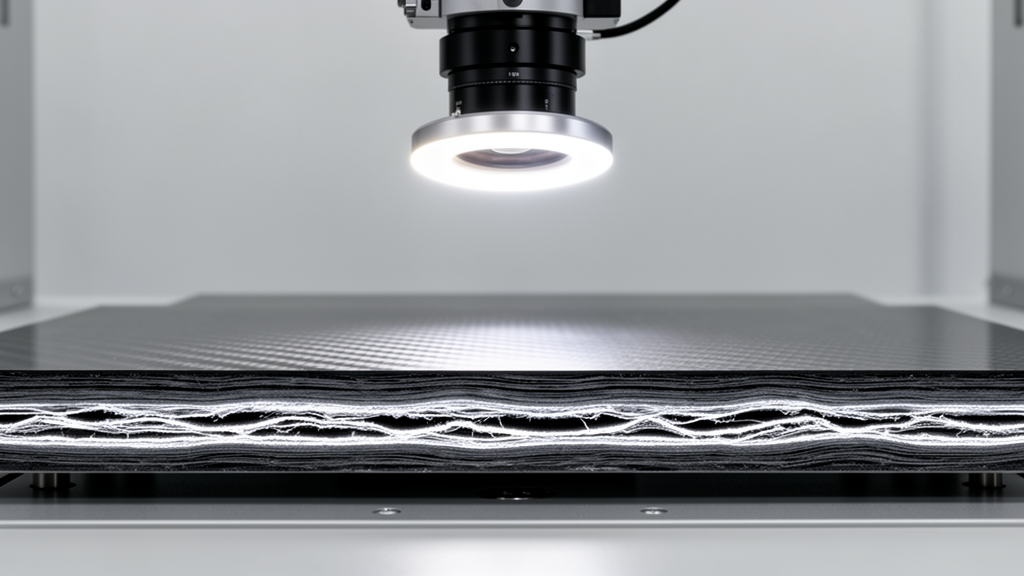
Delamination represents one of the most critical structural failure mechanisms in fiber-reinforced composite laminates, threatening component integrity across numerous industrial and engineering applications. In layered composite materials, mechanical degradation typically evolves chronologically through distinct stages under static and cyclic loading conditions. The failure sequence begins with Stage I damage, marked by the formation of matrix cracks that commonly initiate in plies misaligned relative to the primary loading axis, often termed off-axis cracks. While these early matrix cracks do not directly cause catastrophic structural collapse, the pronounced local stress concentrations formed at their tips induce micro-debonding between adjacent plies. Over successive loading cycles or increased load, these microscopic debonds merge into larger interlaminar separations known as crack-induced or diffuse delamination. Concurrently, out-of-plane stresses arising along exposed edges—a phenomenon known as the edge effect—trigger edge delamination. These compounding interlaminar damage processes define Stage II damage, which eventually progresses into Stage III component failure characterized by widespread delamination, extensive fiber fracture, or combined fracture modes.
To capture the inception and growth of internal damage throughout experimental testing, researchers frequently employ optical inspection methods such as transmitted white light imaging alongside advanced techniques like X-ray computed tomography. Transmitted white light imaging places an illumination source behind a test specimen while an optical camera records transmitted intensity from the opposing side, causing internal material disruptions to scatter light and appear as dark zones. While this imaging approach is fundamentally restricted to translucent materials such as glass-fiber-reinforced polymers, its experimental simplicity has maintained its widespread utility in structural mechanics laboratories. Nevertheless, evaluating and quantifying the resulting experimental image sets has historically relied on manual crack counting and labor-intensive manual measurements of delaminated surface areas. To resolve this analytical bottleneck, researchers introduced DelaDect, an open-source Python package engineered to automate the detection, segmentation, and quantification of both diffuse and edge delamination in composite laminates.
The DelaDect software framework integrates with established crack-detection methodologies, adapting core feature representations to trace irregular delamination morphologies across high-resolution image stacks. The package is organized into dedicated subsystems managed by a coordinating Specimen class, which consolidates experiment metadata and image sequences into a unified structure. Because mechanical testing causes specimen translation within the camera frame alongside strain-induced local shear and angular rotation, uncorrected raw sequences can cause identical damage sites to register across varying coordinate positions, producing duplicate damage detections. DelaDect addresses this experimental artifact by providing preprocessing routines equipped with a graphical user interface to correct translation, rotation, and multi-anchor strain distortions. Following motion compensation, image sequences are handled through the ImageStack architecture adapted from the CrackDect tool, providing a choice between full in-memory processing for rapid access and an SQLite caching backend designed to manage large experimental image stacks within constrained random-access memory limits.
Crack analysis within DelaDect is executed via functionalities derived from CrackDect, utilizing sequence-based algorithms or single-frame evaluation methods to construct chronological crack registries across loading intervals. For delamination analysis, the tool implements an eight-step image-processing pipeline designed to address optical variations and enforce physical consistency. First, a cumulative minimum history filter is applied across the image sequence, enforcing a monotonic darkening constraint over time to prevent transient illumination flickers and sensor noise from corrupting detection. Second, target frames undergo normalization by dividing them by a reference image, which may be either the initial undeformed frame or a rolling median calculated from a window of preceding frames. Third, morphological closing via combined maximum and minimum filtering suppresses slender matrix cracks while retaining broader delamination regions. Fourth, unsharp masking expands the intensity contrast between intact and separated regions, followed by Gaussian smoothing to suppress high-frequency noise.
The subsequent steps of the core pipeline convert the processed grayscale representations into reproducible binary damage boundaries. In the fifth step, intensity values are scaled to a fixed bounded range to stabilize numerical thresholding across dynamic test sequences. Sixth, candidate delamination zones are segmented using two-cluster k-means thresholding, backed by Otsu thresholding as an automated fallback when k-means iterations fail to converge. Pixels must simultaneously satisfy an adjustable intensity ceiling, filtering out subtle background gradients and surface artifacts. Seventh, morphological closing fills internal voids and bridges narrow discontinuities within candidate masks. Eighth, an accumulation step performs a spatial union of the current frame detection with previously identified damage masks, strictly enforcing a non-decreasing damage area over time. Final delaminated areas are computed from the total active pixel count within the assembled masks and converted into physical area measurements.
DelaDect separates delamination tracking into two distinct operational modes: an edge-delamination pipeline and a diffuse-delamination pipeline, which can operate independently or concurrently. The edge-delamination routine processes full-frame images directly, filtering segmented candidate masks so that only connected regions originating at the specimen boundaries are retained as valid edge delamination. The package also incorporates options to evaluate edge delamination progression across multiple plies sequentially, tracking secondary darkening events within existing damage zones under an assumed damage sequence. In contrast, the diffuse-delamination pipeline operates strictly on local regions of interest centered on pre-identified matrix cracks. These local inspection zones are automatically rotated to align with local crack angles, processed through the foundational seven-step pipeline, and projected back into the global coordinate frame to assemble a composite damage mask. When both pipelines run concurrently, DelaDect applies an edge-priority rule to overlapping pixel assignments, preventing double-counting by allocating shared regions exclusively to the edge delamination mask.
The authors demonstrated the software’s workflow using an illustrative cross-ply glass-fiber-reinforced polymer specimen fabricated from HexPly M79-LT/25%/UD1200/G unidirectional prepreg in a symmetric [0/90]s laminate configuration. The test sample was subjected to quasi-static tensile loading while a camera recorded 623 total frames at an acquisition frequency of two frames per second and an optical resolution of 2211 by 624 pixels. For demonstration, five representative frames were evaluated across an interval of approximately 72 seconds between frames. The crack detection routine analyzed the 0-degree and 90-degree plies independently, tracking crack density evolution over time. Delamination evaluation was then configured at the interlaminar boundary between the distinct ply groups, applying parameter settings including suppression window sizes, boundary seed ratios, and local region dimensions to generate overlaid visual damage boundaries, quantitative crack density curves, relative delamination area metrics, and three-dimensional spatial reconstructions.
The authors identified several experimental constraints and operational boundaries that govern DelaDect’s performance. The accuracy of optical delamination detection depends fundamentally on the quality of acquired transmitted white light images, including consistent illumination intensity, optical focus, interfacial contrast, and accurate motion compensation. In diffuse delamination modes, detection is directly constrained by the reliability of prior crack detection; missed cracks or insufficiently sized regions of interest directly result in undetected delamination zones. Furthermore, because transmitted white light imaging collapses a three-dimensional translucent volume into a two-dimensional through-thickness projection, the optical setup cannot independently resolve through-thickness depth or identify the specific internal interface where delamination resides. As a consequence, structural attribution relies on user interpretation and predefined ply sequences, meaning incorrect sequence assumptions in multi-interface evaluations will misallocate damage states. Despite these physical limitations, the modular architecture provides a reproducible, open-source computational foundation for extracting quantitative damage kinetics from composite mechanical testing.
Beyond standard default settings, the software enables fine configuration of operational parameters to balance sensitivity and false-detection suppression. The window sizing parameters govern how aggressively narrow, crack-like features are eliminated during morphological filtering, where oversized windows risk inadvertently removing authentic delamination boundaries alongside matrix cracks. For boundary-initiated damage, a seed ratio parameter defines the specific proportion of rows along the specimen boundary permitted to initiate edge delamination tracking. In diffuse damage regions, researchers adjust perpendicular and vertical dimensional offsets around detected crack vectors to define the rotated inspection windows. Correctly scaling these inspection boxes prevents the truncation of developing damage zones, while establishing intermediate checkpoints allows operators to verify image preprocessing and crack detection parameters before executing extensive analytical runs across full experimental campaigns.
The package is implemented in Python 3.10 under the GNU Affero General Public License v3.0 and is distributed through the Python Package Index. The software relies on core scientific libraries including NumPy, SciPy, pandas, scikit-image, Pillow, SQLAlchemy, Numba, psutil, and CrackDect, with verified compatibility tested across Microsoft Windows 11 and Zorin OS 18.1. Its modular design permits external crack evaluation utilities to replace the native detection routines, provided the imported crack lists conform to the expected format. Furthermore, individual image filtering and thresholding routines can be substituted or rewritten as new evaluation methods emerge without necessitating broader modifications to the overarching code structure.
Because the computational architecture manages memory through efficient caching, the framework scales across thousands of high-resolution image frames on standard hardware. This computational efficiency makes the tool suitable for tracking damage progression across long-duration cyclic fatigue testing in addition to monotonic tension. The resulting quantitative area measurements provide validated experimental datasets to calibrate or verify numerical composite damage models. Although developed primarily for transmitted light imaging of translucent glass-fiber laminates, the underlying segmentation pipeline can be transferred to alternative imaging modalities and composite materials that display adequate optical contrast between intact and fractured regions, or adapted for general scientific tasks requiring area tracking over time.
Subject of Research: Automated optical detection and quantification of delamination damage in fiber-reinforced composite laminates
Article Title: DelaDect: Optical delamination detection in fiber-reinforced polymers
Article References: Pires, V. D. C., Rettl, M., Pletz, M., & Schuecker, C. (2026). DelaDect: Optical delamination detection in fiber-reinforced polymers. SoftwareX, 36, Article 103236. https://doi.org/10.1016/j.softx.2026.103236
Image Credits: AI Generated
DOI: 10.1016/j.softx.2026.103236
Keywords: composite materials, delamination detection, fiber-reinforced polymers, DelaDect, CrackDect, transmitted white light imaging, damage quantification, open-source software, Python, image processing, matrix cracking, edge delamination, diffuse delamination, glass fiber composites, nondestructive evaluation, structural mechanics
News Source: Denise Maddox. (November 20, 2026). Open-Source Python Tool Automates Optical Delamination Detection in Composite Laminates. Scienmag.