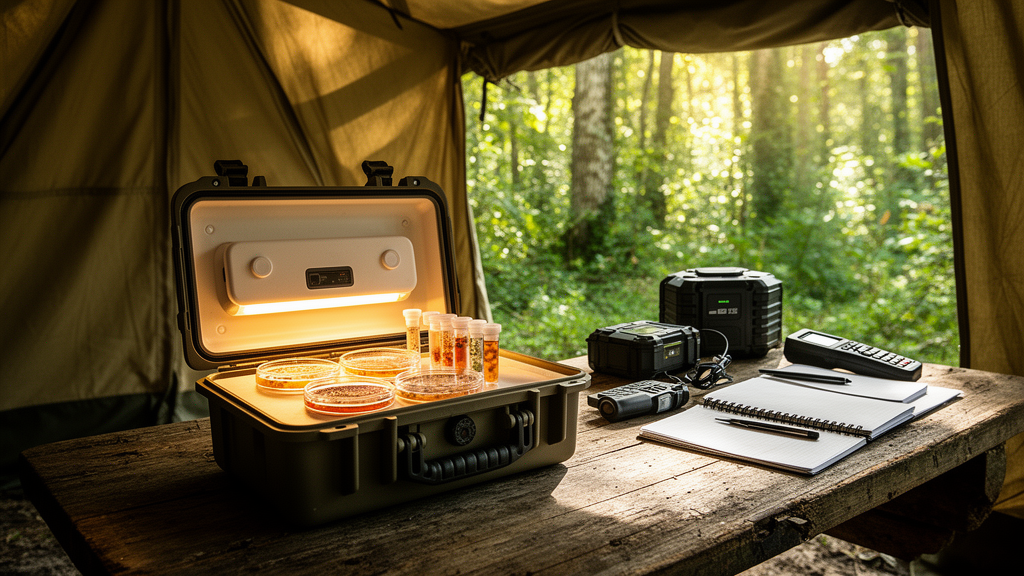
Researchers and volunteer engineers have introduced Moonrat II, an open-source, battery-powered portable incubator designed to maintain precise cultivation temperatures for biological samples in remote, resource-limited field locations. Biological assays, such as detecting Escherichia coli as an indicator of fecal contamination in rural drinking water supplies, typically depend on holding samples at controlled temperatures around thirty-five degrees Celsius for twenty-four to forty-eight hours. While standard microbiological incubators function reliably in conventional laboratories, they generally cost between five hundred and fifteen hundred dollars, weigh fifteen to forty pounds, and require uninterrupted alternating-current power. In remote communities where transporting samples to centralized facilities within regulatory holding times can be difficult or impossible due to terrain or logistics, delays can severely obstruct water safety assessments. Moonrat II was designed to bridge this operational gap by combining widely accessible commercial components with custom digital controls to deliver sustained thermal stability in a rugged, highly transportable package.
The physical structure of Moonrat II centers around a commercially available vacuum-insulated food container, specifically a Thermos Big Boss jar, which serves as the core incubation chamber. Choosing a vacuum flask provides substantial thermal resistance in a compact footprint, achieving superior insulation compared to older, bulky insulated cooler designs previously evaluated by the team in the field. Within the vacuum container, heating is delivered through two flexible mylar joule-heating cloths connected in series to yield a total electrical resistance of 12.7 ohms. To overcome thermal gradients caused by proximity to localized heating elements, the designers incorporated an internal cylinder made of general-purpose aluminum tubing and aluminum sheet end discs. Wrapping the heating cloths directly around this aluminum sleeve allows conductive heat distribution throughout the chamber volume, ensuring that biological test media, such as 3M Petrifilm plates, experience a consistent thermal environment without requiring internal mechanical circulation fans that would consume additional electrical energy and introduce moving parts vulnerable to mechanical breakdown.
The control assembly is built as a custom printed circuit shield interfaced directly with an Arduino R4 Minima microcontroller board. Temperature measurements within the chamber are captured using a digital thermometer attached to a dedicated internal heater printed circuit board assembly. The control unit features a three-button interface and a 0.96-inch monochrome OLED display, enabling operators to adjust target incubation temperatures in increments of half a degree Celsius, program experiment run times, and visually review temperature trends recorded over the preceding two hours. Temperature readings taken every minute are preserved in non-volatile electrically erasable programmable read-only memory, allowing operators to verify post-run thermal histories even if the external power supply is temporarily interrupted during field handling or battery exchanges.
The engineering team implemented and evaluated three distinct firmware control architectures within the microcontroller code: a basic bang-bang thermostat strategy, a fuzzy logic control scheme, and a proportional-integral-derivative algorithm. While a straightforward thermostat routine proved functional, it exhibited cyclical thermal oscillations and potential temperature overshoot caused by delays in heat conduction through the internal aluminum cylinder. The proportional-integral-derivative controller, adapted from Brett Beauregard’s established Arduino library, mitigated overshoot through tailored anti-windup integration parameters tuned to accommodate the thermal lag of the conductive structure. Although the fuzzy logic strategy remains documented in the open-source repository for prospective regimes requiring dynamic temperature ramps, the proportional-integral-derivative strategy was established as the primary validated operating mode, producing a steady-state mean temperature of 34.997 degrees Celsius with a standard deviation of 0.040 degrees Celsius across a forty-eight-hour evaluation run at normal room temperatures.
Thermal mapping trials were conducted inside the chamber to quantify spatial temperature variation and verify that samples placed in different positions experience uniform heating. Using two calibrated precision temperature sensors suspended across various axial and radial coordinates within a specialized wire-cloth test cage, investigators recorded temperature differentials across multiple operating configurations. Across eight experimental placements inside and outside the vacuum flask enclosure, the greatest observed spatial temperature divergence was 0.64 degrees Celsius, comfortably within the typical plus-or-minus one degree Celsius tolerance required by standard microbial Petrifilm assays. Tests evaluating orientation effects demonstrated that inversion of the chamber produced minimal thermal changes, confirming that convective stack effects inside the small metallic cylinder are negligible compared to direct conductive distribution facilitated by the aluminum sleeve and wrap-around heating pads.
Power consumption and battery longevity represent primary operating constraints for field instrumentation deployed far from electrical grids. Operational current measurements revealed that the control circuitry, display, and microcontroller consume approximately 0.25 to 0.72 watts, while maintaining an incubation chamber temperature of thirty-five degrees Celsius against an ambient twenty-five degrees Celsius baseline requires roughly 1.1 watts of thermal input. Under standard ambient laboratory conditions, the complete prototype consumed an average of 1.31 watts, allowing a standard twelve-volt lithium-ion rechargeable battery pack rated at six ampere-hours to sustain continuous incubation for fifty hours and forty-four minutes on a single charge. In an extreme cold-weather endurance stress test conducted inside a laboratory refrigerator held at 4.2 degrees Celsius, system power draw increased to 3.5 watts, yielding nineteen continuous hours of operation from one battery pack and enabling the derivation of a linear predictive model to help technicians calculate battery capacity requirements under divergent field temperatures.
Biological cultivation equivalence was examined by benchmarking the portable device against a conventional eighteen-liter Thermo-Scientific Heratherm benchtop laboratory incubator. Initial testing utilizing natural surface water samples drawn from an urban creek yielded low baseline bacterial counts that lacked sufficient statistical power to draw robust conclusions. Consequently, researchers conducted a controlled validation using a standardized saline suspension prepared from an agar-slant culture of Escherichia coli, inoculating fifteen paired Petrifilm plates per device with one-milliliter aliquots. The benchtop incubator yielded a mean colony count of 58.8 colony forming units with a standard deviation of 17.2, whereas the Moonrat II produced a mean count of 54.7 colony forming units with a standard deviation of 20.1, representing an observed mean count ratio of 1.076. A two-sample statistical test showed no statistically significant difference between the two devices, although high plate-to-plate variance resulted in a ninety-percent confidence interval between 0.884 and 1.321, indicating that while average outcomes fell within a ten percent margin, strict statistical equivalence could not be firmly proven.
Electrical and thermal safety protections are incorporated into the hardware to mitigate potential hazards during unattended operation in remote locations. The printed circuit board integrates a six-ampere self-resetting polyfuse that limits current flow in the event of an internal short circuit or severed wiring. Furthermore, the firmware continually interrogates the primary temperature sensor; should a wire break or sensor disconnection be detected, the microcontroller automatically cuts drive power to the heating circuit transistor. Documented under strongly reciprocal open hardware and open-source software licenses with total bill-of-materials component costs near two hundred and twenty-five dollars, the Moonrat II provides a documented framework to support decentralized sanitation tracking, ecological field assays, and public health water monitoring.
Subject of Research: Development and validation of an open-source portable biological incubator for field diagnostics
Article Title: Moonrat II: A portable incubator
Article References: Read, R. L., Laporte, M. Y., Erickson, F. L., García–Vázquez, H., Casillas, S. A., & Ruiz–Fernández, L. E. (2026). Moonrat II: A portable incubator. HardwareX, 28, Article e00849. https://doi.org/10.1016/j.ohx.2026.e00849
Image Credits: AI Generated
DOI: 10.1016/j.ohx.2026.e00849
Keywords: Moonrat II, portable incubator, open-source hardware, HardwareX, water quality testing, Escherichia coli, Engineers Without Borders, microbial cultivation, field diagnostics, Arduino Minima, vacuum flask, PID controller, temperature uniformity, remote sensing, low-cost technology, public health engineering
News Source: Denise Maddox. (November 12, 2026). Open-Source Portable Incubator Cultivates Microbes in Rugged Field Settings. Scienmag.