Researchers have developed an integrated deep learning framework combining convolutional neural networks and graph convolutional networks to classify complex athletic movements in ice hockey with an overall accuracy of 98.73 percent. Reported in the journal Discover Artificial Intelligence, the study addresses a longstanding technical limitation in automated sports analytics, where conventional computer vision systems fail to reliably capture rapid physical maneuvers because they analyze either visual appearance or body skeletal coordinates in isolation. To overcome this constraint, the research team designed an end-to-end architecture that simultaneously extracts frame-level visual information and spatial interactions between human joints, fusing both streams into a unified representation. Evaluated on the standardized Hockey Action Recognition Pose Estimation dataset across four distinct movement categories, the system demonstrated that merging optical imagery with skeletal geometry substantially improves classification precision over single-modality pipelines, establishing a robust computational baseline for dynamic athletic monitoring, tactical evaluation, and automated sports telecasting.
Automated sports action recognition represents an active frontier within computer vision, particularly in dynamic, fast-paced team sports where high velocities and player interactions complicate scene interpretation. Traditional identification approaches historically relied on fundamental image processing techniques and rigid template matching algorithms, which consistently proved inadequate for capturing the intricate dynamism of human biomechanics and compound arena environments. Within competitive hockey, the automated identification of directional movements and puck-handling tasks is critical for providing tactical decision-making support, objective performance assessments, and biomechanical injury prevention insights. The experimental investigation specifically focused on four mutually exclusive movement categories: forward skating, backward skating, passing, and shooting. In the dataset annotations, forward and backward categories denote directional skating maneuvers executed while maintaining posture and puck control, whereas passing and shooting represent active puck-handling behaviors carried out with the hockey stick. By accurately isolating these foundational behaviors, computational tracking tools can generate real-time feedback that aids coaching staff during live practices and structured gameplay.
To construct and validate the recognition architecture, the researchers utilized the Hockey Action Recognition Pose Estimation dataset obtained from Kaggle, which comprises video recordings containing visual frames and annotated skeletal coordinate data. The corpus was partitioned using a strict subject-independent protocol divided into 1,216 training clips, 260 validation clips, and 260 held-out testing clips, representing a 70/15/15 distribution designed to prevent data leakage across individual athletes. Prior to model ingestion, raw video frames underwent extensive preprocessing to ensure numerical stability and generalization. Input images were standardized to a uniform resolution of 224 by 224 pixels using bilinear interpolation, which preserves spatial correspondence while minimizing distortion. The data augmentation policy, applied exclusively to training samples to ensure strict experimental reproducibility, incorporated controlled rotations between five and ten degrees, horizontal and vertical reflections, scaling adjustments, random spatial cropping, and channel-level color jittering across brightness, contrast, and saturation dimensions. Pixel intensities were subsequently normalized via zero-to-one rescaling and channel standardization.
The visual processing branch of the architecture employs a custom three-stage convolutional neural network designed to extract frame-level spatial hierarchies directly from sequential RGB video frames. Built from scratch without relying on pretrained weights or batch normalization layers, the network processes normalized three-channel inputs through successive convolutional operations utilizing 64, 128, and 256 filters across its respective stages. Each convolutional operation applies three-by-three sliding kernels with unit stride, same padding, and non-linear rectified linear unit activation functions to preserve fine structural patterns such as player boundaries, rink boundaries, and puck locations. Down-sampling is achieved via two-by-two max pooling layers with a stride of two situated immediately after the first and second convolutional blocks, condensing spatial dimensions while retaining salient features. The resulting high-dimensional activation maps are compressed through a global average pooling layer and routed through a fully connected dense layer, producing a compact 128-dimensional embedding that encodes comprehensive environmental and contextual visual features from each hockey video frame.
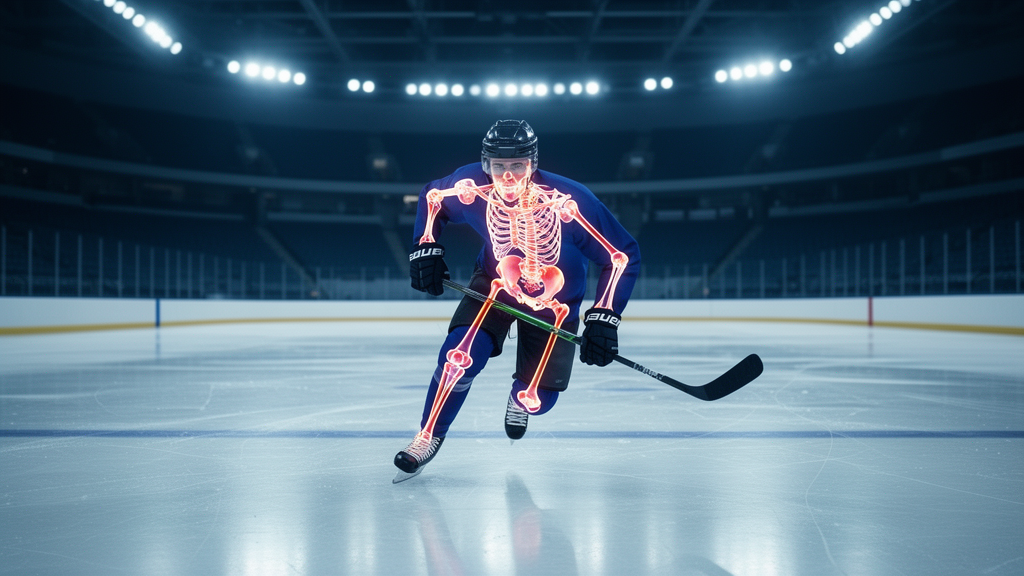
Operating alongside the visual network, a graph convolutional network models the topological geometry and kinematic relationships governing the athlete’s body posture and equipment. The skeletal configuration is structured as an 18-node spatial graph consisting of 16 anatomical joints—including the head, upper body, shoulders, elbows, wrists, pelvis, hips, knees, and ankles—alongside two dedicated nodes representing the endpoints of the hockey stick. Spatial connections between adjacent anatomical structures are formalized using a binary adjacency matrix, enabling graph convolution operations to recursively aggregate spatial information across connected neighbors according to parameterized weight matrices, structural normalization factors, and rectified linear unit activations. Each node is initialized using normalized spatial coordinates coupled with landmark confidence metrics extracted from pose annotations. Through successive graph convolution layers, the network learns higher-order spatial dependencies and coordinated limb interactions, such as synchronous arm and torso configurations during stick handling. The node-level representations are subsequently aggregated through global average pooling into a complementary 128-dimensional skeletal feature embedding.
The core methodological contribution of the system centers on an integrated feature fusion mechanism that transforms independent visual and skeletal streams into a single expressive feature vector. Rather than relying on late decision voting or complex weighted attention networks, the framework concatenates the 128-dimensional visual embedding from the convolutional network with the 128-dimensional graph embedding from the skeletal network, yielding an unweighted 256-dimensional multimodal vector. To prevent model overfitting and mitigate co-adaptation among synthetic feature dimensions, a dropout layer with a rate of 0.4 is applied directly to the fused representation. The regularized feature vector is then projected through an intermediate dense layer comprising 128 units before reaching a final Softmax classification layer. The Softmax function computes normalized probability distributions over the four target action categories, mapping the joint spatial and skeletal cues to the final class prediction. This design preserves explicit environmental context alongside articulated joint dynamics without imposing additional modality-weighting overhead during inference.
Model convergence and parameter optimization were directed using the sign-based Lion optimization algorithm, which calculates parameter updates using the sign of aggregated momentum estimates while maintaining an exponential moving average of historical gradients. The algorithm was deployed in its standard formulation without structural modification, operating with a base learning rate of 1 multiplied by 10 to the negative fourth power, momentum coefficients beta-one set to 0.9 and beta-two set to 0.99, and a weight decay parameter of 1 multiplied by 10 to the negative fourth power. The training regime spanned 20 total epochs, initiating with a ten-epoch baseline training phase followed by a fine-tuning phase where convolutional and graph layers were unfrozen and trained under a learning rate reduced by a factor of 0.1. Model checkpoints were continually assessed against validation loss to preserve the optimal parameter state, ensuring stable convergence across deep non-linear transformations while reducing computational overhead relative to traditional adaptive momentum algorithms.
Controlled ablation experiments conducted under identical experimental conditions demonstrated the measurable superiority of the multimodal integration strategy over single-modality alternatives. When evaluated on the 260 held-out test clips, an RGB-only convolutional network achieved an accuracy of 93.84 percent, while a skeleton-only graph convolutional network achieved 94.92 percent, confirming that both visual context and skeletal geometry contain distinct, non-redundant predictive signals. Implementing score-level fusion between the two networks raised overall accuracy to 96.14 percent, whereas conventional feature concatenation achieved 97.28 percent accuracy. The proposed framework, which combined multimodal feature-level concatenation with Lion optimization, attained the peak classification accuracy of 98.73 percent, representing an absolute improvement of 1.45 percentage points over standard concatenation. Furthermore, repeated-run evaluations documented a sustained accuracy of 98.69 plus or minus 0.17 percent for the proposed system compared to 97.25 plus or minus 0.21 percent for conventional concatenation, verifying that performance enhancements stemmed from systematic architecture synergy rather than favorable parameter initialization.
Detailed class-level evaluations across the 260 test samples demonstrated exceptional diagnostic precision, accompanied by specific behavioral nuances illustrated in the experimental confusion matrix. The overall model registered a macro precision of 98.69 percent, a recall of 98.73 percent, and an F1-score of 98.71 percent, correctly classifying 257 out of 260 total instances with only three erroneous predictions recorded. Specifically, the framework correctly identified 67 forward skating instances with an F1-score of 0.984 and a precision of 0.984, alongside 63 passing actions yielding an F1-score of 0.938. The shooting category achieved a perfect recall score of 1.000, successfully recognizing all 65 ground-truth attempts, though its precision measured 0.835 and its F1-score reached 0.910. Conversely, backward skating attained a perfect precision of 1.000 and an F1-score of 0.940 across 62 correctly classified samples, but exhibited a recall of 0.887 due to seven samples being misclassified as shooting actions, reflecting postural ambiguities during rapid bodily transitions.
Beyond offline accuracy metrics, the research team evaluated end-to-end real-time deployment feasibility using an enterprise workstation equipped with an Intel Core i9-13900K central processor, an NVIDIA RTX 4090 graphics processing unit, and 64 gigabytes of DDR5 system memory. Processing single-frame batches through the complete pipeline—including frame ingestion, MediaPipe pose extraction, dual-stream feature computation, fusion, and classification—required an average processing latency of 21.0 milliseconds per frame, equating to an inference throughput of 47.6 frames per second while concurrently tracking up to six athletes. Despite these operational speeds, the authors acknowledged several fundamental boundaries: the pipeline functions strictly as a frame-level spatial classifier rather than a temporal sequence model, leaving multi-frame temporal dependencies unmodeled. Future extensions proposed expanding the system toward temporal video architectures, integrating auxiliary physical data streams like motion capture systems or depth sensors, and evaluating cross-sport generalizability across broader competitive athletic environments.
Subject of Research: Multimodal deep learning and feature fusion for automated hockey action recognition
Article Title: Action recognition method based on deep learning and feature fusion and its application in sports
Article References: Peng, X., Mao, X., Fang, X., & Zhao, X. (2026). Action recognition method based on deep learning and feature fusion and its application in sports. Discover Artificial Intelligence, 6(1), Article 1921. https://doi.org/10.1007/s44163-026-02436-0
Image Credits: AI Generated
DOI: 10.1007/s44163-026-02436-0
Keywords: hockey action recognition, convolutional neural networks, graph convolutional networks, multimodal feature fusion, Lion optimizer, pose estimation, HARPET dataset, sports analytics, computer vision, skeletal tracking, deep learning, action classification, frame-level analysis, bilinear interpolation, data augmentation, gradient optimization, MediaPipe pose
News Source: Blake Davidson. (November 20, 2026). Deep Learning Model Fusing Vision and Skeletons Classifies Hockey Actions Accurately. Scienmag.