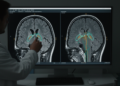
A three-dimensional, target-image-free framework improved segmentation of brain metastases on an independent MRI dataset without using target-domain cases for training, fine-tuning, normalization recalibration, threshold adjustment, probability calibration or target-specific post-processing. The system combined a source-aligned atomic tissue representation, categorical ontology projection, multi-ontology projection supervision and training-only lesion-specific counterfactual supervision. In the locked external evaluation of 38 cases from MOTUM, the approach achieved a Dice score of 0.7676 for the primary contrast-enhancing tumor endpoint, outperforming nnU-Net by 0.0802.
The researchers developed the framework exclusively with the Pretreat-MetsToBrain-Masks dataset and then reserved the 38 brain-metastasis cases from MOTUM for external testing. The two datasets differed in institutional MRI conditions and annotation conventions, while the study also focused on small and multifocal lesions. Keeping MOTUM outside model development made it possible to evaluate transfer without adapting the system to the target cohort.
The approach represented tissue through discrete components aligned with the source data, projected them into target-aware categories and applied supervision across multiple ontology projections. For contrast-enhancing tumor, the primary cross-dataset endpoint, the framework produced a Dice score of 0.9037 on Pretreat, with a 95% confidence interval of 0.880–0.924. Its external Dice score on MOTUM was 0.7676, with a 95% confidence interval of 0.727–0.804.
The paired difference relative to nnU-Net on MOTUM was 0.0802, with a 95% confidence interval of 0.034–0.126. The authors specified that these projections represent operational harmonization across datasets rather than biological equivalence of the underlying tissue compartments. Lesion-level analysis showed an external sensitivity of 0.8648, alongside 1.0842 false-positive lesions per patient.
For small lesions, sensitivity rose from 0.7061 with nnU-Net to 0.8063 with the proposed framework. The improvement in lesion detection did not remove all segmentation error: lesion-wise Dice was 0.7246. Thus, the study distinguished between identifying metastases and delineating their exact boundaries, with the latter remaining a weaker aspect of performance.
The external results also showed that performance differed between the development and independent datasets, underscoring the remaining challenge of cross-dataset segmentation rather than establishing uniform performance across settings. Overall, the findings support the feasibility of combining ontology-aware projection with lesion-specific training under a locked external evaluation protocol. The study is a computational imaging evaluation, not a clinical trial, and its external sample included 38 brain-metastasis cases.
The authors noted that broader generalization requires validation in additional independent cohorts, including prospective studies. The research was published as an accepted, open-access article in BMC Medical Imaging; the shared version remained subject to further edits and was to be replaced by the final Version of Record.
Subject of Research: Cross-dataset MRI segmentation of multifocal brain metastases using ontology-aware modeling and counterfactual supervision
Article Title: Target-image-free ontology-aware segmentation of multifocal brain metastases with atomic tissue representation and counterfactual supervision
Article References: Moradi, M., Emadi, S., & Zarchi, M. S. (2026). Target-image-free ontology-aware segmentation of multifocal brain metastases with atomic tissue representation and counterfactual supervision. BMC Medical Imaging. https://doi.org/10.1186/s12880-026-02978-w
Image Credits: AI Generated
DOI: 10.1186/s12880-026-02978-w
Keywords: brain metastases, MRI segmentation, medical imaging, ontology-aware learning, counterfactual supervision, external validation, deep learning, nnU-Net, lesion detection, cross-dataset generalization, Target-image-free, ontology-aware
News Source: Nathaniel Bowman. (October 22, 2026). Ontology-aware model improves external brain-metastasis MRI segmentation. Scienmag.