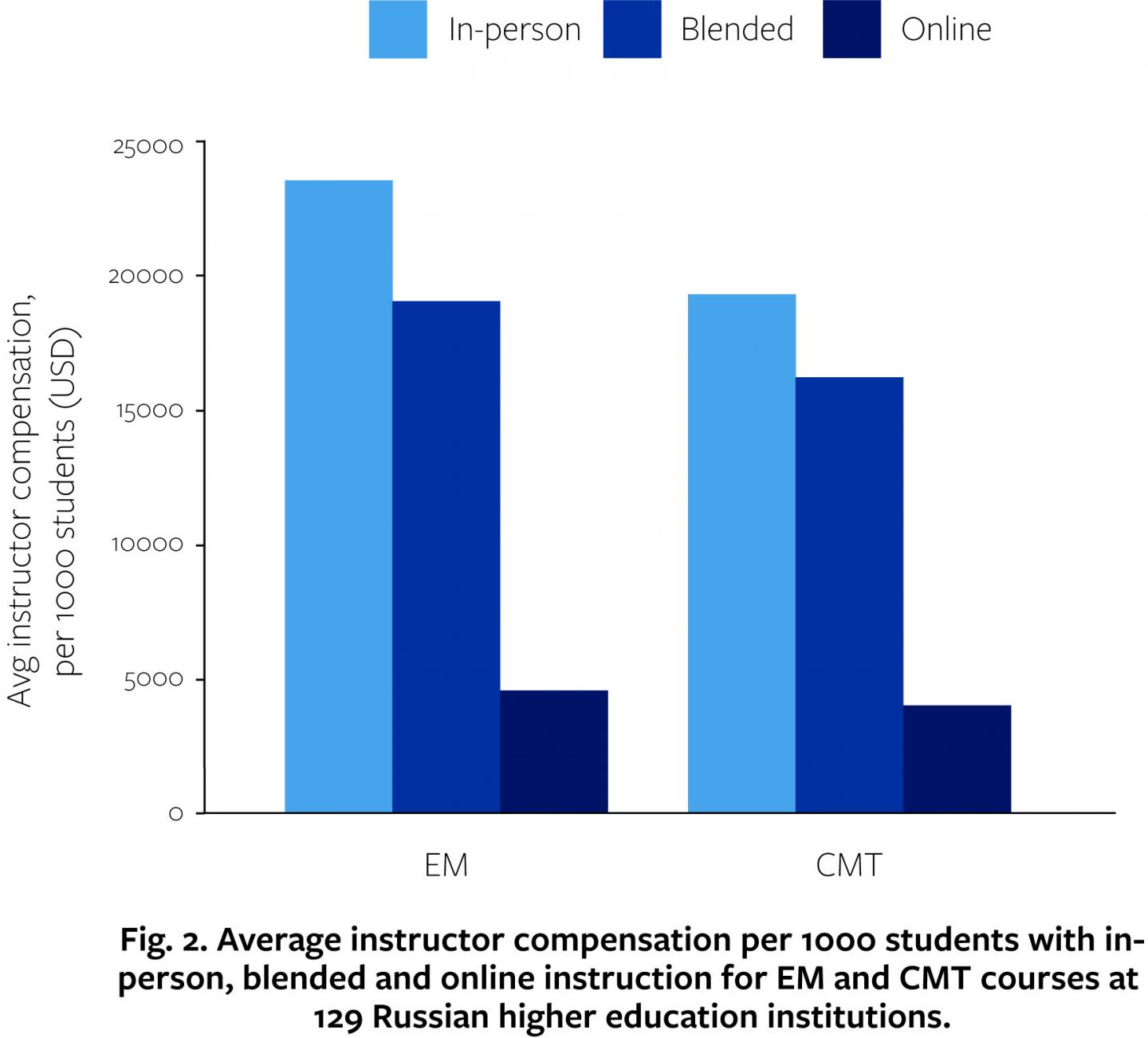
Credit: Chirikov, et. al.,
Online and blended (online and in-person) STEM instruction can produce the same learning outcomes for students as traditional, in-person classes at a fraction of the cost, finds research published today in Science Advances.
A team of researchers from the University of California at Berkeley, HSE University Moscow in Russia, Stanford University, and Cornell University used a multi-site, randomized controlled study at three Russian universities to compare performance and satisfaction for students in two engineering courses. The students were randomly divided into the three cohorts and received identical lessons and assignments via one of three delivery modalities: 1) in-person lectures and discussion sections 2) a blend of online and in-person instruction, and 3) fully online instruction. The online and blended instruction utilized OpenEdu, a platform developed by a non-profit organization in Russia to make online university courses available to the public.
At the conclusion of the courses, researchers measured final exam scores, performance on course assignments, and student satisfaction. Students in all three modalities had similar scores on final exams. Students in fully online modality scored higher on course assignments but reported slightly lower satisfaction than students in the in-person modality. Furthermore, the online and blended modes of instruction cost significantly less per-student than traditional, in- person instruction. Blended instruction lowered the cost of per-student instruction by 15-19% depending on the course; online instruction lowered the cost of per-student instruction by 79- 81% depending on the course. These cost-savings can fund increases in STEM enrollment.
“Online education platforms have a big potential to expand access to quality STEM education worldwide,” says Igor Chirikov, SERU Consortium Director and Senior Researcher at UC Berkeley’s Center for Studies in Higher Education and the project’s Principal Investigator. “Such platforms could bring cost-savings to financially distressed colleges and offer flexible learning opportunities to students without diminishing learning outcomes. They could also strengthen the instructional resilience of colleges when in-person delivery is not an option, such as right now, when most universities are closed to mitigate the COVID-19 outbreak.”
“This is the strongest evidence to date that an average college student can learn just as much from a course online as on campus or with blended learning,” says Cornell professor of information science and study co-author Rene Kizilcec. “The fact that students find online learning less satisfying doesn’t mean it is less effective. That’s why we shouldn’t rely too much on student surveys like teaching evaluations to judge the quality of instruction, especially in a time of crisis when the transition to online learning is unplanned. In this study, we only used basic online course materials to match the in-person content, but prior research shows that interactive and social online activities with immediate feedback could have produced even larger learning gains.”
Ongoing challenges of adopting this model include the initial cost of investing in online platforms and training instructors. Also, the model requires a high degree of synchronization of academic programs and courses across multiple colleges.
“The proposed model is relevant in the countries or regions where college courses and programs are aligned across several institutions,” says Chirikov. “In the United States, some states (e.g., Florida) maintain statewide common course numbering systems and allow students to take online courses from other state universities and transfer credits. There are also private online platforms, like Coursera, that allow colleges to integrate online courses from the world’s top universities into their curricula. These examples are very similar to the model that we tested in our study.”
###
Media Contact
Igor Chirikov
[email protected]