Approximately 80% of Apple’s latest iPhone 15 pre-orders in Korea fall within the age group of 20s and 30s. Their keen interest in this expensive device is primarily attributed to tis camera’s ability to deliver sharp and particular mood of colors, a hallmark of iPhones. If it can achieve high quality image and video without the need for multiple lenses, it may garner greater support from millennials and generation Z.
Credit: POSTECH
Approximately 80% of Apple’s latest iPhone 15 pre-orders in Korea fall within the age group of 20s and 30s. Their keen interest in this expensive device is primarily attributed to tis camera’s ability to deliver sharp and particular mood of colors, a hallmark of iPhones. If it can achieve high quality image and video without the need for multiple lenses, it may garner greater support from millennials and generation Z.
A collaborative research team led by Professor Junsuk Rho from the Department of Mechanical Engineering and the Department of Chemical Engineering, Trevon Badloe from the Graduate School of Artificial Intelligence, and Yeseul Kim and Joohoon Kim, PhD candidates from the Department of Mechanical Engineering at Pohang University of Science and Technology (POSTECH), and Professor Inki Kim from the Institute of Quantum Biophysics at Sungkyunkwan University has successfully engineered a dual metalens capable of switching between different imaging modes using a single lens. The research findings have been featured in ACS Nano, an international journal specializing in the fields of nanotechnology, materials, and chemistry.
Typically, during the process of photographing an object, two distinct modes are employed: the normal mode which extracts fundamental information and the edge mode which focuses solely on outlining the object. These modes traditionally require separate lenses, each with different focal points. However, in response to the recent trend towards miniaturization and lightweight design in electronic devices, researchers have been diligently working on integrating both modes into a single lens.
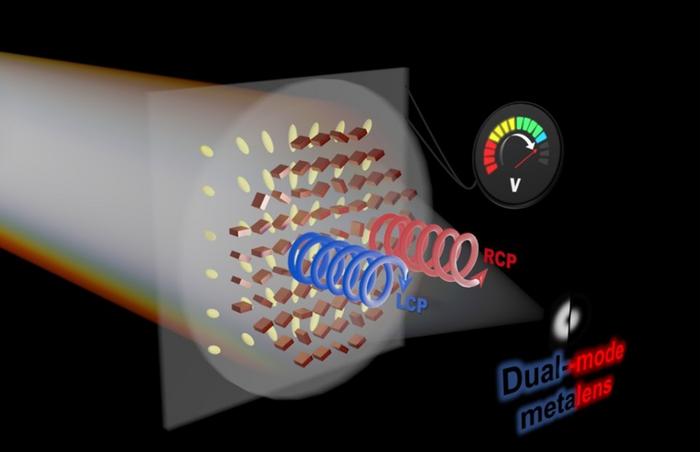
In this study, the team tackled the issue using metalenses that can dynamically alter their focal point through electrical means. These metalenses, without concern for the properties of light, are constructed from nanoscale artificial structures. By fine-tuning parameters like size, shape, and rotational orientation of these structures, the team successfully engineered a dual-mode imaging metalens capable of transitioning between normal and edge modes based on the direction of light polarization rotation.
This lens can swiftly modify its focus by adjusting the voltage applied to the liquid crystal (LC) layer, allowing for rapid mode-switching in mere milliseconds (a millisecond is one thousandth of a second), matching the speed of liquid crystal switching. In this research, the team employed hydrogenated amorphous silicon as the nanostructure, known for minimal losses in the visible light region, resulting in remarkable lens efficiency at 32.3%, 31.7%, and 20.4% for red, green, and blue wavelengths respectively. By integrating two distinct modes within a single lens, the team achieved the acquisition of high-resolution images.
Professor Junsuk Rho explained, “We can now swiftly capture high-resolution images in applications such as bio-imaging, encompassing cellular reactions and drug screening.” Furthermore, he expressed optimism by saying, “I hope this innovation will find utility across various domains including smartphones, virtual reality (VR) and augmented reality (AR) devices, and fixed LiDAR systems.”
The study was sponsored by a program of POSCO–POSTECH-RIST Convergence Research Center, the STEAM Research Program of the National Research Foundation of Korea funded by the Ministry of Science and ICT.
Journal
ACS Nano
DOI
10.1021/acsnano.3c02471
Article Title
Bright-Field and Edge-Enhanced Imaging Using an Electrically Tunable Dual-Mode Metalens
Article Publication Date
8-Aug-2023