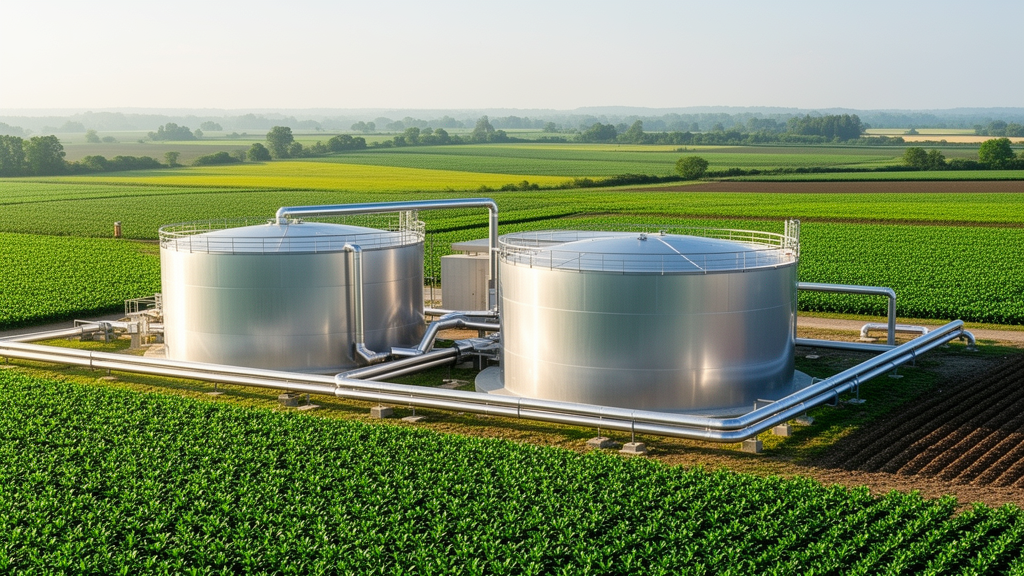
On-farm biogas production through anaerobic digestion drives complex, indirect transformations throughout wider agricultural systems rather than operating as an isolated technical intervention, according to an agronomic investigation across commercial holdings in northeastern France. While renewable energy policies across Europe have encouraged on-farm anaerobic digestion to generate decarbonized power and improve manure handling, standard environmental evaluations frequently presume that underlying farm operations remain static following installation. The empirical findings indicate that introducing an anaerobic digestion facility fundamentally alters how agricultural managers allocate machinery, field labor, organic nutrients, and forage acreage, producing operational outcomes that diverge substantially from theoretical agronomic models.
The investigation examined the operational realities of twenty-three farmers managing nineteen distinct anaerobic digestion units located within two municipal districts of northeastern France, Vosges and Bas-Rhin. These two territories provided contrasting operational environments: Vosges featured predominantly livestock-oriented farming systems where biogas plants primarily converted energy via combined heat and power electrical generation, whereas Bas-Rhin contained diversified arable systems alongside mixed livestock operations and largely channeled biogas into the municipal gas grid through biomethane injection. Using a snowball sampling methodology that incorporated facilities commissioned predominantly before 2018 to capture long-term structural adjustments, the investigators gathered qualitative operational data through semi-structured on-site and telephone interviews. Analyzing recurring practice adaptations through a farming systems perspective allowed the research team to evaluate how field-scale interventions, whole-farm economics, and regional biomass availability interact over extended production cycles.
Prevailing scientific literature assessing agricultural anaerobic digestion has historically concentrated on isolated environmental indicators such as greenhouse gas balances, soil carbon storage, and direct nitrogen losses, under the prevailing assumption that operators implement idealized agronomic best practices. In theoretical projections, digestate application is presumed to directly replace commercial synthetic fertilizers, while dedicated energy cover cropping is modeled as an environmentally neutral means of generating extra organic biomass without displacing existing production. However, field observations revealed that farm managers operate within situated technical and economic rationalities, where actual practices are heavily shaped by labor constraints, capital equipment limitations, soil carrying capacity, and volatile feedstock markets. The disconnect between theoretical environmental optimization and practical farm-scale implementation demonstrates that anaerobic digestion cannot be evaluated accurately without documenting the broader structural shifts occurring across everyday agricultural operations.
Field cropping patterns underwent pronounced adjustments following digester installation, influenced by feedstock requirements and French government policies that offer tariff bonuses when manure constitutes at least sixty percent of the input mix. To supplement livestock effluents with methanogenic feedstocks, operators developed four distinct rotational patterns ranging from marginal adjustments to radical farm restructuring. In the first pattern, observed in two farms, operators maintained established crop rotations and made only minor alterations to summer energy cover crops like sorghum or maize, choosing to purchase agricultural and agro-industrial by-products off-farm rather than risk yield reductions on their spring grain crops during dry summers. The second pattern, implemented by three growers, retained core commercial rotations while substantially expanding winter energy cover crops such as rye and ryegrass across up to eighty hectares to supply biomass without displacing cash crops.
The third and most prevalent rotational adaptation, observed on twelve farms, involved systematic alterations to established successions to secure feedstock autonomy. Eleven of these operators expanded their production of maize silage, while others integrated rye and triticale intercrops, directly substituting energy biomass for conventional cash crops including winter cereals, oilseed rape, and grain maize. Many of these growers embraced double-cropping sequences despite acknowledging that cultivating winter energy cover crops drained soil moisture and reduced the subsequent yields of main-season maize crops, accepting the penalty because the aggregate financial margin per hectare remained favorable. Conversely, other managers in this group deliberately avoided double cropping with maize to protect spring crop yields, opting instead for prolonged winter cereals followed by temporary grasslands or summer cover crops to minimize external feedstock expenditures.
A fourth trajectory involved structural transformations across four operations, where anaerobic digestion served as an economic and operational catalyst for complete farming redesign. Three growers leveraged anaerobic digestion to transition their holdings to certified organic management, using nutrient-dense digestate to overcome historical fertility bottlenecks and achieve organic yields approaching conventional levels. One organic arable manager introduced energy cover crops followed by temporary grasslands while procuring conventional maize silage externally to satisfy digester requirements. Another conventional dairy operator diversified into on-farm milk processing, eliminated maize production in favor of a grass-based bovine feeding regimen, integrated meslin energy crops, and plowed up ten hectares of permanent grassland to expand total biomass volume, highlighting how bioenergy units can reconfigure entire enterprise orientations.
The evolution of crop successions was strongly governed by regional biomass markets and digester profitability pressures. Operators running older installations commissioned between 2012 and 2016 reported dramatic cost escalations for off-farm feedstocks, noting that agro-industrial by-products once secured freely or at minimal expense had become costly commercial commodities, exemplified by mustard residues doubling from twenty-eight euros per ton in 2013 to fifty-six euros per ton by 2021. To maintain profitability while complying with national statutory limits capping dedicated main energy crops at fifteen percent of digester inputs, several farmers shifted away from purchased residues toward farm-grown winter cereals and maize. Because cultivating dedicated energy cover crops demands significant machinery and labor hours, growers prioritized high-yielding biomass species such as rye, triticale, and meslin, generally avoiding leguminous species that yield lower biomass volumes despite their acknowledged ecological advantages for nitrogen fixation.
Fertilization regimes changed across almost every studied operation due to the continuous generation of digestate requiring local land application, yet reductions in synthetic mineral fertilizer varied widely. A group of six operations achieved negligible or no reduction in synthetic nitrogen consumption. These operators routinely applied digestate prior to spring maize sowing or during autumn cereal establishment, spreading residual volumes onto permanent pastures before winter to empty slurry storage tanks. Spring digestate applications to standing winter cereals were heavily constrained by low soil bearing capacity, machinery weight, the extended hours required to haul large liquid volumes, and concerns regarding physical damage to emerging seedlings. Furthermore, several of these holdings introduced new synthetic nitrogen applications to support dedicated energy crops, counteracting anticipated nutrient savings.
Nearly all surveyed growers utilized dribble bars to limit ammonia volatilization, whereas direct soil burying implements were largely eschewed due to prohibitive capital expense, excessive tractor horsepower requirements, and lower working widths.
The integration of anaerobic digestion similarly reshaped livestock feeding systems and grassland dynamics. Six livestock producers increased forage cultivation and expanded ensiled stockpiles, utilizing the digester as a guaranteed outlet for surplus biomass if unneeded during severe drought. Other producers prioritized herd feed needs, diverting crops originally planned for digestion to cattle and purchasing external maize to maintain digester throughput. Seven operators observed that biogas production delivered higher economic returns per labor hour than traditional animal husbandry, prompting two farms to discontinue calf fattening entirely to redirect labor and forage assets toward the digester. Meanwhile, twelve farmers reported that increased digestate applications to permanent pastures raised grass yields, prompting several to market surplus hay, harvest lower-quality secondary grass cuts for digester feedstock, or plow meadows to cultivate cash crops.
These empirical findings demonstrate that on-farm anaerobic digestion initiates ripple effects that challenge simplified life cycle assessments and standard agri-environmental assumptions. Because farmers must manage technical trade-offs involving heavy transport machinery, labor bottlenecks, and seasonal weather constraints, the theoretical benefits of digestate utilization can be offset by elevated soil compaction hazards or untimely autumn applications driven by storage constraints. Similarly, while bioenergy infrastructure can successfully facilitate organic conversions and enhance regional nutrient cycling, it can also stimulate forage intensification, permanent grassland conversion, and regional competition for biomass. Sustainable deployment of agricultural bioenergy requires evaluators and policymakers to look beyond the physical boundaries of the digester, accounting for farmer agency, systemic operational interactions, and local structural dynamics when designing future agro-environmental policies.
Subject of Research: Systemic impacts of on-farm anaerobic digestion on agricultural management practices
Article Title: Accounting for the systemic effects of anaerobic digestion on the practices of farmers
Article References: Cadiou, J., Aubert, P.-M., & Meynard, J.-M. (2026). Accounting for the systemic effects of anaerobic digestion on the practices of farmers. Agronomy for Sustainable Development, 46(4), Article 61. https://doi.org/10.1007/s13593-026-01128-4
Image Credits: AI Generated
DOI: 10.1007/s13593-026-01128-4
Keywords: anaerobic digestion, on-farm biogas, agricultural practices, farming systems research, crop rotations, digestate management, nitrogen fertilization, energy cover crops, grassland management, soil compaction, organic farming transition, manure digestion, Vosges, Bas-Rhin, feedstock competition, agricultural policy
News Source: Alan Morgan. (November 26, 2026). On-Farm Biogas Units Trigger Complex Systemic Changes Across French Agricultural Practices. Scienmag.