Materials researchers have demonstrated that biochar powder produced from agricultural olive stone residues can transform sustainable flax fiber-reinforced composites into electrically conductive, self-sensing structural components. In a comprehensive study examining the mechanical, electrical, and piezoresistive behavior of bio-based laminates, the experimental incorporation of olive stone biochar into an epoxy matrix yielded a 39 percent increase in Young’s modulus alongside enhanced impact toughness while preventing catastrophic material embrittlement. These findings reveal that renewable carbon additives derived from agricultural leftovers can overcome longstanding trade-offs in green composite engineering by simultaneously imparting structural rigidity and functional conductivity to semi-structural natural fiber components without relying on fossil-derived conductive additives.
Natural fiber-reinforced composites, particularly flax fiber-reinforced plastics, have emerged as promising bio-based alternatives to conventional glass and carbon fiber composites for stiffness-critical semi-structural parts in transportation and mobility sectors such as aircraft, buses, and trains. In these applications, minimizing component weight directly reduces fuel expenditure and carbon dioxide emissions while mechanical reliability remains strictly paramount. However, natural fiber systems inherently lack electrical conductivity, restricting their deployment in critical operating environments where lightning strike protection, electromagnetic interference shielding, and structural health monitoring are necessary. Introducing conductive functional fillers into the insulating polymer matrix addresses these shortcomings by establishing an internal conductive pathway whose electrical resistance shifts predictably when deformed or damaged, creating an integrated piezoresistive sensing mechanism.
Historically, conductive polymer composites have relied on carbon black, a fossil-derived spherical nanoparticle synthesized from hydrocarbons that carries substantial financial and environmental costs. When compounded using conventional mixing procedures, conductive carbon black typically requires significant mass fractions, ranging from 6 to 17 weight percent, to transition an insulating matrix into an electrically conductive state. Although sophisticated laboratory dispersing techniques can lower this percolation threshold below 1 weight percent or even down to 0.085 weight percent in epoxy resin, such processing techniques remain unfeasible at industrial manufacturing scales. Furthermore, carbon black additions frequently trigger premature matrix embrittlement in polymeric systems and increase overall composite density without reliably translating into improved stiffness or strength when embedded within natural fiber composite architectures.
To establish a renewable and cost-effective alternative, the research team investigated biochar produced via the pyrolysis of olive stones obtained from Novocarbo GmbH. Pyrolyzed for 20 to 30 minutes at temperatures between 650 and 750 degrees Celsius, the resulting porous carbon material was sieved to isolate particles smaller than 200 micrometers, exhibiting a broad particle size distribution spanning from the micrometer down to the nanometer scale. This biochar was systematically compared against a commercial fossil-derived reference material, Printex L6 carbon black from Orion Engineered Carbons, which featured highly uniform spherical nanoparticles measuring between 10 and 60 nanometers.
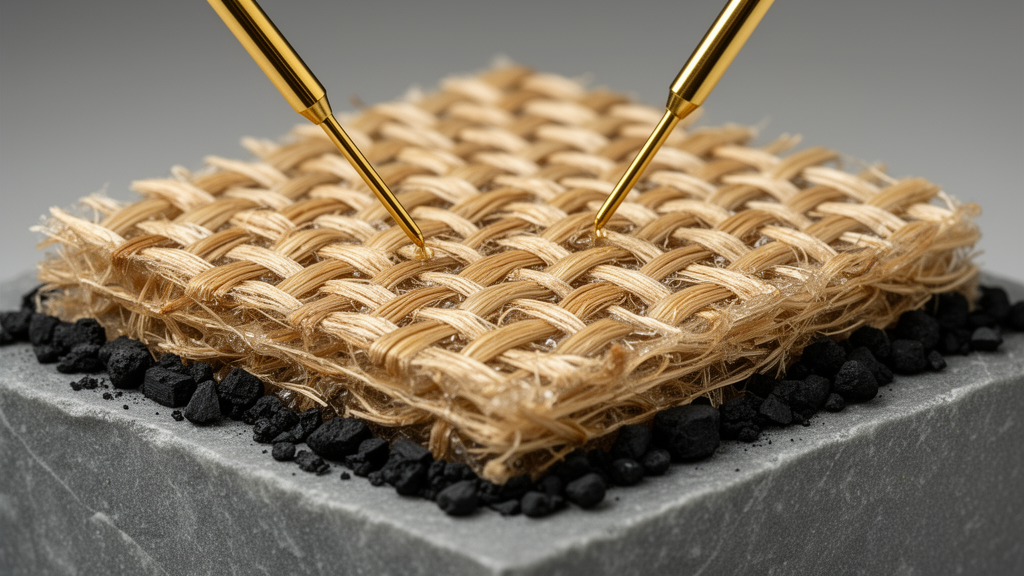
The experimental campaign examined structural laminates constructed using three layers of FlaxDry BL200 flax fiber twill fabric with an aerial weight of 200 grams per square meter, stacked in a balanced zero-degree and ninety-degree orientation within an ECO System Clear epoxy matrix. Fabricated using hand lamination and compressed to a uniform thickness of 2 millimeters between Teflon foils within an aluminum spacer frame, the plates were cold cured overnight before undergoing three additional days of room-temperature post-curing. The final composite plates exhibited flax fiber mass fractions ranging between 23.7 and 29.4 weight percent, corresponding to an estimated fiber volume fraction of 24.7 volume percent for unreinforced reference laminates, with variations driven primarily by matrix density shifts resulting from the respective carbon filler loadings.
Two distinct processing routes were developed to evaluate how spatial particle distribution affects functional performance. In the first approach, designated as Carbon in Matrix or CiM, carbon powders were directly dispersed into the epoxy resin and hardener under vacuum at 1000 revolutions per minute for 3 minutes using a vacuum dissolver, incorporating 40 weight percent biochar or 12 weight percent carbon black into the resin to yield 30 weight percent biochar and 8.6 weight percent carbon black in the final composite plates. In the alternative Carbon on Fabric or CoF approach, aqueous suspensions containing 25 weight percent biochar or 6 weight percent carbon black in de-ionized water were brushed directly onto the flax fabric and dried at room temperature for at least 20 hours before lamination. This fabric-coating technique successfully localized conductive particles adjacent to the fiber bundles, enabling electrical percolation at reduced overall composite concentrations of 21.8 weight percent biochar and 3.6 weight percent carbon black, saving approximately 30 percent and 60 percent of filler content respectively.
Mechanical characterization conducted via one-way analysis of variance and Games-Howell post-hoc tests revealed that mixing olive stone biochar directly into the epoxy resin produced a substantial 39 percent enhancement in Young’s modulus relative to unfilled control specimens. In sharp contrast, the addition of 8.6 weight percent carbon black yielded no statistically significant alteration in composite tensile stiffness. The authors noted that effective microparticle stiffening relies on uniform dispersion, high intrinsic particulate modulus, and sufficient volume fraction, which the CiM biochar morphology achieved across the bulk resin. However, the localized CoF biochar distribution demonstrated less pronounced stiffness gains because the dense particulate packing clustered around fiber surfaces encouraged localized agglomeration while leaving the surrounding matrix volume unreinforced.
Tensile strength evaluations illustrated distinct operational trade-offs, showing that the high 40 weight percent biochar loading in the epoxy resin induced a measurable drop in ultimate tensile strength, while carbon black specimens experienced no significant tensile strength degradation. Scanning electron microscopy of fractured tensile surfaces confirmed that dense biochar concentrations impaired mechanical bonding across the fiber-matrix boundary by displacing active epoxy contact points on the natural flax fibers. Importantly, tensile elongation at fracture showed no statistically significant reduction for the biochar-filled composites compared to unfilled reference plates, demonstrating that despite the reduced interfacial tensile strength and increased matrix stiffness, the high biochar content did not cause material embrittlement. Conversely, the fossil-derived carbon black composite exhibited a distinct reduction in tensile ductility under identical testing conditions.
Flexural and impact evaluations underscored additional structural advantages associated with the biochar additive. Three-point bending tests revealed that biochar incorporation significantly enhanced flexural modulus while maintaining flexural strength comparable to unreinforced references, avoiding the strength reductions observed under pure tensile loading. The researchers suggested that during flexural deformation, where tensile and compressive stresses occur concurrently, the stiffened epoxy matrix effectively stabilizes fiber alignment against premature buckling. Furthermore, falling-weight impact testing demonstrated that composites containing 30.5 weight percent biochar absorbed significantly greater impact energy than unfilled or carbon black-modified counterparts. This enhanced impact toughness was attributed to microparticles deflecting and branching advancing crack fronts, combined with energy-absorbing frictional fiber pull-out mechanisms triggered along the modified fiber-matrix interfaces.
To address lightweight engineering criteria, the investigators evaluated specific stiffness indices across established Ashby structural design lines, including ratios of modulus to density for tensile beams, the square root of modulus to density for bending members, and the cube root of modulus to density for structural plates. Because olive stone biochar increased composite stiffness by 39 percent, the CiM processing route successfully compensated for the added filler mass across all three lightweight design regimes, confirming that components could be made thinner to achieve net weight reductions. In comparison, carbon black increased composite density without enhancing mechanical stiffness, failing to satisfy the mass-compensation criteria across any structural geometry.
Electrical and piezoresistive testing conducted during tensile loading revealed that biochar-modified composites exhibited robust strain-sensing capabilities characterized by monotonic, non-linear resistance increases and remarkably high gauge factors under elongation. At 4 millimeters of applied displacement, the gauge factor of biochar laminates vastly exceeded that of carbon black specimens, an effect primarily attributed to the larger micro-scale particle dimensions of biochar separating more rapidly under strain. While the carbon black CiM specimens exhibited an unusual non-monotonic resistance profile where electrical resistance stagnated and decreased at higher displacements due to conductive aggregate rearrangement, biochar laminates maintained consistent resistance tracking across five successive loading cycles, confirming the viability of olive stone biochar as a sustainable, multifunctional modifier for self-sensing lightweight structures.
Subject of Research: Multifunctional olive stone biochar additives in flax fiber-reinforced composites
Article Title: Olive Stone Biochar for Tuning Mechanical, Electrical and Piezoresistive Properties of Flax Fiber-Reinforced Composites
Article References: Schulte, S., Kroll, S., Renz, F., & Siebert-Raths, A. (2026). Olive Stone Biochar for Tuning Mechanical, Electrical and Piezoresistive Properties of Flax Fiber-Reinforced Composites. Applied Composite Materials, 33(3), Article 87. https://doi.org/10.1007/s10443-026-10464-3
Image Credits: AI Generated
DOI: 10.1007/s10443-026-10464-3
Keywords: biochar, olive stone biochar, flax fiber-reinforced composites, natural fiber composites, piezoresistive properties, electrical conductivity, structural health monitoring, Young's modulus, tensile strength, flexural modulus, impact toughness, carbon black, lightweight construction, epoxy matrix, gauge factor, percolation threshold, pyrolysis
News Source: Denise Maddox. (November 26, 2026). Olive Stone Biochar Boosts Flax Composite Stiffness and Enables Electrical Sensing. Scienmag.