Jewel wasps (Chalcidoidea) are one of the most diverse groups of insects, with more than 120,000 species described and an estimated true diversity of nearly one million. The chalcids are parasitoid wasps, which attack other insects to lay their eggs upon in order to feed and grow within the host. The evolution and origin of this immense group has puzzled scientists for decades. Based on fossils and molecular work, the group is thought to have originated in the late Jurassic around 162 million years ago. Until recently, no confirmed fossils were known from earlier than 100 million years ago. Now, a newly described family, Protoidae, provides the first glimpse into how these wasps appeared at the earliest stages of their evolution.
Credit: UImer et al.
Jewel wasps (Chalcidoidea) are one of the most diverse groups of insects, with more than 120,000 species described and an estimated true diversity of nearly one million. The chalcids are parasitoid wasps, which attack other insects to lay their eggs upon in order to feed and grow within the host. The evolution and origin of this immense group has puzzled scientists for decades. Based on fossils and molecular work, the group is thought to have originated in the late Jurassic around 162 million years ago. Until recently, no confirmed fossils were known from earlier than 100 million years ago. Now, a newly described family, Protoidae, provides the first glimpse into how these wasps appeared at the earliest stages of their evolution.
Scientists Jonah M. Ulmer, Dr. Petr Janšta, and Prof. Dr. Lars Krogmann, from SMNS – State Museum of Natural History Stuttgart, alongside Dr. Dany Azar from the Lebanese University describe the new family and 10 new species of jewel wasps in a paper in the open-access Journal of Hymenoptera Research.
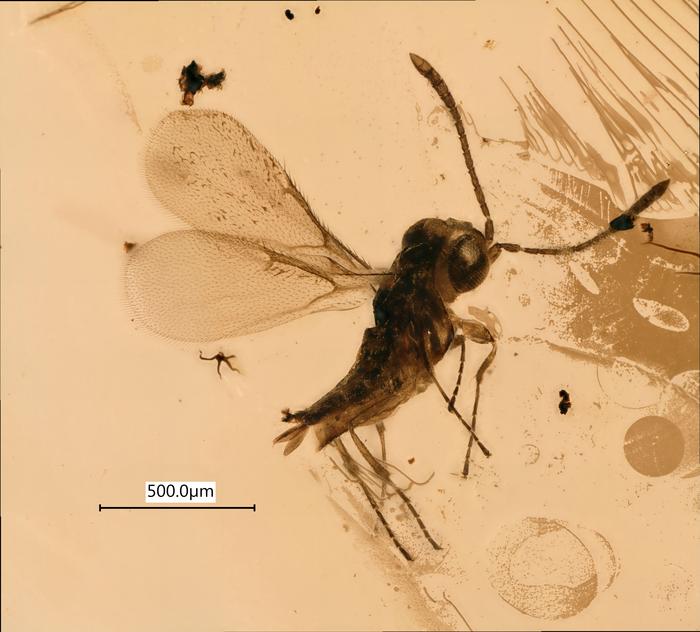
The discovery of the family came about when one of the coauthors, Prof. Dr. Lars Krogmann, noticed an unusual fossil during a visit to the Natural History Museum in Paris. The specimen embedded in the amber had a long tail-like structure covering its ovipositor. “It was previously described as a completely different type of wasp, however the authors were quick to recognize it was indeed an ancient chalcid. Despite the prevalence of Chalcidoidea in the fossil record, none had ever been recorded from Lebanon or were known to be that old, nearly 130 million years old to be exact,” says Jonah Ulmer.
The researchers soon realized they had a new, and very old, family: currently the oldest known within the jewel wasps. “Multiple similar specimens in amber soon became apparent and the family now contains two genera, Protoita and Cretaxenomerus. The family name is derived from being a ‘proto’ form of the Chalcidoidea,” Ulmer explains.
These ancient species present a unique snapshot of what these wasps looked like in their earliest forms, this allows researchers to better understand the order of evolutionary events through time and when certain structures evolved that ultimately led to the massive diversity we see today.
The new family’s most striking characteristic is the long, shovel-like process, which extends from the end of the abdomen. While no living species have such a pronounced structure, it is hypothesized to have assisted with egg-laying and ovipositing or perhaps sifting through loose leaf litter for hosts.
The authors note that there are likely other equally old families of Chalcidoidea still lying in wait to be discovered, either in the ground or in old forgotten museum cabinets. “Protoitidae shows that we can keep looking further back in time than we expected and still find new, and old, species” says Ulmer.
Original source:
UImer JM, Janšta P, Azar D, Krogmann L (2023) At the dawn of megadiversity – Protoitidae, a new family of Chalcidoidea (Hymenoptera) from Lower Cretaceous Lebanese amber. Journal of Hymenoptera Research 96: 879-924. https://doi.org/10.3897/jhr.96.105494
Journal
Journal of Hymenoptera Research
DOI
10.3897/jhr.96.105494
Article Title
At the dawn of megadiversity – Protoitidae, a new family of Chalcidoidea (Hymenoptera) from Lower Cretaceous Lebanese amber
Article Publication Date
23-Oct-2023