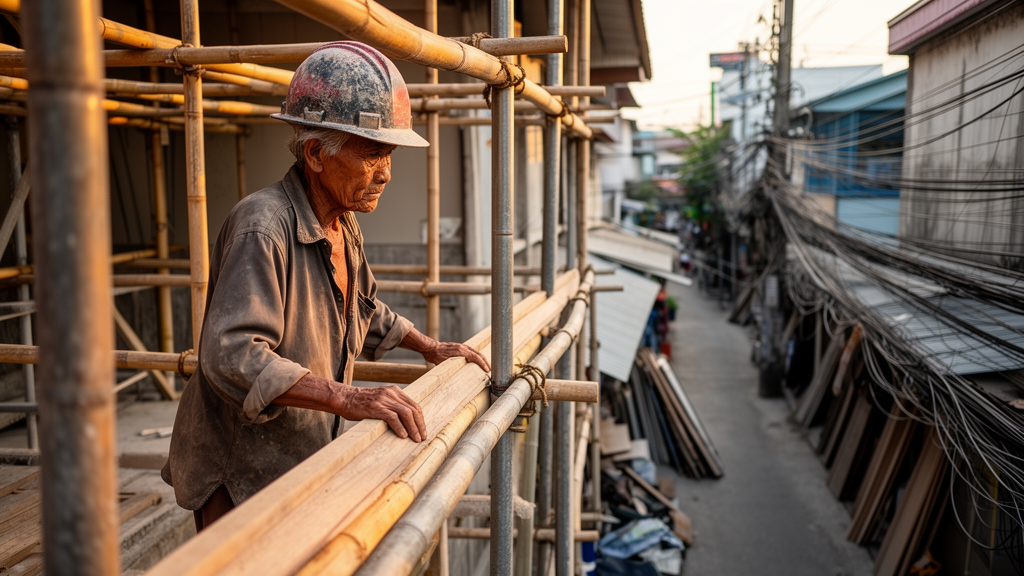
Falls from heights remain the second leading cause of occupational death among Thai workers, and a new national analysis of more than 17,000 compensation claims has now mapped out exactly who is dying, where they work, and how their injuries unfold. The retrospective cross-sectional study, published in Discover Public Health, examined 17,046 occupational falls from heights reported to Thailand’s Workmen’s Compensation Fund between 2016 and 2018, of which 293 were fatal. Its central finding is stark: the highest adjusted odds of a fatal outcome clustered among older male workers, in micro-sized enterprises with ten or fewer employees, and in falls involving construction-related sources of injury.
The research team, led by Preedee Banyatrachata and colleagues, drew on case-level records from the Fund, which operates under the Social Security Office of the Ministry of Labour and serves as the principal national surveillance source for work-related injuries in Thailand. After extracting 17,062 records and removing 16 cases with demonstrable coding errors, the final analytical sample retained 99.91 percent of the extracted falls. The researchers used a five-category descriptive severity outcome — death, disability, organ loss, sick leave of more than three days, and sick leave of three days or less — alongside a binary fatal-versus-non-fatal outcome for their multivariate logistic regression model.
The raw numbers reveal a heavily skewed gender distribution. Male workers accounted for 13,823 of the 17,046 cases, a male-to-female ratio of 4.3 to 1 overall, rising to 25.6 to 1 among fatalities, with 282 of the 293 deaths involving men. After adjustment for other covariates, male workers still had 2.45 times the odds of a fatal fall compared with female workers (95% CI 1.24–4.84). The authors note that Thai labour law prohibits employers from requiring female employees to work on scaffolds at heights of ten metres or more, which may reduce women’s exposure to the highest-risk tasks, while men’s overrepresentation in construction, roofing, and electrical work plausibly drives their elevated risk.
Age showed a striking double pattern. The frequency of falls followed a bell-shaped distribution, peaking among workers aged 35 to 44, who accounted for 30.7 percent of cases, followed by those aged 25 to 34 and 45 to 54. Yet the odds of dying once a fall occurred climbed steadily with age. Compared with workers aged 18 to 24, the adjusted odds ratio was 1.90 for ages 35 to 44, 2.62 for 45 to 54, 3.10 for 55 to 64, and 6.87 for those aged 65 and over (95% CI 1.56–30.28). Workers aged 55 and above together contributed only 6.6 percent of falls but 13.3 percent of fatalities. The authors point to age-related declines in balance, strength, and vision, together with reduced physiological resilience after trauma, as plausible mechanisms reported in the broader literature.
Company size emerged as one of the most consequential organizational factors. Micro-sized enterprises, defined operationally as having ten or fewer employees, accounted for 13.3 percent of all falls but 28.0 percent of fatalities and 60 percent of disabilities. Although the absolute number of deaths was similar between micro-sized and large enterprises — 82 versus 84 — the fatality rate was roughly three times higher in the micro category, at 3.6 percent versus 1.1 percent. In the adjusted model, micro-sized enterprises carried 1.75 times the odds of fatal falls compared with large enterprises of more than 200 employees (95% CI 1.17–2.62), while small and medium enterprises did not differ significantly from the reference. The authors situate this within international evidence, including United States data showing that 55 percent of fatal construction falls between 2008 and 2010 occurred in establishments with one to ten employees, and suggest that shared-resource safety services, such as pooled safety officers or sector-level training programs, warrant further evaluation as policy responses.
Construction-related sources dominated the injury landscape, accounting for 70.5 percent of all falls and 75.4 percent of fatalities. In the adjusted model, construction-related sources — defined as fixed environmental elements such as roofs, floor openings, permanent platforms, building ledges, and incomplete structural frameworks — carried approximately ten-fold higher adjusted odds of fatal outcome compared with object sources such as ladders, mobile scaffolding, and hand tools (aOR 10.26, 95% CI 1.26–83.65). The authors urge caution here: the object reference category contained only a single fatal case, making these estimates vulnerable to sparse-data instability. Machine sources showed an aOR of 8.63 and vehicle sources an aOR of 6.57, neither reaching conventional statistical significance at the 0.05 level.
The injury patterns among fatal cases were dominated by high-impact trauma. Fatal falls primarily involved multiple body parts, at 62.8 percent of deaths, or head and neck injuries, at 30.7 percent. In the adjusted model, head and neck injuries carried the highest odds of any body-part category, at 27.53 times those of back and spine injuries (95% CI 10.18–74.46), a wide interval the authors attribute to the small number of fatalities in the reference category. Internal organ injuries (aOR 8.01) and multiple body-part injuries (aOR 5.58) were also significantly associated with death. Among nature-of-injury categories, multiple organ failure showed the most extreme estimate — an aOR of 168.12 (95% CI 37.28–880.43) — but this rests on just nine cases, seven of which were fatal, and the authors explicitly caution that the estimate is better understood as evidence of a near-uniformly fatal injury pattern than as a stable quantitative effect size. Multiple traumas (aOR 26.50) and internal organ injury (aOR 2.73) were also strongly associated with fatal outcomes, while strains and wounds were associated with markedly lower odds.
Not every descriptive pattern survived adjustment. Falls were distributed fairly evenly across Thailand’s three meteorological seasons, and although the rainy season accounted for the highest proportion of fatalities at 42.7 percent, the adjusted odds ratios for summer and rainy seasons were not statistically significant. Regional findings were presented descriptively only, because regional information in the source dataset was available solely as aggregate counts that could not be linked to individual case records. Bangkok and its vicinities accounted for 57.2 percent of cases, while the Northeastern region contributed the smallest share at 6.3 percent yet showed higher proportions of severe outcomes within its total, including 40 percent of disabilities and 15.4 percent of fatalities. The authors note this could reflect either genuine regional differences in risk or systematic underreporting in peripheral provinces, a question the current data cannot resolve.
The model itself showed strong statistical performance, with an area under the receiver operating characteristic curve of 0.981 (95% CI 0.976–0.985), a Hosmer–Lemeshow goodness-of-fit p-value of 0.388, and a mean variance inflation factor of 2.02 indicating no substantial collinearity. A sensitivity analysis excluding the sparsest category, multiple organ failure, preserved the direction and statistical significance of all remaining estimates. The authors also acknowledge that formal interaction testing was deliberately not undertaken, since only 293 fatal events distributed across multiple covariate strata would have left such testing underpowered.
Several limitations frame the findings. Data-access constraints restricted the study period to 2016 through 2018, because at the time the research was initiated in 2020 that was the most recent fully validated case-level dataset available under the approved data transfer agreement. The Fund’s agency-of-injury coding is not optimized for falls-specific analysis, and more specialized classifications covering agents such as scaffolds and ladders, or surfaces such as platforms and walkways, were not available. Underreporting, particularly in peripheral provinces and among micro-sized enterprises, may also affect the observed distributions. Even so, the authors argue the study provides the first adjusted, Thai-specific estimates of these associations, and that the findings support targeted safety training for older workers, shared-resource safety services for micro-sized enterprises, and reinforced enforcement of existing fall-protection requirements under Thailand’s Occupational Safety, Health and Environment Act in construction settings.
Subject of Research: Risk factors for fatal occupational falls from heights among Thai workers, 2016–2018
Article Title: Prevalence and risk factors of occupational falls from heights in Thailand during 2016–2018
Article References: Banyatrachata, P., Kongtip, P., Nankongnab, N., Kitidumrongsuk, P., & Kongtawelert, A. (2026). Prevalence and risk factors of occupational falls from heights in Thailand during 2016–2018. Discover Public Health, 23(1), Article 1723. https://doi.org/10.1186/s12982-026-03168-3
Image Credits: AI Generated
DOI: 10.1186/s12982-026-03168-3
Keywords: occupational falls from heights, Thailand, Workmen's Compensation Fund, fatal workplace injuries, construction safety, micro-sized enterprises, worker age, logistic regression, injury severity, occupational health, fall prevention, compensation data
News Source: Ophelia Keating. (October 29, 2026). Older male workers in micro-sized enterprises face highest odds of fatal falls from heights in Thailand. Scienmag.