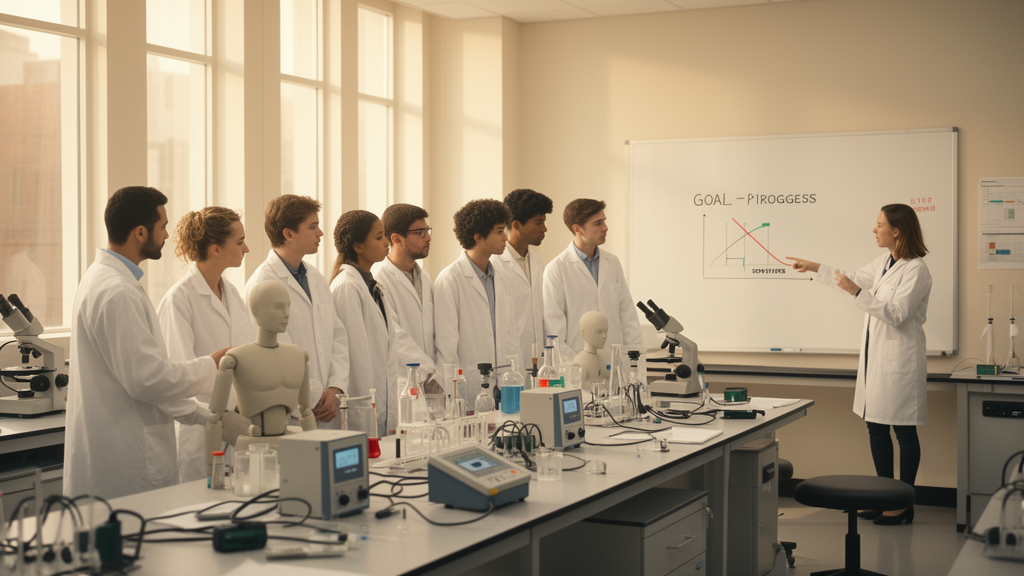
A teaching reform study published in BMC Medical Education reports that applying the Objectives and Key Results (OKR) method to a comprehensive experimental course in occupational health and occupational medicine improved undergraduate students' mastery of experimental knowledge and their overall satisfaction compared with traditional teaching. The open-access paper, authored by Jia-xiang Zhang and colleagues, describes a comparison involving 60 fourth-year preventive medicine undergraduates randomly selected from two classes. The study responds to what the authors describe as an urgent need in recent years to cultivate occupational health action ability among future practitioners.
The team set out to test whether the OKR assessment method, applied to the comprehensive experimental teaching of occupational health and occupational medicine (OHOM), could improve the experimental teaching level and the experimental ability of undergraduate students majoring in preventive medicine, making full use of existing teaching resources. The researchers established an OKR teaching model specifically for a comprehensive dust exposure experiment within the OHOM course. The model covered the design of teaching procedures, the arrangement of key steps, and specific evaluation methods tied to the objectives.
Participants were divided into a control group and a study group. The control group contained 15 male and 15 female students, an even 50-50 split, while the study group contained 17 male and 13 female students, or 56.67 percent and 43.33 percent respectively. The control group proceeded through the comprehensive experiment under the traditional teaching mode, while the study group worked under the OKR assessment method, with objectives and key results framing each stage of the dust exposure experiment.
The outcomes favored the OKR group on several measures. Within the OKR experimental group, 26.67 percent of students said the mode improved their learning efficiency and 23.33 percent said it improved their comprehensive learning ability. Assessment of students' grasp of experimental knowledge showed significantly greater mastery in the experimental group than in the control group, and the authors conclude that OKR had an obvious effect on students' mastery of experimental knowledge in this setting.
Satisfaction also rose under the new approach. The paper reports that students' learning satisfaction was significantly improved through the OKR teaching method. The authors note that both the traditional teaching mode and the OKR evaluation method produced good teaching effects overall, but that the OKR teaching effect was better than the traditional method.
The comprehensive experiment score in the OKR group was significantly higher than the score achieved under the traditional method, with the difference reaching statistical significance at P < 0.05. In practical terms, this indicates that the improvement in performance was unlikely to be due to chance alone, although the study involved a single cohort of 60 students, so the findings should be generalized with caution. The authors frame the reform as a way of highlighting, to a certain extent, the professional characteristics of the OHOM comprehensive experimental course while strengthening the teaching of experimental skills.
By integrating the OKR assessment method into practical teaching, the course becomes, in their words, an important supplement to and resource expansion of traditional classroom learning. They argue the approach holds considerable value for promotion in improving the quality of comprehensive experimental teaching.
Subject of Research: Application of the OKR method to undergraduate occupational health and occupational medicine experimental teaching
Article Title: Improving undergraduates study ability of occupational health and occupational medicine comprehensive experiment applying objectives and key results method
Article References: Zhang, J.-X., Zhang, X.-Y., Xu, S.-H., Wang, Y., & Shen, T. (2026). Improving undergraduates study ability of occupational health and occupational medicine comprehensive experiment applying objectives and key results method. BMC Medical Education. https://doi.org/10.1186/s12909-026-10707-8
Image Credits: AI Generated
DOI: 10.1186/s12909-026-10707-8
Keywords: OKR, occupational health, occupational medicine, medical education, preventive medicine, experimental teaching, dust exposure, undergraduate students, teaching reform, learning outcomes, BMC Medical Education, Improving
News Source: Courtney Benton. (October 27, 2026). OKR Method Boosts Learning in Occupational Health Experiment Course. Scienmag.