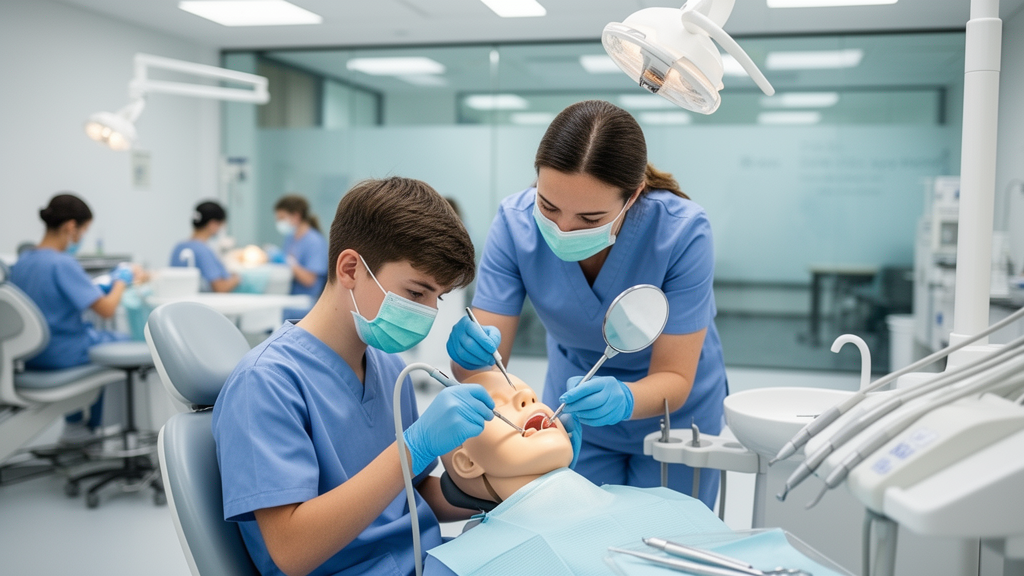
Third-year dental students at Sakarya University rated practical teaching slightly higher than theoretical lectures for learning about the temporomandibular joint, temporomandibular disorders, and occlusal splint therapy, but the clear majority said the best way to learn the material would be a combination of both methods. The findings come from a randomized teaching-sequence study published in BMC Medical Education. A total of 83 third-year dental students took part, 52 of them female and 31 male.
The researchers used a within-subject design, meaning every student experienced both teaching methods on the same day. Randomization determined only the order in which the methods were delivered. One group of 42 students received theoretical teaching first, followed by practical teaching, while a second group of 41 students received practical teaching first, followed by the theoretical session.
Both methods covered exactly the same educational content. Immediately after completing both sessions, students filled out a 17-item questionnaire assessing their perceptions of each method and their preferences for the most effective and ideal teaching approach. The researchers analyzed the responses with chi-square goodness-of-fit tests, the Wilcoxon signed-rank test, the Mann–Whitney U test, and mixed analysis of variance, with a p-value below 0.05 considered statistically significant.
On the perception scores, practical teaching came out ahead, but only narrowly. Students gave practical teaching a mean evaluation score of 4.06, with a standard deviation of 0.88, compared with 3.95, with a standard deviation of 0.81, for theoretical teaching. The Wilcoxon signed-rank test showed this difference was statistically significant, with a test statistic of Z equal to −2.374 and a p-value of 0.018.
Because every student experienced both formats, each student served as their own comparison, which strengthens the interpretation of this paired difference. The preference results were more striking. When asked which method was most effective for learning the topic, 61 of the 83 students chose an integrated approach combining theoretical and practical teaching rather than either method alone.
When asked about the ideal teaching approach, 65 of 83 students again chose the integrated option. Both distributions differed significantly from the equal proportions that would be expected if preferences were spread evenly across the three response options, with chi-square goodness-of-fit tests yielding p-values below 0.001 in both cases. The order in which students received the two methods did not appear to shape their overall evaluations.
Total evaluation scores showed no statistically significant difference between the group that started with theoretical teaching and the group that started with practical teaching, with a Mann–Whitney U value of 847.500 and a p-value of 0.902. This suggests the findings were not an artifact of whether students ended their day with a hands-on session or a lecture. The authors are careful about what the preference data can and cannot show.
Because the study did not directly evaluate an integrated teaching condition, the strong preference for a combined approach reflects what students said they would want, not measured evidence that integration produces greater educational effectiveness. The retrospective ratings of practical teaching, gathered after students had experienced both formats, are likewise perceptions rather than objective measures of learning outcomes such as exam performance. The study was registered on ClinicalTrials.gov under identifier NCT07821918, first submitted on 10 September 2026 and first posted on 16 September 2026, though the registration was retrospective.
The article was published as an open access research paper on 27 October 2026, initially shared as an accepted version subject to further editorial edits before the final version of record. For dental educators, the message is measured rather than dramatic. Students in this single-institution cohort of 83 third-year students judged practical teaching marginally better than lectures for TMJ-related content, but they overwhelmingly wanted the two formats woven together.
Whether that stated preference translates into better learning when an integrated curriculum is actually tested remains a question for future studies.
Subject of Research: Dental students' perceptions of theoretical versus practical teaching methods for temporomandibular joint topics
Article Title: Dental students’ perceptions and preferences regarding two teaching methods for TMJ anatomy, TMDs, and prosthodontic treatment approaches: a randomized teaching-sequence study
Article References: Sencan, B. B., & Bayat, T. (2026). Dental students’ perceptions and preferences regarding two teaching methods for TMJ anatomy, TMDs, and prosthodontic treatment approaches: a randomized teaching-sequence study. BMC Medical Education. https://doi.org/10.1186/s12909-026-10702-z
Image Credits: AI Generated
DOI: 10.1186/s12909-026-10702-z
Keywords: dental education, temporomandibular joint, temporomandibular disorders, teaching methods, practical teaching, theoretical teaching, randomized study, student perceptions, occlusal splint therapy, BMC Medical Education, medical education research, Dental
News Source: Courtney Benton. (October 27, 2026). Dental Students Rate Hands-On Teaching Above Lectures but Favor a Combined Approach. Scienmag.