Credit: Jeffrey Chase/University of Delaware
Injecting large amounts of offshore wind power into the U.S. electrical grid is manageable, will cut electricity costs, and will reduce pollution compared to current fossil fuel sources, according to researchers from the University of Delaware and Princeton University who have completed a first-of-its-kind simulation with the electric power industry.
The researchers consulted with PJM Interconnection — a grid operator supplying electricity to more than 60 million people in 14 states — to develop a computer model that simulates how the electric grid would respond to injections of wind power from offshore wind farms along the East Coast at five build-out levels, between 7 and 70 gigawatts of installed capacity. The two-part study is published in the journal Renewable Energy.
One hurdle grid operators face is how to integrate increasing amounts of naturally fluctuating offshore wind into a network that has to deliver reliable power to customers, 24-7. The UD and Princeton team showed conservatively that, with some upgrades to transmission lines but without any need for added storage, the PJM grid can handle over 35 gigawatts of offshore wind–that's 35 billion watts–enough to power an estimated 10 million homes. They also found that the PJM grid could in the future handle twice that amount, up to 70 gigawatts, as wind forecasting improves, allowing the power operator to better predict and harness more wind.
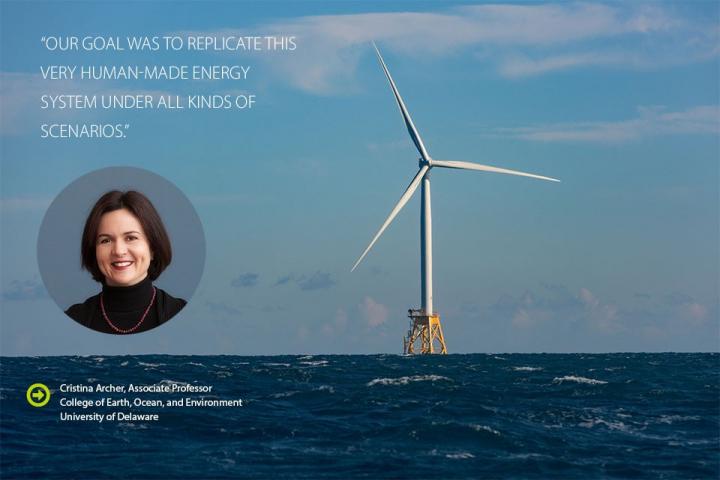
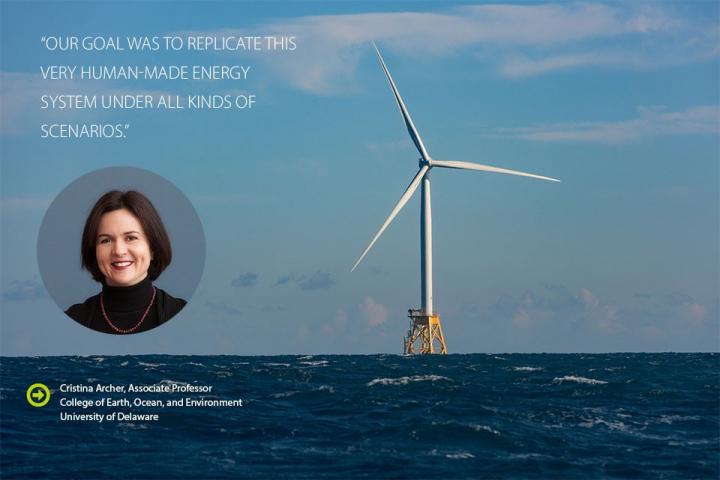
"Our goal was to replicate this very human-made energy system under all kinds of scenarios," said Cristina Archer, associate professor of physical ocean science and engineering at the University of Delaware. "What would you do as a grid operator if you thought it was going to be windy today and it isn't, or if the wind storm arrives earlier than expected? We simulated the entire PJM grid, with each power plant and each wind farm in it, old and new, every five minutes. As far as we know, this is the first model that does this."
From her office in UD's Harker Interdisciplinary Science and Engineering Laboratory, Archer led the team's efforts to generate realistic offshore wind forecasts based on real wind farm data from land-based systems, which colleagues at Princeton then incorporated into their model of the PJM electric power system. The team used stochastic modeling, running hundreds of forecasts with various tweaks in conditions, to realistically represent the fluctuating and sometimes unpredictable behavior of wind.
The model of PJM, called Smart-ISO, created at Princeton, is designed to handle both the variability and uncertainty of growing inputs of offshore wind energy, simulating what happens over an extensive power grid with more than 60,000 miles of transmission lines.
"The uncertainty of wind will require that we develop strategies to minimize the need for spinning reserve," said Warren Powell, professor and lead researcher at Princeton in charge of the SMART-ISO model, referring to electric generators that need to keep "spinning" and be ready for any electricity shortage. "Although we found that reserves were needed — 21 percent of the 70 gigawatt wind capacity — there are a number of strategies that could be investigated to better handle the variability as wind grows in the future."
The first U.S. offshore wind farm, consisting of five wind turbines at Block Island, Rhode Island, with a generating capacity of 30 megawatts, had not been built yet when the researchers began their study five years ago. The 70 gigawatts offshore modeled in this study would be almost equal to the total U.S. wind power capacity installed on land through the end of 2016.
Archer says that adding more offshore wind farms would lower consumers' electricity costs and reduce pollution by replacing coal and natural gas power plants.
"We saw up to a 50 percent reduction in carbon and sulfur dioxide and up to a 40 percent reduction in nitrogen oxides emissions at the highest build-out level, a 70-gigawatt set of wind farms. Plus, the costs of electricity would go down every month except in July when air conditioning is at a peak," Archer said. "Wind power is a very good idea — for people's health and their wallets."
###
The research was supported by the U.S. Department of Energy.
The two-part study is published in Renewable Energy. Part I, "The Challenge of Integrating Offshore Wind Power in the U.S. Electric Grid: Wind Forecast Error," was written by Cristina Archer, H. P. Simao, Willett Kempton, Warren Powell and M. J. Dvorak. Part II, "The Challenge of Integrating Offshore Wind Power in the U.S. Electric Grid: Simulation of Electricity Market Operations," was written by H.P. Simao, Warren Powell, Cristina Archer and Willett Kempton.
Media Contact
Peter Bothum
[email protected]
302-831-1418
@UDResearch
http://www.udel.edu
############
Story Source: Materials provided by Scienmag