• HOME
  • NEWS
  • EXPLORE
    • CAREER
      • Companies
      • Jobs
    • EVENTS
    • iGEM
      • News
      • Team
    • PHOTOS
    • VIDEO
    • WIKI
  • BLOG
  • COMMUNITY
    • FACEBOOK
    • INSTAGRAM
    • TWITTER
Wednesday, August 19, 2026
BIOENGINEER.ORG
No Result
View All Result
  • Login
  • HOME
  • NEWS
  • EXPLORE
    • CAREER
      • Companies
      • Jobs
        • Lecturer
        • PhD Studentship
        • Postdoc
        • Research Assistant
    • EVENTS
    • iGEM
      • News
      • Team
    • PHOTOS
    • VIDEO
    • WIKI
  • BLOG
  • COMMUNITY
    • FACEBOOK
    • INSTAGRAM
    • TWITTER
  • HOME
  • NEWS
  • EXPLORE
    • CAREER
      • Companies
      • Jobs
        • Lecturer
        • PhD Studentship
        • Postdoc
        • Research Assistant
    • EVENTS
    • iGEM
      • News
      • Team
    • PHOTOS
    • VIDEO
    • WIKI
  • BLOG
  • COMMUNITY
    • FACEBOOK
    • INSTAGRAM
    • TWITTER
No Result
View All Result
Bioengineer.org
No Result
View All Result
Home NEWS Science News Biology

Obesity, infertility and oxidative stress in mouse egg cells

Bioengineer by Bioengineer
August 16, 2018
in Biology
Reading Time: 2 mins read
0
Share on FacebookShare on TwitterShare on LinkedinShare on RedditShare on Telegram
IMAGE

Credit: Wang et al.

Excessive body fat is associated with negative effects on female fertility and pregnancy. In mice, maternal obesity impairs proper development of egg precursor cells called oocytes. In a recent paper published in Molecular & Cellular Proteomics, Qiang Wang and colleagues at the State Key Laboratory of Reproductive Medicine in China describe the link between poor oocyte development and oxidative stress in mice.

The authors used proteomics to compare oocytes from mice fed a high-fat diet, which became obese, with normally fed mice. When they compared protein expression level in oocytes from these mice, they found numerous changes in mitochondrial and redox proteins, In particular, a mitochondrial protein called TP53-inducible glycolysis and apoptosis regulator, or TIGAR, was expressed at a lower level in oocytes from mice on a high-fat diet.

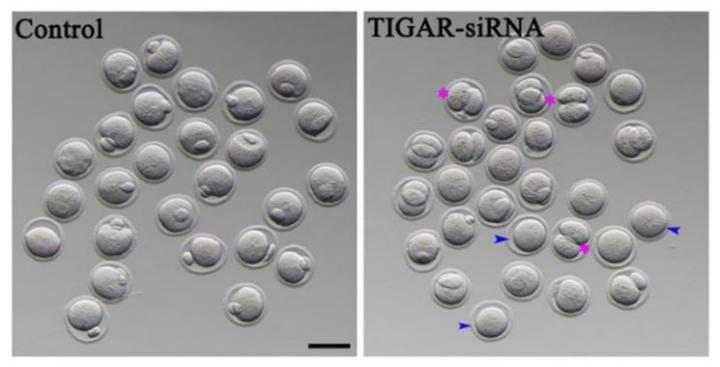
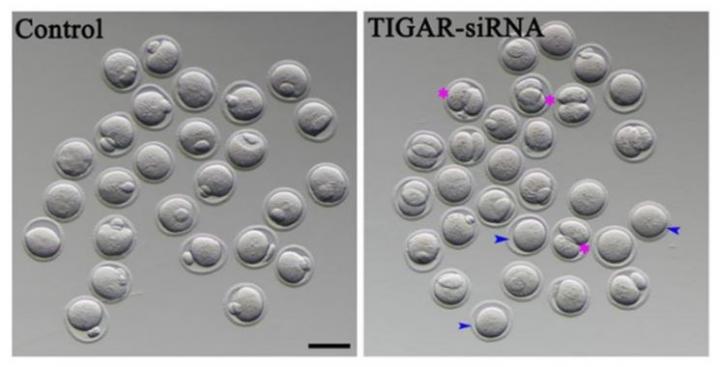
To develop into egg cells that can be fertilized, oocytes need to complete a type of cell division known as meiosis. Researchers found evidence that TIGAR may play a role in the meiotic spindle, a cell structure that coordinates the movements of DNA in the oocyte. When the researchers reduced TIGAR level using siRNA, they found that oocytes were much more likely to divide unevenly, indicating problems with meiosis that could prevent production of a viable egg cell in obese mice.

Eggs lacking TIGAR also had significantly higher levels of reactive oxygen species, a byproduct of cellular respiration. The researchers traced this result to TIGAR's known role in generating antioxidants. When TIGAR was depleted in mouse oocytes either by feeding or RNA interference, reactive oxygen species were higher, which activated a cellular quality-control pathway called autophagy.

Wang and colleagues demonstrated that the ROS production that TIGAR suppresses is a driving force for downstream autophagy, providing a link between TIGAR-mediated redox homeostasis and cell development. This study provides evidence of the direct effects of maternal obesity on the quality of oocyte development and implicates TIGAR in oocyte maturation in mice. The finding may have implications for infertility treatments for obese women.

###

Media Contact

Laurel Oldach
[email protected]
240-283-6648
@asbmb

http://www.asbmb.org

Related Journal Article

http://dx.doi.org/10.1074/mcp.RA118.000620

Share12Tweet8Share2ShareShareShare2

Related Posts

Acoustic Tweezers Reveal Biomolecular Droplet Stiffness

Acoustic Tweezers Reveal Biomolecular Droplet Stiffness

August 19, 2026
Prior antibodies shape distinct immune responses to influenza vaccination

Prior antibodies shape distinct immune responses to influenza vaccination

August 19, 2026

New Study Challenges Long-Held Assumption in Cell Biology

August 19, 2026

Harvard’s George Church to Present at 13th ARDD Meeting in Boston

August 19, 2026
Please login to join discussion

POPULAR NEWS

  • Chronic Kidney Disease in Women: Global Burden and Metabolic-Cardiovascular Connections

    29 shares
    Share 12 Tweet 7
  • Molecular Self-Assembly Enables High-Throughput DNA Fragment Synthesis from Overlapping Oligonucleotides

    29 shares
    Share 12 Tweet 7
  • Dynamic duo weaves hierarchical DNA materials using two classes of biomolecular nanomachines

    29 shares
    Share 12 Tweet 7
  • Wiley Launches First Spectral Analysis API Portfolio to Speed Substance Identification

    29 shares
    Share 12 Tweet 7

About

We bring you the latest biotechnology news from best research centers and universities around the world. Check our website.

Follow us

Recent News

Chronic Kidney Disease in Women: Global Burden and Metabolic-Cardiovascular Connections

Molecular Self-Assembly Enables High-Throughput DNA Fragment Synthesis from Overlapping Oligonucleotides

Dynamic duo weaves hierarchical DNA materials using two classes of biomolecular nanomachines

Subscribe to Blog via Email

Enter your email address to subscribe to this blog and receive notifications of new posts by email.

Join 85 other subscribers
  • Contact Us

Bioengineer.org © Copyright 2023 All Rights Reserved.

Welcome Back!

Login to your account below

Forgotten Password?

Retrieve your password

Please enter your username or email address to reset your password.

Log In
No Result
View All Result
  • Homepages
    • Home Page 1
    • Home Page 2
  • News
  • National
  • Business
  • Health
  • Lifestyle
  • Science

Bioengineer.org © Copyright 2023 All Rights Reserved.