• HOME
  • NEWS
  • EXPLORE
    • CAREER
      • Companies
      • Jobs
    • EVENTS
    • iGEM
      • News
      • Team
    • PHOTOS
    • VIDEO
    • WIKI
  • BLOG
  • COMMUNITY
    • FACEBOOK
    • INSTAGRAM
    • TWITTER
Tuesday, June 16, 2026
BIOENGINEER.ORG
No Result
View All Result
  • Login
  • HOME
  • NEWS
  • EXPLORE
    • CAREER
      • Companies
      • Jobs
        • Lecturer
        • PhD Studentship
        • Postdoc
        • Research Assistant
    • EVENTS
    • iGEM
      • News
      • Team
    • PHOTOS
    • VIDEO
    • WIKI
  • BLOG
  • COMMUNITY
    • FACEBOOK
    • INSTAGRAM
    • TWITTER
  • HOME
  • NEWS
  • EXPLORE
    • CAREER
      • Companies
      • Jobs
        • Lecturer
        • PhD Studentship
        • Postdoc
        • Research Assistant
    • EVENTS
    • iGEM
      • News
      • Team
    • PHOTOS
    • VIDEO
    • WIKI
  • BLOG
  • COMMUNITY
    • FACEBOOK
    • INSTAGRAM
    • TWITTER
No Result
View All Result
Bioengineer.org
No Result
View All Result
Home NEWS Science News Chemistry

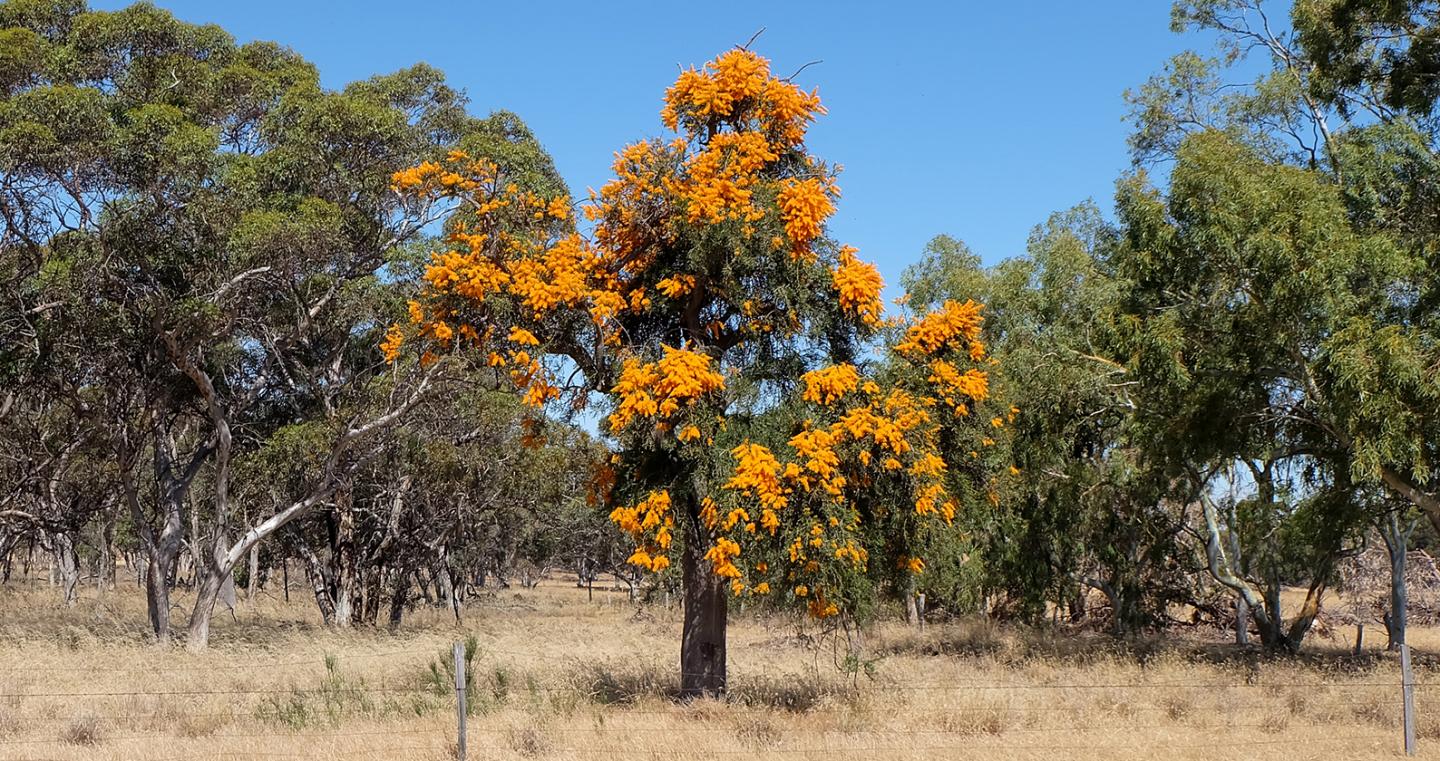
O Christmas Tree: DNA shows WA’s largest parasitic plant adapts to climate

Bioengineer by Bioengineer
July 22, 2020
in Chemistry
Reading Time: 2 mins read
0
IMAGE
Share on FacebookShare on TwitterShare on LinkedinShare on RedditShare on Telegram

IMAGE

Credit: Curtin University

A closer look at DNA from south-western Australia’s native Nuytsia floribunda, known as the WA Christmas Tree, has found that temperature, rather than rainfall, impacts the tree’s resilience and reproductive success.

The WA Christmas Tree is the largest parasitic plant in the world, obtaining its water and nutrients from host plants using a specialised structure called a haustorium to attach its own root system to the roots of others.

Lead researcher Curtin PhD candidate Sheree Walters from the ARC Centre for Mine Site Restoration said that the latest DNA sequencing techniques were used in the study, which compared the WA Christmas tree to the non-parasitic Swamp Paperbark tree (Melaleuca rhaphiophylla) to determine if the different ways they acquire water affected their adaptation to climate.

“Traditionally, we would have used common garden studies to collect this data, so basically growing the different tree populations in the same area to compare growth and survival under the same environmental conditions,” Ms Walters said.

“Here we did the same comparison using a next generation genotyping-by-sequencing approach that essentially cuts the trees’ DNA up into lots of short pieces that we can sequence. In this study we ended up with tens of thousands of different pieces of DNA sequenced for each species.

“We found that temperature of the local environment was more important for the adaptation and resilience of the WA Christmas Tree, while precipitation, or rainfall, was more important for the Swamp Paperbark, a non-parasitic plant.

“When plants are adapted to local climates they tend to have greater reproduction and survival in those same environments. For example plants adapted to higher temperatures will generally survive better at higher temperatures than plants adapted to lower temperatures.

“Temperature is important for parasitic plants because it affects the rate at which plants transpire water from their leaves. For parasitic plants to survive they have to transpire water at a faster rate than their host plants.

“Precipitation is important for non-parasitic plants as they generally rely on rainfall to survive.”

The three year project was carried out using samples collected from 17 sites across the South Western region of WA and will have implications for the conservation and restoration of the species.

“The findings from our study could now be used in further research to identify areas where we can collect seed for these two species and use it in restoration projects,” Ms Walters said.

###

The full paper Contrasting patterns of local adaptation along climatic gradients between a sympatric parasitic and autotrophic tree species, published in Molecular Ecology can be read online here.

Media Contact
April Kleer
[email protected]

Original Source

https://news.curtin.edu.au/media-releases/o-christmas-tree-dna-shows-was-largest-parasitic-plant-adapts-to-climate/

Related Journal Article

http://dx.doi.org/10.1111/mec.15537

Tags: Chemistry/Physics/Materials SciencesClimate ChangeEcology/EnvironmentGeneticsMolecular BiologyPlant Sciences
Share12Tweet8Share2ShareShareShare2

Related Posts

Why Dissolved Black Carbon Persists in Water Instead of Disappearing — Chemistry

Why Dissolved Black Carbon Persists in Water Instead of Disappearing

June 16, 2026
Biochar Revolutionizes Catalyst Chemistry to Accelerate Pesticide Removal from Water — Chemistry

Biochar Revolutionizes Catalyst Chemistry to Accelerate Pesticide Removal from Water

June 16, 2026

Alkyl-Swap Platform Transforms Secondary N-Methylamines Late-Stage

June 15, 2026

You Just Devoured That Planet, Didn’t You?

June 15, 2026
Please login to join discussion

POPULAR NEWS

  • ESMO 2025: mRNA COVID Vaccines Enhance Efficacy of Cancer Immunotherapy

    325 shares
    Share 130 Tweet 81
  • Saying Goodbye to PGY-6: Pediatric Fellowship Realities

    100 shares
    Share 40 Tweet 25
  • Multi-Hospital Study Reveals Long Covid Burden Is Twice as High as Current Estimates

    91 shares
    Share 36 Tweet 23
  • Detection of EDCs in Breast Milk and Infant Urine Up to Six Months Highlights Early Exposure Risks

    74 shares
    Share 30 Tweet 19

About

BIOENGINEER.ORG

We bring you the latest biotechnology news from best research centers and universities around the world. Check our website.

Follow us

Recent News

Net-Export Limits Challenge Netherlands’ Global Food Role

Evaluating Social Media on Femoral Head Necrosis

Boosting Elderly Health: Health Literacy’s Key Role

Subscribe to Blog via Email

Enter your email address to subscribe to this blog and receive notifications of new posts by email.

Join 82 other subscribers
  • Contact Us

Bioengineer.org © Copyright 2023 All Rights Reserved.

Welcome Back!

Login to your account below

Forgotten Password?

Retrieve your password

Please enter your username or email address to reset your password.

Log In
No Result
View All Result
  • Homepages
    • Home Page 1
    • Home Page 2
  • News
  • National
  • Business
  • Health
  • Lifestyle
  • Science

Bioengineer.org © Copyright 2023 All Rights Reserved.