A team of researchers from NYU Abu Dhabi (NYUAD) has discovered new insights into the evolution of color patterns in frogs and toads – collectively known as anurans. Animal color patterns can help them camouflage with their surroundings and avoid detection from preys or predators. Many anurans have a light stripe along their back, which, when observed from above, creates the optical illusion that the animal is split in two halves and confuses visually-oriented predators. Although this color pattern is widespread in frogs around the world, little is known regarding its evolution or genetic origin.
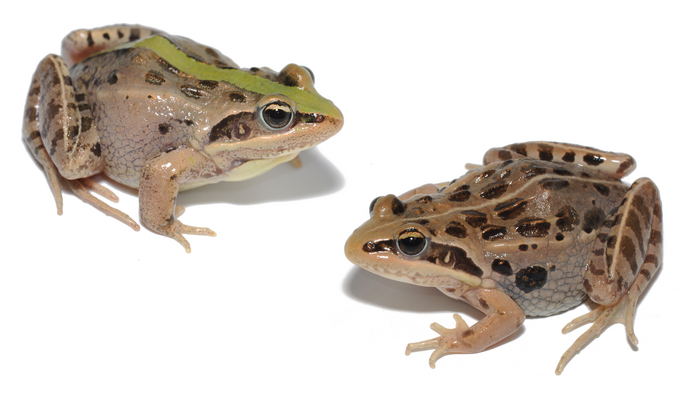
Credit: Courtesy of NYU Abu Dhabi
A team of researchers from NYU Abu Dhabi (NYUAD) has discovered new insights into the evolution of color patterns in frogs and toads – collectively known as anurans. Animal color patterns can help them camouflage with their surroundings and avoid detection from preys or predators. Many anurans have a light stripe along their back, which, when observed from above, creates the optical illusion that the animal is split in two halves and confuses visually-oriented predators. Although this color pattern is widespread in frogs around the world, little is known regarding its evolution or genetic origin.
In their paper published in the journal Molecular Biology and Evolution, the researchers of the Evolutionary Genomics Lab at NYUAD completed a broad-scale comparative analysis, which included over 2,700 species of anurans, to further the understanding of the evolutionary history of the vertebral stripe. They found that the vertebral stripe has evolved hundreds of times and is selected for in terrestrial habitats where visual predators coming directly from above – such as mammals or birds – are more prevalent. In contrast, the pattern was lost significantly more often in arboreal lineages – those living in trees – than in other habitats. While beneficial to frogs living on the ground, this color pattern may thus be disadvantageous to frogs living in trees.
To understand the genetic basis of the pattern, the researchers focused on the Ethiopian grass frog species Ptychadena robeensis, which is polymorphic – meaning that it presents the vertebral stripe trait in multiple forms – wide, thin or absent. They found that the gene ASIP is linked to the stripe pattern in that species. This genetic variation affects the level of expression of ASIP in the different morphs, a higher expression leading to a wide stripe and a lower expression leading to a thin stripe.
They also compared the genes of closely-related species of frogs and found that, while they present the same stripe patterns, they do not share the genetic variation found in P. robeensis. This led the researchers to the conclusion that the stripe alleles found in P. robeensis evolved recently. The researchers further conclude that the vertebral stripe evolves rapidly in anurans, which may allow species to adapt to environmental changes or variable conditions.
This study is the first large-scale study of the adaptive value of the anuran vertebral stripe, whose evolutionary history has, until now, not been well understood. This study also establishes a link between the ASIP gene and a color pattern in anurans for the first time. ASIP is a well-studied gene in mammals, known to be linked to melanin production and color variation. The fact that it is linked to color patterns in frogs opens new research avenues on anuran color patterns and comparative studies across vertebrates.
“Our findings establish that the vertebral stripe in frogs and toads holds a great potential in the field of evolutionary biology as it represents a clear example of repeated evolution. Studying this color pattern in other species can thus help us understand to which extent evolution predictably employs the same molecular paths when identical phenotypes evolve under similar selection pressures,” said Sandra Goutte, PhD, a research associate at the Evolutionary Genomics Lab at NYUAD. “The identification of ASIP’s role in the coloration of anurans by our team can also guide future comparative studies across vertebrates.”
Image caption: The images are all Ptychadena robeensis, taken by Sandra Goutte, PhD, a research associate at the Evolutionary Genomics Lab at NYUAD. The landscape is a grassland in the Ethiopian Highlands near Dinsho, in Oromia.
About NYU Abu Dhabi
www.nyuad.nyu.edu
NYU Abu Dhabi is the first comprehensive liberal arts and research campus in the Middle East to be operated abroad by a major American research university. NYU Abu Dhabi has integrated a highly selective undergraduate curriculum across the disciplines with a world center for advanced research and scholarship. The university enables its students in the sciences, engineering, social sciences, humanities, and arts to succeed in an increasingly interdependent world and advance cooperation and progress on humanity’s shared challenges. NYU Abu Dhabi’s high-achieving students have come from over 115 countries and speak over 115 languages. Together, NYU’s campuses in New York, Abu Dhabi, and Shanghai form the backbone of a unique global university, giving faculty and students opportunities to experience varied learning environments and immersion in other cultures at one or more of the numerous study-abroad sites NYU maintains on six continents.
Journal
Molecular Biology and Evolution
Article Title
Genomic Analyses Reveal Association of ASIP with a Recurrently evolving Adaptive Color Pattern in Frogs
Article Publication Date
1-Nov-2022