

• HOME
  • NEWS
  • EXPLORE
    • CAREER
      • Companies
      • Jobs
    • EVENTS
    • iGEM
      • News
      • Team
    • PHOTOS
    • VIDEO
    • WIKI
  • BLOG
  • COMMUNITY
    • FACEBOOK
    • INSTAGRAM
    • TWITTER
Friday, June 5, 2026
BIOENGINEER.ORG
No Result
View All Result
  • Login
  • HOME
  • NEWS
  • EXPLORE
    • CAREER
      • Companies
      • Jobs
        • Lecturer
        • PhD Studentship
        • Postdoc
        • Research Assistant
    • EVENTS
    • iGEM
      • News
      • Team
    • PHOTOS
    • VIDEO
    • WIKI
  • BLOG
  • COMMUNITY
    • FACEBOOK
    • INSTAGRAM
    • TWITTER
  • HOME
  • NEWS
  • EXPLORE
    • CAREER
      • Companies
      • Jobs
        • Lecturer
        • PhD Studentship
        • Postdoc
        • Research Assistant
    • EVENTS
    • iGEM
      • News
      • Team
    • PHOTOS
    • VIDEO
    • WIKI
  • BLOG
  • COMMUNITY
    • FACEBOOK
    • INSTAGRAM
    • TWITTER
No Result
View All Result
Bioengineer.org
No Result
View All Result
Home NEWS Science News

Nucleophilic amino acids as a renewable alternative to petrochemically-derived amines in glycerol epoxy resins

Bioengineer by Bioengineer
March 15, 2024
in Science News
Reading Time: 2 mins read
0
The Appearance of cured resins of GER-Lys, GER-Glu, GER-Ser, and GER-Leu and the water-soluble epoxy resin and hardeners used in this study. CREDIT: THE AUTHORS
Share on FacebookShare on TwitterShare on LinkedinShare on RedditShare on Telegram

Epoxide exhibits superior crosslinking properties, thereby enhancing the bonding performance of soy protein adhesives owing to its elevated glass transition temperature and mechanical property. Commercia resins are mainly derived from petroleum and contain the toxic chemical bisphenol A. Although commercial hardeners have been extensively utilized, these systems still have particular environmental concerns that have been become particularly notable in recent years. Amino acids, a bio-based epoxy curing agent with amino and carboxyl groups, are another potential curing agent. Water-soluble epoxy resins cured with lysine (Lys), glutamic acid (Glu), leucine (Leu), and serine (Ser) as amino acids were investigated. The results showed that the water-soluble epoxy resin (glycerol epoxy resins, GER) was cured with Lys and Glu after reacting. The potential of Lys and Glu alternatives for petrochemical amines is demonstrated and provides promising opportunities for industrial application.
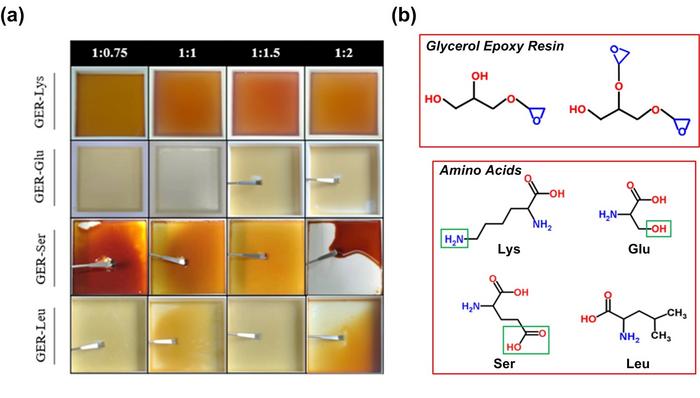
The Appearance of cured resins of GER-Lys, GER-Glu, GER-Ser, and GER-Leu and the water-soluble epoxy resin and hardeners used in this study. CREDIT: THE AUTHORS

Credit: Changlei Xia, College of Materials Science and Engineering, Nanjing Forestry University, Nanjing 210037, China, [email protected]

Epoxide exhibits superior crosslinking properties, thereby enhancing the bonding performance of soy protein adhesives owing to its elevated glass transition temperature and mechanical property. Commercia resins are mainly derived from petroleum and contain the toxic chemical bisphenol A. Although commercial hardeners have been extensively utilized, these systems still have particular environmental concerns that have been become particularly notable in recent years. Amino acids, a bio-based epoxy curing agent with amino and carboxyl groups, are another potential curing agent. Water-soluble epoxy resins cured with lysine (Lys), glutamic acid (Glu), leucine (Leu), and serine (Ser) as amino acids were investigated. The results showed that the water-soluble epoxy resin (glycerol epoxy resins, GER) was cured with Lys and Glu after reacting. The potential of Lys and Glu alternatives for petrochemical amines is demonstrated and provides promising opportunities for industrial application.


DOI

https://doi.org/10.1016/j.jobab.2024.01.003

Original Source URL

https://www.sciencedirect.com/science/article/pii/S2369969824000148

Journal

Journal of Bioresources and Bioproducts


Journal

Journal of Bioresources and Bioproducts

DOI

10.1016/j.jobab.2024.01.003

Method of Research

Experimental study

Article Title

Nucleophilic amino acids as a renewable alternative to petrochemically-derived amines in glycerol epoxy resins

Article Publication Date

23-Jan-2024

COI Statement

The authors have no financial or personal competing interests to declare which could have influenced this manuscript.


Share12Tweet8Share2ShareShareShare2

Related Posts

Here’s a revised version of your headline for a science magazine post: “After Years of Searching, We Discovered ‘The Heaven Sword’ — East Asia’s Tallest Tree” — Technology and Engineering

Here’s a revised version of your headline for a science magazine post: “After Years of Searching, We Discovered ‘The Heaven Sword’ — East Asia’s Tallest Tree”

June 5, 2026
Evaluating Neuroprotective Drugs in Neonatal Rodent Brain Injury — Technology and Engineering

Evaluating Neuroprotective Drugs in Neonatal Rodent Brain Injury

June 5, 2026

Omicron BA.2.86, JN.1 Broaden Intestinal Cell Tropism

June 5, 2026

Kumamoto University Unveils ‘Kumadai Research Institute’ to Advance Semiconductor Management Ecosystem

June 5, 2026

POPULAR NEWS

  • ESMO 2025: mRNA COVID Vaccines Enhance Efficacy of Cancer Immunotherapy

    321 shares
    Share 128 Tweet 80
  • Multi-Hospital Study Reveals Long Covid Burden Is Twice as High as Current Estimates

    88 shares
    Share 35 Tweet 22
  • Saying Goodbye to PGY-6: Pediatric Fellowship Realities

    76 shares
    Share 30 Tweet 19
  • Common Food Preservatives Associated with Elevated Blood Pressure and Increased Heart Disease Risk

    57 shares
    Share 23 Tweet 14

About

We bring you the latest biotechnology news from best research centers and universities around the world. Check our website.

Follow us

Recent News

Here’s a revised version of your headline for a science magazine post: “After Years of Searching, We Discovered ‘The Heaven Sword’ — East Asia’s Tallest Tree”

Evaluating Neuroprotective Drugs in Neonatal Rodent Brain Injury

Omicron BA.2.86, JN.1 Broaden Intestinal Cell Tropism

Subscribe to Blog via Email

Enter your email address to subscribe to this blog and receive notifications of new posts by email.

Join 82 other subscribers
  • Contact Us

Bioengineer.org © Copyright 2023 All Rights Reserved.

Welcome Back!

Login to your account below

Forgotten Password?

Retrieve your password

Please enter your username or email address to reset your password.

Log In
No Result
View All Result
  • Homepages
    • Home Page 1
    • Home Page 2
  • News
  • National
  • Business
  • Health
  • Lifestyle
  • Science

Bioengineer.org © Copyright 2023 All Rights Reserved.