

• HOME
  • NEWS
  • EXPLORE
    • CAREER
      • Companies
      • Jobs
    • EVENTS
    • iGEM
      • News
      • Team
    • PHOTOS
    • VIDEO
    • WIKI
  • BLOG
  • COMMUNITY
    • FACEBOOK
    • INSTAGRAM
    • TWITTER
Monday, October 5, 2026
BIOENGINEER.ORG
No Result
View All Result
  • Login
  • HOME
  • NEWS
  • EXPLORE
    • CAREER
      • Companies
      • Jobs
        • Lecturer
        • PhD Studentship
        • Postdoc
        • Research Assistant
    • EVENTS
    • iGEM
      • News
      • Team
    • PHOTOS
    • VIDEO
    • WIKI
  • BLOG
  • COMMUNITY
    • FACEBOOK
    • INSTAGRAM
    • TWITTER
  • HOME
  • NEWS
  • EXPLORE
    • CAREER
      • Companies
      • Jobs
        • Lecturer
        • PhD Studentship
        • Postdoc
        • Research Assistant
    • EVENTS
    • iGEM
      • News
      • Team
    • PHOTOS
    • VIDEO
    • WIKI
  • BLOG
  • COMMUNITY
    • FACEBOOK
    • INSTAGRAM
    • TWITTER
No Result
View All Result
Bioengineer.org
No Result
View All Result
Home NEWS Science News Biology

NSF funds new iBioFoundry at Illinois

by
September 6, 2025
in Biology
Reading Time: 2 mins read
0
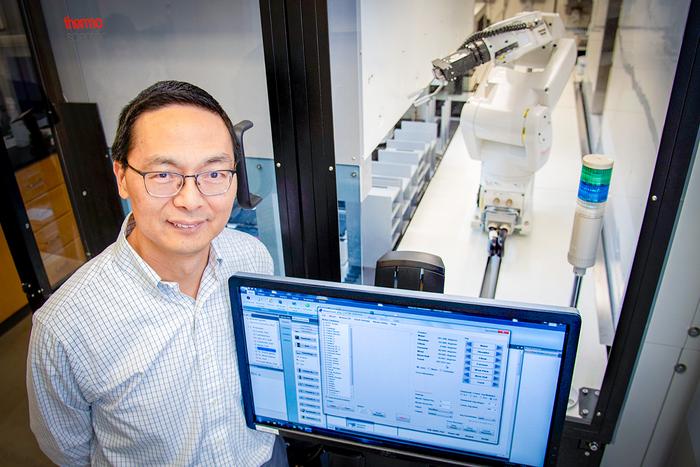
Huimin Zhao
Share on FacebookShare on TwitterShare on LinkedinShare on RedditShare on Telegram

CHAMPAIGN, Ill. — A newly funded U.S. National Science Foundation iBioFoundry at the University of Illinois Urbana-Champaign will build on more than a decade of research at the U. of I. to integrate synthetic biology, laboratory automation and artificial intelligence to advance protein and cellular engineering. This is one of five new biofoundries to be established in the U.S. 

CHAMPAIGN, Ill. — A newly funded U.S. National Science Foundation iBioFoundry at the University of Illinois Urbana-Champaign will build on more than a decade of research at the U. of I. to integrate synthetic biology, laboratory automation and artificial intelligence to advance protein and cellular engineering. This is one of five new biofoundries to be established in the U.S. 

According to the NSF, these facilities will “spur innovation, provide tools and technologies to researchers and help advance biology, biotechnology and the broader science, technology, engineering and math enterprise.” 

Each biofoundry will focus on a different area of biology or biotechnology, said U. of I. chemical and biomolecular engineering professor Huimin Zhao, who will lead the NSF iBioFoundry. The Illinois facility will expand the use of automated systems, machine learning and AI to promote and optimize advances in synthetic biology, biotechnology and genomics. 

Previous efforts at the U. of I. have led to major advances in integrating these elements, Zhao said. Earlier milestones include the development of BioAutomata, an AI-driven, robotic biomanufacturing platform that uses living cells to produce useful chemicals; and FAST-RiPPs, an automated platform for discovering new bioactive compounds. In 2014, Illinois researchers established iBioFab, a facility at the Carl R. Woese Institute for Genomic Biology that supports the efficient design, fabrication, validation and analysis of genetic constructs and organisms.

“The NSF iBioFoundry will serve as a hub for innovation, bringing together researchers, industry experts and policymakers to foster collaboration and accelerate the development of sustainable biomanufacturing processes,” Zhao said. “By centralizing resources and expertise, it will streamline the creation of new bio-based products and technologies, ranging from renewable chemicals to advanced medical treatments.”

Another key focus of the NSF iBioFoundry will be to share its capabilities with “a diverse community of external users who will work to solve important scientific problems through a peer-reviewed, competitive proposal process,” Zhao said. “It also will be an open ecosystem of disruptive thinking, education and community engagement that will revolutionize the way biology is taught and train the next generation workforce in biology, artificial intelligence and robotics.”

The total NIH award to Illinois is $15 million for six years, Zhao said. 

Zhao also is a professor in the IGB, a professor of bioengineering, of chemistry and of biomedical and translational sciences in the Carle Illinois College of Medicine. Chemical and biomolecular engineering is in the College of Liberal Arts and Sciences and ChBE and bioengineering are in The Grainger College of Engineering. 

Editor’s note:   

To reach Huimin Zhao, email [email protected].  

For more information about the NSF biofoundries, see:
NSF invests in BioFoundries to drive advances across science and engineering

Share12Tweet8Share2ShareShareShare2

Related Posts

A Hidden DNA Insertion Paints Quinoa Leaves in Red and Green

A Hidden DNA Insertion Paints Quinoa Leaves in Red and Green

October 5, 2026
Mapping Climate Refuges to Give Panama's Harlequin Toads a Second Chance

Mapping Climate Refuges to Give Panama’s Harlequin Toads a Second Chance

October 5, 2026

Iron’s Master Switch: How Cells and the Body Keep the Perfect Balance

October 5, 2026

A Methylation Signature in Brain Fluid Predicts Who Survives a Deadly Stroke

October 5, 2026

POPULAR NEWS

  • Alloys That Shrink Their Own Grains: New PIX Mechanism Refines Metals With Heat Alone

    Alloys That Shrink Their Own Grains: New PIX Mechanism Refines Metals With Heat Alone

    29 shares
    Share 12 Tweet 7
  • Endurance Exercise Reshapes the Liver in Males and Females Through Distinct Molecular Routes

    29 shares
    Share 12 Tweet 7
  • Single Transcription Factor PU.1 Rapidly Converts Fibroblasts into Macrophage-Lineage Cells

    29 shares
    Share 12 Tweet 7
  • New Scale Measures How Ready Nurse Educators Really Are for the AI Era

    29 shares
    Share 12 Tweet 7

About

We bring you the latest biotechnology news from best research centers and universities around the world. Check our website.

Follow us

Recent News

Alloys That Shrink Their Own Grains: New PIX Mechanism Refines Metals With Heat Alone

Endurance Exercise Reshapes the Liver in Males and Females Through Distinct Molecular Routes

Single Transcription Factor PU.1 Rapidly Converts Fibroblasts into Macrophage-Lineage Cells

Subscribe to Blog via Email

Success! An email was just sent to confirm your subscription. Please find the email now and click 'Confirm' to start subscribing.

Join 85 other subscribers
  • Contact Us

Bioengineer.org © Copyright 2023 All Rights Reserved.

Welcome Back!

Login to your account below

Forgotten Password?

Retrieve your password

Please enter your username or email address to reset your password.

Log In
No Result
View All Result
  • Homepages
    • Home Page 1
    • Home Page 2
  • News
  • National
  • Business
  • Health
  • Lifestyle
  • Science

Bioengineer.org © Copyright 2023 All Rights Reserved.