• HOME
  • NEWS
  • EXPLORE
    • CAREER
      • Companies
      • Jobs
    • EVENTS
    • iGEM
      • News
      • Team
    • PHOTOS
    • VIDEO
    • WIKI
  • BLOG
  • COMMUNITY
    • FACEBOOK
    • INSTAGRAM
    • TWITTER
Friday, May 8, 2026
BIOENGINEER.ORG
No Result
View All Result
  • Login
  • HOME
  • NEWS
  • EXPLORE
    • CAREER
      • Companies
      • Jobs
        • Lecturer
        • PhD Studentship
        • Postdoc
        • Research Assistant
    • EVENTS
    • iGEM
      • News
      • Team
    • PHOTOS
    • VIDEO
    • WIKI
  • BLOG
  • COMMUNITY
    • FACEBOOK
    • INSTAGRAM
    • TWITTER
  • HOME
  • NEWS
  • EXPLORE
    • CAREER
      • Companies
      • Jobs
        • Lecturer
        • PhD Studentship
        • Postdoc
        • Research Assistant
    • EVENTS
    • iGEM
      • News
      • Team
    • PHOTOS
    • VIDEO
    • WIKI
  • BLOG
  • COMMUNITY
    • FACEBOOK
    • INSTAGRAM
    • TWITTER
No Result
View All Result
Bioengineer.org
No Result
View All Result
Home NEWS Science News Biology

NSF award to shine more light on proteins

Bioengineer by Bioengineer
August 8, 2018
in Biology
Reading Time: 2 mins read
0
Share on FacebookShare on TwitterShare on LinkedinShare on RedditShare on Telegram
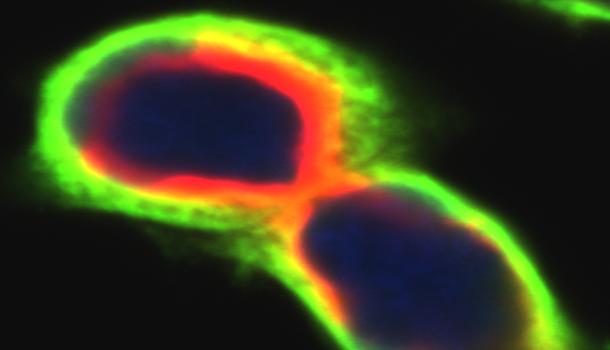
IMAGE

Credit: Yong Wang / Penn State

A better method to "see" proteins for improved medical diagnoses may be possible thanks to a three-year, $318,696 award from the National Science Foundation.

Yong Wang, professor of biomedical engineering at Penn State, received the award to develop a technology that will more easily and accurately visualize trace biomarker proteins under a microscope.

"An NSF award is different from an actual grant from other funding agencies due to the dual purposes," Wang said. "It is not only for scientists to do research but also to help the public, including students of all age levels, become familiar with what's going on in science and engineering."

The research aspect of the award will focus on the importance of protein examination to most biomedical science fields and clinical diagnostics because many important proteins are difficult to detect due to their low concentrations.

"Seeing means truth, but how can you see proteins with a very low amount?" Wang said. "You have to amplify the signal of target proteins, otherwise you cannot clearly see them at all."

Traditionally, one protein would be displayed by a few light-emitting molecules, Wang said. But the method he is seeking to develop is a novel biosensing nanotechnology that would enable proteins to be displayed by 100, or even more, light-emitting molecules.

"Right now, it's like we have a dark room lit by one small bulb. In one area you can see, but for the overall area, it's still dark," Wang said. "If you have 100 bulbs, it's like day, you can see everything."

This method would greatly advance protein sensing, with several real-world benefits, including the improvement of clinical diagnoses that are based on biopsies.

"If a physician thinks a patient may have cancer, they take a small piece of tissue as biopsy," Wang said. "The problem is the sample is very small, sometimes too small. If we can amplify the protein signal, this small piece of tissue is like a bigger piece for accurate diagnosis, so it's easier for physicians as far as diagnostics."

Beyond clinical diagnostics, Wang's research holds great potential to immediately help basic biomedical and biological research areas that require sensitive protein imaging and detection. This technology can also be tuned for the development of other biosensing methods and materials. Wang and his co-workers have a provisional patent for this technology.

As part of the award, Wang said he will actively recruit students, including underrepresented populations at different academic levels.

"If I encourage 10 young students to be scientists in the future, then they educate 10 more scientists, then you have 100 new scientists," Wang said. "That's why we will try to educate students on different levels. Not only our undergrads, grad students, but also high school students."

###

Media Contact

A'ndrea Elyse Messer
[email protected]
814-865-9481
@penn_state

http://live.psu.edu
Share12Tweet8Share2ShareShareShare2

Related Posts

The 28th European Congress of Endocrinology Kicks Off Tomorrow — Biology

The 28th European Congress of Endocrinology Kicks Off Tomorrow

May 8, 2026
Study Links Child Abuse to Alterations in Development and Physiological Regulation — Biology

Study Links Child Abuse to Alterations in Development and Physiological Regulation

May 8, 2026

Researchers Develop Smarter, More Efficient Computer Hardware Inspired by the Brain

May 7, 2026

Illicit Pangolin DNA Uncovers Key Hotspots in Illegal Wildlife Trade

May 7, 2026
Please login to join discussion

POPULAR NEWS

  • Research Indicates Potential Connection Between Prenatal Medication Exposure and Elevated Autism Risk

    837 shares
    Share 335 Tweet 209
  • New Study Reveals Plants Can Detect the Sound of Rain

    725 shares
    Share 290 Tweet 181
  • Scientists Investigate Possible Connection Between COVID-19 and Increased Lung Cancer Risk

    68 shares
    Share 27 Tweet 17
  • Salmonella Haem Blocks Macrophages, Boosts Infection

    61 shares
    Share 24 Tweet 15

About

We bring you the latest biotechnology news from best research centers and universities around the world. Check our website.

Follow us

Recent News

Intravenous Tenecteplase Administered Before Endovascular Therapy Shows Promise for Ischemic Stroke Patients Within 4.5 to 24 Hours

The 28th European Congress of Endocrinology Kicks Off Tomorrow

Nanoscale Directional Dark Field X-Ray Microscopy

Subscribe to Blog via Email

Enter your email address to subscribe to this blog and receive notifications of new posts by email.

Join 82 other subscribers
  • Contact Us

Bioengineer.org © Copyright 2023 All Rights Reserved.

Welcome Back!

Login to your account below

Forgotten Password?

Retrieve your password

Please enter your username or email address to reset your password.

Log In
No Result
View All Result
  • Homepages
    • Home Page 1
    • Home Page 2
  • News
  • National
  • Business
  • Health
  • Lifestyle
  • Science

Bioengineer.org © Copyright 2023 All Rights Reserved.