• HOME
  • NEWS
  • EXPLORE
    • CAREER
      • Companies
      • Jobs
    • EVENTS
    • iGEM
      • News
      • Team
    • PHOTOS
    • VIDEO
    • WIKI
  • BLOG
  • COMMUNITY
    • FACEBOOK
    • INSTAGRAM
    • TWITTER
Sunday, May 10, 2026
BIOENGINEER.ORG
No Result
View All Result
  • Login
  • HOME
  • NEWS
  • EXPLORE
    • CAREER
      • Companies
      • Jobs
        • Lecturer
        • PhD Studentship
        • Postdoc
        • Research Assistant
    • EVENTS
    • iGEM
      • News
      • Team
    • PHOTOS
    • VIDEO
    • WIKI
  • BLOG
  • COMMUNITY
    • FACEBOOK
    • INSTAGRAM
    • TWITTER
  • HOME
  • NEWS
  • EXPLORE
    • CAREER
      • Companies
      • Jobs
        • Lecturer
        • PhD Studentship
        • Postdoc
        • Research Assistant
    • EVENTS
    • iGEM
      • News
      • Team
    • PHOTOS
    • VIDEO
    • WIKI
  • BLOG
  • COMMUNITY
    • FACEBOOK
    • INSTAGRAM
    • TWITTER
No Result
View All Result
Bioengineer.org
No Result
View All Result
Home NEWS Science News Chemistry

NRL tests sensor on-orbit the ISS to protect space-based assets

Bioengineer by Bioengineer
May 6, 2019
in Chemistry
Reading Time: 2 mins read
0
IMAGE
Share on FacebookShare on TwitterShare on LinkedinShare on RedditShare on Telegram

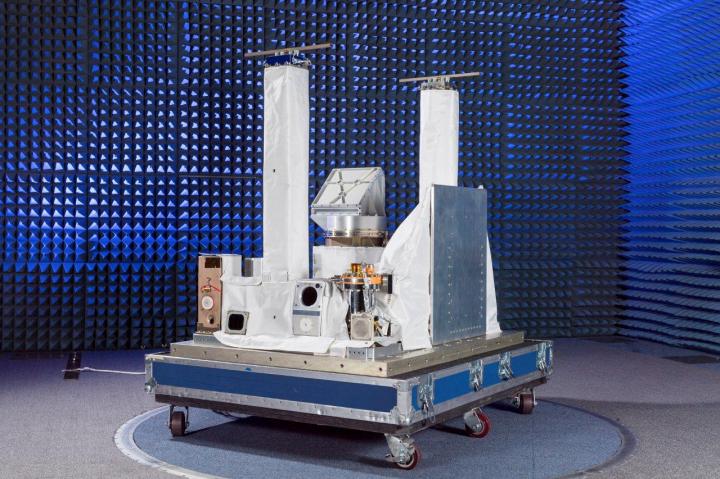
IMAGE

Credit: (NASA/Space Test Program-Houston 6)

WASHINGTON — Developed by the U.S. Naval Research Laboratory Plasma Physics Division, in conjunction with the Spacecraft Engineering Department, the Space PlasmA Diagnostic suitE (SPADE) experiment launched from Kennedy Space Center in Florida to the International Space Station onboard the SpaceX Dragon resupply mission (CRS-17), May 4.

Integrated onto the Space Test Program-Houston 6 (STP-H6) pallet, SPADE is designed to monitor background space plasma conditions on-orbit the International Space Station and provide early warning of the onset of hazardous levels of spacecraft charging.

The space environment is filled with a collection of electrically charged particles, plasma, and properties that depend on variable solar conditions. Satellite operations in space require continuous monitored plasma conditions and the results it has on spacecraft.

Dr. Erik Tejero, a plasma physicist at NRL’s Plasma Physics Division, compared the effects of spacecraft charging to the electrical charge build-up that occurs when walking across a carpet.

“While the shock you get from your carpet isn’t dangerous, a sudden discharge in space can pose a serious threat or costly damage to sensitive satellite electronics,” Tejero said.

At present, there are no simple, dedicated sensors to monitor spacecraft charging.

The SPADE experiment is designed to demonstrate the instrument’s response to slight changes in the plasma sheath. This is often referred to as the Debye sheath formed around a charged object that provides a unique NRL-developed method for early detection.

A component of the SPADE suite consists of an active antenna used to excite the local plasma and a passive antenna that observes the excitation.

The active probe is swept across a range of frequencies and DC voltage biases to determine the plasma impedance spectrum.

The impedance measurement then assists to determine the plasma’s physical properties, such as density, plasma potential and electron temperature. It provides data to indicate the charging level of the International Space Station relative to the local plasma.

“This is an indication of the plasma’s ‘resistance’ to current flow at each setting,” Tejero said.

“Laboratory investigations have illustrated that the NRL impedance probe can yield useful data in operational regimes where other techniques are less feasible,” he said. “This opens many new possibilities for measurements in industrial processed plasmas and in atmospheric pressure discharge experiments.”

The year-long mission will test SPADE’s ability to detect hazardous station charging events and provide long-term records of space weather conditions.

###

Media Contact
Daniel Parry
[email protected]

Original Source

https://www.nrl.navy.mil/news/releases/nrl-tests-sensor-orbit-iss-protect-space-based-assets

Tags: AstrophysicsExperiments in SpaceSatellite Missions/ShuttlesSpace/Planetary Science
Share12Tweet8Share2ShareShareShare2

Related Posts

Miniature Sensor Uses Light to Detect Touch — Chemistry

Miniature Sensor Uses Light to Detect Touch

May 8, 2026
Iron Minerals Determine Whether Dissolved Organic Matter Fuels Microbes or Becomes Long-Term Carbon Storage — Chemistry

Iron Minerals Determine Whether Dissolved Organic Matter Fuels Microbes or Becomes Long-Term Carbon Storage

May 8, 2026

Kate Evans Appointed Associate Lab Director for Biological and Environmental Systems Science at ORNL

May 8, 2026

Advancing Multiscale Modeling and Overcoming Operational Challenges in Autothermal COâ‚‚-to-Methanol Reactors

May 8, 2026
Please login to join discussion

POPULAR NEWS

  • Research Indicates Potential Connection Between Prenatal Medication Exposure and Elevated Autism Risk

    840 shares
    Share 336 Tweet 210
  • New Study Reveals Plants Can Detect the Sound of Rain

    727 shares
    Share 290 Tweet 181
  • Scientists Investigate Possible Connection Between COVID-19 and Increased Lung Cancer Risk

    68 shares
    Share 27 Tweet 17
  • Salmonella Haem Blocks Macrophages, Boosts Infection

    61 shares
    Share 24 Tweet 15

About

We bring you the latest biotechnology news from best research centers and universities around the world. Check our website.

Follow us

Recent News

Evaluating Digoxin Use in Patients with Symptomatic Rheumatic Heart Disease

Evaluating the Effectiveness and Safety of Digitalis Glycosides in Treating Heart Failure

Urdu Fall Risk Questionnaire Adapted for Elderly

Subscribe to Blog via Email

Enter your email address to subscribe to this blog and receive notifications of new posts by email.

Join 82 other subscribers
  • Contact Us

Bioengineer.org © Copyright 2023 All Rights Reserved.

Welcome Back!

Login to your account below

Forgotten Password?

Retrieve your password

Please enter your username or email address to reset your password.

Log In
No Result
View All Result
  • Homepages
    • Home Page 1
    • Home Page 2
  • News
  • National
  • Business
  • Health
  • Lifestyle
  • Science

Bioengineer.org © Copyright 2023 All Rights Reserved.