• HOME
  • NEWS
  • EXPLORE
    • CAREER
      • Companies
      • Jobs
    • EVENTS
    • iGEM
      • News
      • Team
    • PHOTOS
    • VIDEO
    • WIKI
  • BLOG
  • COMMUNITY
    • FACEBOOK
    • INSTAGRAM
    • TWITTER
Sunday, May 10, 2026
BIOENGINEER.ORG
No Result
View All Result
  • Login
  • HOME
  • NEWS
  • EXPLORE
    • CAREER
      • Companies
      • Jobs
        • Lecturer
        • PhD Studentship
        • Postdoc
        • Research Assistant
    • EVENTS
    • iGEM
      • News
      • Team
    • PHOTOS
    • VIDEO
    • WIKI
  • BLOG
  • COMMUNITY
    • FACEBOOK
    • INSTAGRAM
    • TWITTER
  • HOME
  • NEWS
  • EXPLORE
    • CAREER
      • Companies
      • Jobs
        • Lecturer
        • PhD Studentship
        • Postdoc
        • Research Assistant
    • EVENTS
    • iGEM
      • News
      • Team
    • PHOTOS
    • VIDEO
    • WIKI
  • BLOG
  • COMMUNITY
    • FACEBOOK
    • INSTAGRAM
    • TWITTER
No Result
View All Result
Bioengineer.org
No Result
View All Result
Home NEWS Science News Chemistry

NRL, NASA combine to produce sun imagery with unprecedented clarity

Bioengineer by Bioengineer
December 4, 2019
in Chemistry
Reading Time: 3 mins read
0
IMAGE
Share on FacebookShare on TwitterShare on LinkedinShare on RedditShare on Telegram

IMAGE

Credit: (U.S. Navy/Released)


WASHINGTON — Early returns from the U.S. Naval Research Laboratory’s camera on NASA’s latest mission to study the Sun’s corona revealed on Dec. 4 a star more complex than ever imagined.

NRL’s Wide-field Imager for Parker Solar Probe, or WISPR, the only imaging instrument aboard the NASA Parker Solar Probe mission, is now 84 percent of the way to the Sun.

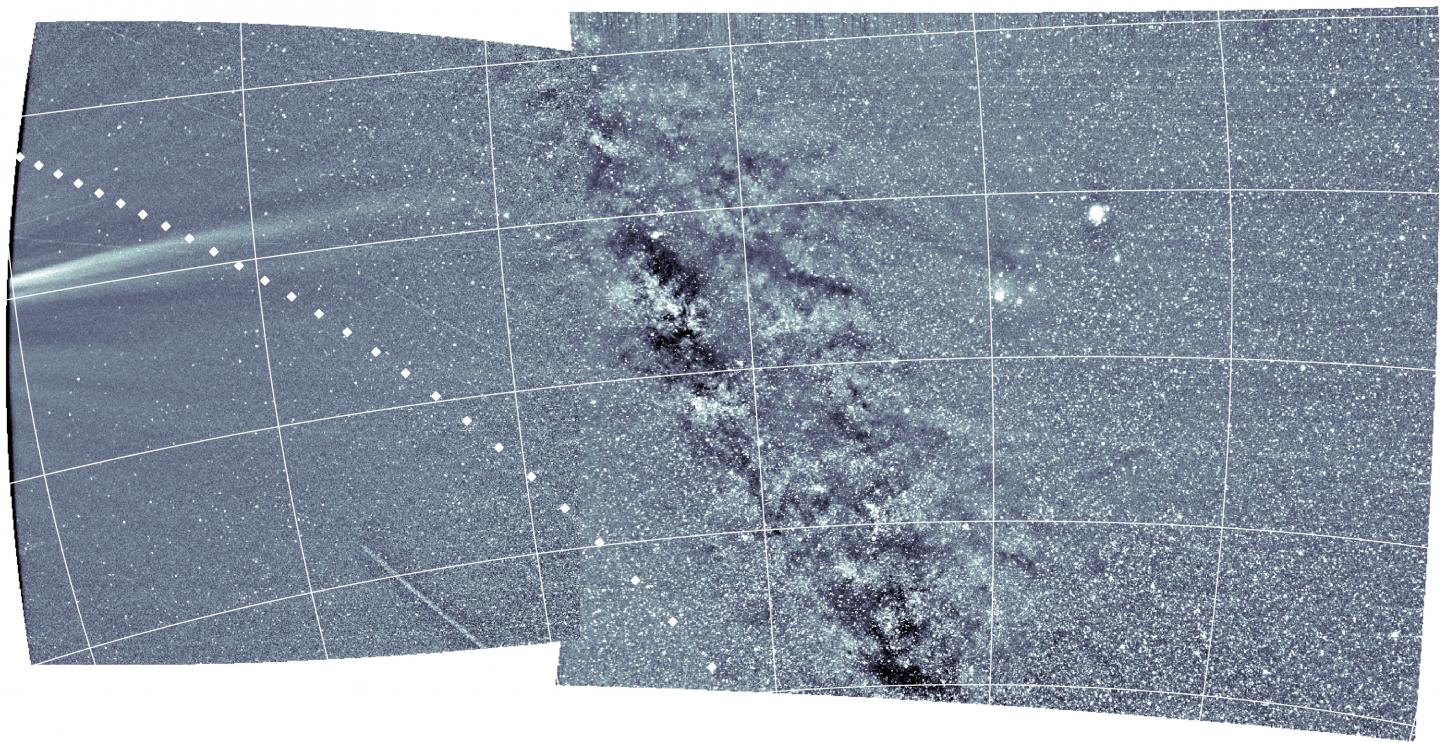
WISPR produced multiple scientifically relevant photos, capturing the beginning of a dust-free zone around the Sun, detailed plasma eruptions, magnetic flux ropes, and the first image of a magnetic island around the Sun, a small region of space with a circulating magnetic field.

“The images help in the modeling of the behavior and the transport of the solar wind to Earth,” said Russ Howard, an NRL astrophysicist and principal WISPR investigator. “They allow us to develop more accurate models by putting proper physics in the models.”

Understanding how the solar wind behaves is important to the Navy and Marine Corps because when the winds reach Earth, they can impact GPS, spacecraft operations, and ground-based power grids.

WISPR, designed, developed and led by NRL, records visible-light images of the solar corona and solar outflow in two overlapping cameras, which together cover more than 100-degrees angular width from the Sun.

The findings just released stem from Parker Solar Probe’s most recent approach to the Sun during a quiet part of the solar cycle, and set the stage for discoveries when the Sun is more active.

“Parker is going to swoop past the sun three or four times a year for the next few years, getting successively closer each time,” said Karl Battams, a computational scientist at NRL. “Every encounter is going to give us a view that humankind has never seen, and along with that a lot of new questions – and hopefully quite a few answers – about what we are seeing.”

Parker Solar Probe recently completed its third perihelion, or closest approach to the Sun. By the end of its 7-year-long mission, the spacecraft will have circled the Sun a total of 24 times. In 2024, the Parker Solar Probe is expected to have traveled 96 percent of the distance to the Sun.

“We’re explorers and we’re getting in closer and closer until we’re finally at the Sun,” Howard said. “It’s mindboggling because you’re going to see things that we can’t even imagine.”

The Parker Solar Probe is a robotic spacecraft NASA launched in August 2018, whose mission is repeatedly probing and making observations of the outer corona of the Sun. WISPR is one of four instruments on Parker Solar Probe.

###

More information on WISPR can be found at https://wispr.nrl.navy.mil.

About the U.S. Naval Research Laboratory

NRL is a scientific and engineering command dedicated to research that drives innovative advances for the Navy and Marine Corps from the seafloor to space and in the information domain. NRL headquarters is located in Washington, D.C., with major field sites in Stennis Space Center, Mississippi, Key West, Florida, and Monterey, California, and employs approximately 2,500 civilian scientists, engineers and support personnel.

Media Contact
Mary Estacion
[email protected]
202-404-6422

Original Source

https://www.nrl.navy.mil/news/releases/nrl-nasa-combine-produce-sun-imagery-unprecedented-clarity

Tags: AstrophysicsExperiments in SpacePlanets/MoonsSatellite Missions/ShuttlesSpace/Planetary Science
Share12Tweet8Share2ShareShareShare2

Related Posts

Miniature Sensor Uses Light to Detect Touch — Chemistry

Miniature Sensor Uses Light to Detect Touch

May 8, 2026
Iron Minerals Determine Whether Dissolved Organic Matter Fuels Microbes or Becomes Long-Term Carbon Storage — Chemistry

Iron Minerals Determine Whether Dissolved Organic Matter Fuels Microbes or Becomes Long-Term Carbon Storage

May 8, 2026

Kate Evans Appointed Associate Lab Director for Biological and Environmental Systems Science at ORNL

May 8, 2026

Advancing Multiscale Modeling and Overcoming Operational Challenges in Autothermal COâ‚‚-to-Methanol Reactors

May 8, 2026
Please login to join discussion

POPULAR NEWS

  • Research Indicates Potential Connection Between Prenatal Medication Exposure and Elevated Autism Risk

    840 shares
    Share 336 Tweet 210
  • New Study Reveals Plants Can Detect the Sound of Rain

    727 shares
    Share 290 Tweet 181
  • Scientists Investigate Possible Connection Between COVID-19 and Increased Lung Cancer Risk

    68 shares
    Share 27 Tweet 17
  • Salmonella Haem Blocks Macrophages, Boosts Infection

    61 shares
    Share 24 Tweet 15

About

We bring you the latest biotechnology news from best research centers and universities around the world. Check our website.

Follow us

Recent News

Evaluating Digoxin Use in Patients with Symptomatic Rheumatic Heart Disease

Evaluating the Effectiveness and Safety of Digitalis Glycosides in Treating Heart Failure

Urdu Fall Risk Questionnaire Adapted for Elderly

Subscribe to Blog via Email

Success! An email was just sent to confirm your subscription. Please find the email now and click 'Confirm' to start subscribing.

Join 82 other subscribers
  • Contact Us

Bioengineer.org © Copyright 2023 All Rights Reserved.

Welcome Back!

Login to your account below

Forgotten Password?

Retrieve your password

Please enter your username or email address to reset your password.

Log In
No Result
View All Result
  • Homepages
    • Home Page 1
    • Home Page 2
  • News
  • National
  • Business
  • Health
  • Lifestyle
  • Science

Bioengineer.org © Copyright 2023 All Rights Reserved.