• HOME
  • NEWS
  • EXPLORE
    • CAREER
      • Companies
      • Jobs
    • EVENTS
    • iGEM
      • News
      • Team
    • PHOTOS
    • VIDEO
    • WIKI
  • BLOG
  • COMMUNITY
    • FACEBOOK
    • INSTAGRAM
    • TWITTER
Sunday, May 10, 2026
BIOENGINEER.ORG
No Result
View All Result
  • Login
  • HOME
  • NEWS
  • EXPLORE
    • CAREER
      • Companies
      • Jobs
        • Lecturer
        • PhD Studentship
        • Postdoc
        • Research Assistant
    • EVENTS
    • iGEM
      • News
      • Team
    • PHOTOS
    • VIDEO
    • WIKI
  • BLOG
  • COMMUNITY
    • FACEBOOK
    • INSTAGRAM
    • TWITTER
  • HOME
  • NEWS
  • EXPLORE
    • CAREER
      • Companies
      • Jobs
        • Lecturer
        • PhD Studentship
        • Postdoc
        • Research Assistant
    • EVENTS
    • iGEM
      • News
      • Team
    • PHOTOS
    • VIDEO
    • WIKI
  • BLOG
  • COMMUNITY
    • FACEBOOK
    • INSTAGRAM
    • TWITTER
No Result
View All Result
Bioengineer.org
No Result
View All Result
Home NEWS Science News Chemistry

NRL-built camera provides view into sun’s polar regions

Bioengineer by Bioengineer
February 10, 2020
in Chemistry
Reading Time: 3 mins read
0
IMAGE
Share on FacebookShare on TwitterShare on LinkedinShare on RedditShare on Telegram

IMAGE

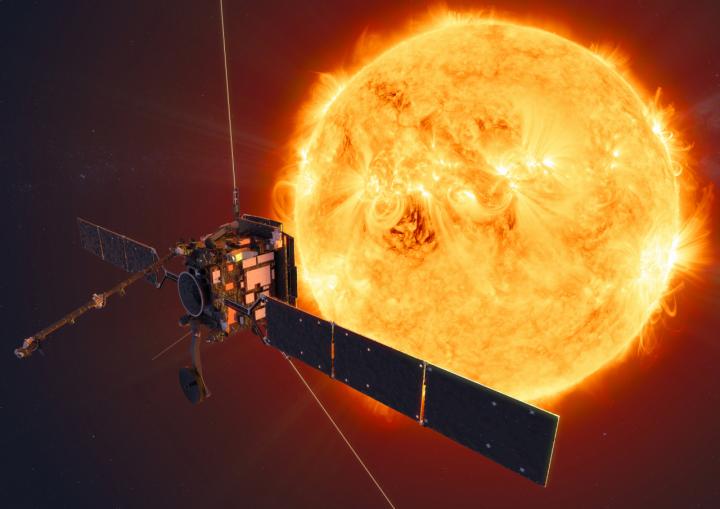
Credit: (Image Courtesy of ESA/ATG Medialab)


WASHINGTON — The Solar Orbiter mission will use a U.S. Naval Research Laboratory-designed and -built heliospheric camera, known as SoloHI, to provide unique perspectives and unprecedented views of the Sun’s North and South poles. The spacecraft, a NASA and European Space Agency collaboration, launched aboard an Atlas V rocket at Cape Canaveral, Florida, Feb. 9.

A number of other solar missions are currently studying the Sun’s impact on Earth. Those spacecraft, however, travel in the same plane Earth orbits the Sun while the Solar Orbiter circles at an angle off this ecliptic plane to provide views of each pole.

“The magnetic field at the Sun’s poles are controlling the overall magnetic structure of the interplanetary magnetic field. We’re just embedded in the Sun’s magnetic field,” said NRL astrophysicist Robin Colaninno. “When solar storms occur, that’s the Earth’s magnetic field interacting with the Sun’s magnetic field. That’s what generates aurora borealis and similar events that have a great deal of effect here on Earth.”

An aurora is a light show caused by collisions between electrically charged particles released from the Sun that enter the Earth’s atmosphere and collide with gases such as oxygen and nitrogen. The Northern and Southern Hemispheres light up around the magnetic poles.

Researchers can use SoloHI and the other nine instruments on Solar Orbiter to examine phenomena on the Sun like never before since the spacecraft looks down at the Sun, instead of viewing it from the side.

“We see an event at one point in the solar atmosphere. The question has always been, ‘does that instability occur in isolation or does it impact other regions as well,'” said SoloHI principal investigator Russ Howard. “Now, we will have a view of this whole region. If something goes off in one area, we’ll be able to see it propagating through the atmosphere.”

Solar Orbiter seeks to resolve the physics of the stream of charged particles from the Sun. SoloHI will image the variable solar wind as it leaves the Sun, and as it hits the spacecraft and heads to Earth.

“We know that the interplanetary medium is filled with charged dust, but all the space weather models ignore this dust,” said Howard. “Solar Orbiter is putting the focus back on the processes that are involved in transporting material from the Sun to Earth.”

For the next seven years, scientists will look to Solar Orbiter to supplement results from other missions for a comprehensive look at this huge volume of space. Refined forecasts of solar storms, and other Sun-related disturbances, will improve satellite communications and spacecraft operations in the solar system.

###

About the U.S. Naval Research Laboratory

NRL is a scientific and engineering command dedicated to research that drives innovative advances for the Navy and Marine Corps from the seafloor to space and in the information domain. NRL headquarters is located in Washington, D.C., with major field sites in Stennis Space Center, Mississippi, Key West, Florida, and Monterey, California, and employs approximately 2,500 civilian scientists, engineers and support personnel.

Media Contact
Maria Estacion
[email protected]
202-404-3751

Original Source

https://www.nrl.navy.mil/news/releases/nrl-built-camera-provides-view-sun%E2%80%99s-polar-regions

Tags: AstrophysicsExperiments in SpacePlanets/MoonsSatellite Missions/ShuttlesSpace/Planetary ScienceStars/The Sun
Share12Tweet8Share2ShareShareShare2

Related Posts

Miniature Sensor Uses Light to Detect Touch — Chemistry

Miniature Sensor Uses Light to Detect Touch

May 8, 2026
Iron Minerals Determine Whether Dissolved Organic Matter Fuels Microbes or Becomes Long-Term Carbon Storage — Chemistry

Iron Minerals Determine Whether Dissolved Organic Matter Fuels Microbes or Becomes Long-Term Carbon Storage

May 8, 2026

Kate Evans Appointed Associate Lab Director for Biological and Environmental Systems Science at ORNL

May 8, 2026

Advancing Multiscale Modeling and Overcoming Operational Challenges in Autothermal COâ‚‚-to-Methanol Reactors

May 8, 2026
Please login to join discussion

POPULAR NEWS

  • Research Indicates Potential Connection Between Prenatal Medication Exposure and Elevated Autism Risk

    840 shares
    Share 336 Tweet 210
  • New Study Reveals Plants Can Detect the Sound of Rain

    727 shares
    Share 290 Tweet 181
  • Scientists Investigate Possible Connection Between COVID-19 and Increased Lung Cancer Risk

    68 shares
    Share 27 Tweet 17
  • Salmonella Haem Blocks Macrophages, Boosts Infection

    61 shares
    Share 24 Tweet 15

About

We bring you the latest biotechnology news from best research centers and universities around the world. Check our website.

Follow us

Recent News

Evaluating Digoxin Use in Patients with Symptomatic Rheumatic Heart Disease

Evaluating the Effectiveness and Safety of Digitalis Glycosides in Treating Heart Failure

Urdu Fall Risk Questionnaire Adapted for Elderly

Subscribe to Blog via Email

Success! An email was just sent to confirm your subscription. Please find the email now and click 'Confirm' to start subscribing.

Join 82 other subscribers
  • Contact Us

Bioengineer.org © Copyright 2023 All Rights Reserved.

Welcome Back!

Login to your account below

Forgotten Password?

Retrieve your password

Please enter your username or email address to reset your password.

Log In
No Result
View All Result
  • Homepages
    • Home Page 1
    • Home Page 2
  • News
  • National
  • Business
  • Health
  • Lifestyle
  • Science

Bioengineer.org © Copyright 2023 All Rights Reserved.