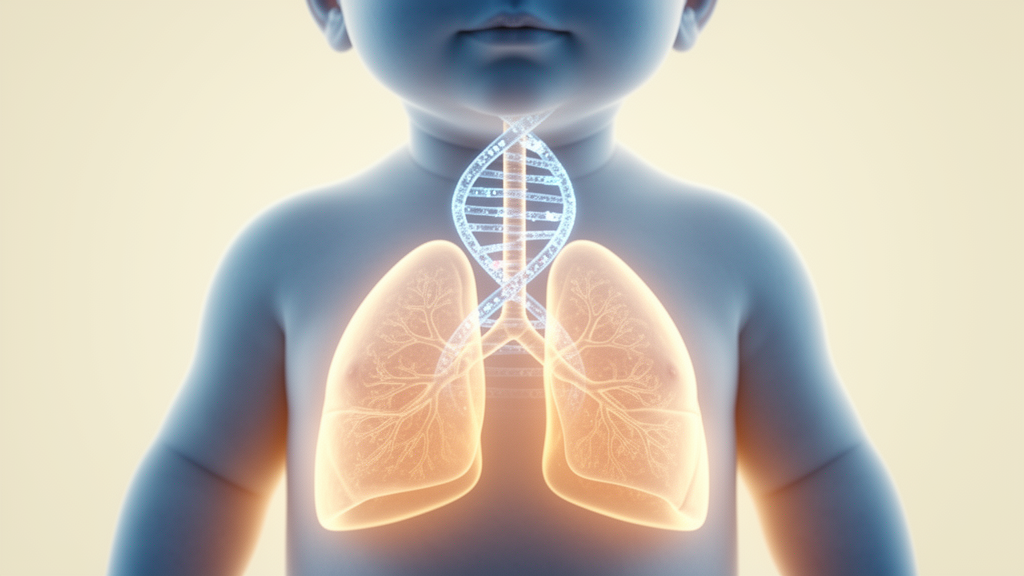
A novel genetic variant in a key lung-development gene has been linked to the deaths of two newborn siblings who both succumbed to overwhelming respiratory failure within hours of birth, according to a case report published in Frontiers in Pediatrics. The infants, born to the same mother in 2017 and 2019, carried an identical heterozygous variant in the TBX4 gene, which encodes a transcription factor critical to embryonic lung formation. Neither pregnancy showed warning signs on routine prenatal ultrasound, yet both babies developed severe hypoxemia and pulmonary hypertension that proved refractory to every available therapy. The first infant, a full-term girl, died at 11 hours of life; her late-preterm brother died at 9 hours despite maximal intensive care. Whole-exome sequencing performed on the second infant identified the missense variant c.741G>C, which changes the amino acid lysine at position 247 to asparagine (p.Lys247Asn) in exon 6 of the TBX4 gene. Genetic testing confirmed that the variant was inherited from the children’s father, who himself shows no signs of disease.
TBX4 belongs to the T-box family of transcription factors, a group of genes (TBX1 through TBX5) that are highly expressed during both early and later stages of embryogenesis. The TBX4 protein plays a central role in embryonic lung branching morphogenesis, distal airway formation, mesenchymal differentiation, and pulmonary vascular development. Pathogenic variants in this gene are associated with a remarkably broad phenotypic spectrum, ranging from childhood pulmonary arterial hypertension and a skeletal condition known as small patella syndrome to devastating neonatal developmental lung disease, including acinar dysplasia and congenital alveolar dysplasia. Both de novo and inherited TBX4 variants have been documented in the literature, and microdeletions involving chromosomal region 17q23.2, which contains TBX4 and other genes, have been reported in individuals with skeletal anomalies, pulmonary arterial hypertension, intellectual disability, congenital heart defects, and other features. Duplications of the same region have also been linked to clubfoot with or without additional anomalies.
The first case began in 2017, when a 29-year-old woman delivering her first child at 41 weeks’ gestation after induction for post-term pregnancy gave birth to an appropriate-for-gestational-age female infant weighing 3,030 grams. Maternal history was notable only for restless leg syndrome, managed with prenatal vitamins, ranitidine, and carbidopa-levodopa. There was no family history of neonatal respiratory failure, pulmonary hypoplasia, pulmonary hypertension, skeletal abnormalities, recurrent pregnancy loss, or congenital anomalies, and serial fetal ultrasonography had revealed no structural abnormalities. A fetal ultrasound performed two days before delivery showed a normal amniotic fluid index of 9.2 centimeters at the 25th percentile, and umbilical artery Doppler studies demonstrated preserved end-diastolic flow. The infant’s Apgar scores were 7, 1, 4, 6, and 6 at 1, 5, 10, 15, and 20 minutes. Although initially vigorous, she developed secondary apnea at approximately 4 minutes of life, requiring positive-pressure ventilation followed by continuous positive airway pressure.
Admitted to the neonatal intensive care unit with persistent hypoxemia, the baby maintained oxygen saturations in the mid-60 percent range despite maximal support. Her initial arterial blood gas revealed severe mixed respiratory and metabolic acidosis, with a pH of 6.84, a PaCO2 of 97 mmHg, a PaO2 of 35 mmHg, a bicarbonate of 16.9 mmol/L, and a base excess of −23.1 mmol/L. Combined with moderate-to-severe encephalopathy on modified Sarnat examination, these findings raised concern for hypoxic-ischemic encephalopathy, prompting whole-body therapeutic hypothermia. Chest radiography demonstrated markedly reduced lung volumes with diffuse bilateral opacities, prominent air bronchograms, and a small right subpulmonic pneumothorax. She was intubated, given exogenous surfactant, and placed on high-frequency oscillatory ventilation. Echocardiography showed structurally normal cardiac anatomy with severely depressed biventricular systolic function; right-to-left shunting across fetal circulatory pathways alongside profound refractory hypoxemia raised strong suspicion for persistent pulmonary hypertension of the newborn. Inhaled nitric oxide brought no significant improvement, and the course was complicated by bilateral pneumothorax and pneumomediastinum requiring needle decompression and chest tubes. After she developed disseminated intravascular coagulation and cardiopulmonary arrest, life-sustaining treatment was withdrawn and she died at 11 hours of life.
Two years later, in 2019, the same mother delivered a late-preterm male infant at 36 weeks’ gestation, weighing 2,930 grams via spontaneous vaginal delivery. Again, prenatal screening and serial ultrasounds showed no structural abnormalities; an ultrasound about one month before delivery recorded a normal amniotic fluid index of 17 centimeters at the 62nd percentile, a biophysical profile score of 8/8, and a thoracic-to-abdominal circumference ratio of 0.79, with no findings suggestive of pulmonary hypoplasia. The infant’s Apgar scores were 7, 2, and 4 at 1, 5, and 10 minutes. He developed secondary apnea requiring positive-pressure ventilation, and because of an inadequate response, advanced resuscitation was initiated with endotracheal intubation, chest compressions, and epinephrine. He arrived in the neonatal intensive care unit at 18 minutes of life with oxygen saturations in the 60 percent range despite mechanical ventilation with 100 percent oxygen. His initial blood gas showed a pH of 6.87, PaCO2 of 119 mmHg, PaO2 of 23 mmHg, bicarbonate of 20.6 mmol/L, and base excess of −19.5 mmol/L, and therapeutic hypothermia was again initiated for suspected hypoxic-ischemic encephalopathy.
The boy’s hospital course mirrored his sister’s with grim fidelity. Chest radiography showed markedly low lung volumes and diffuse poor aeration. He was transitioned to high-frequency oscillatory ventilation, given surfactant, and required escalating support for refractory hypoxemic and hypercapnic respiratory failure, later complicated by bilateral pneumothoraces requiring chest tubes. Echocardiography this time demonstrated suprasystemic pulmonary artery pressures, right-to-left shunting at the patent ductus arteriosus and patent foramen ovale, severe right ventricular pressure overload, and significant biventricular systolic dysfunction—findings consistent with severe pulmonary vascular disease and persistent pulmonary hypertension of the newborn. Despite inhaled nitric oxide, inotropic support, and vasoactive medications, serial echocardiograms showed progressive ventricular deterioration. After extensive discussions about prognosis, the family elected comfort-focused care, and the infant died at 9 hours of life.
Complete autopsies were performed in both cases and provided the pathological anchor for the diagnosis. Gross examination showed markedly reduced lung size and weight with firm, poorly expanded parenchyma: combined lung weights were 30 grams in the first infant against an expected 59.6 grams, and 25 grams in her brother against an expected 54.1 grams, yielding significantly reduced lung-to-body-weight ratios consistent with severe bilateral pulmonary hypoplasia. Histopathology revealed severe disruption of distal lung development, with markedly reduced alveolarization, simplified airspaces, diminished radial alveolar counts, immature distal airspaces, and poor acinar development. The lungs were composed predominantly of bronchiolar structures with only rare respiratory bronchioles, alveolar ducts, and primitive alveolar saccules—a pattern closely resembling acinar dysplasia. Importantly, the pulmonary arteries were patent without thrombi or significant vascular remodeling, there was no evidence of alveolar capillary dysplasia or misalignment of pulmonary veins, and no autopsy evidence of skeletal dysplasia, neuromuscular disease, prolonged anhydramnios, or other recognized causes of secondary pulmonary hypoplasia was identified.
The genetic workup proceeded in stages. Chromosomal microarray analysis in the first case found no clinically significant copy number abnormalities; in the second, it detected a duplication of chromosome 3p26.3–p26.2 encompassing the CNTN4 gene, but this was classified as a variant of uncertain significance and judged insufficient to explain the pulmonary phenotype. Whole-exome sequencing in the second infant then identified the novel heterozygous missense TBX4 variant, c.741G>C (p.Lys247Asn), classified as likely pathogenic. Parental segregation analysis confirmed paternal inheritance, consistent with autosomal dominant transmission. The substituted residue sits within the highly conserved T-box DNA-binding domain, the region responsible for sequence-specific DNA binding and transcriptional regulation of downstream target genes, and in silico prediction supports a deleterious effect of the substitution. In a multicenter study of 137 individuals with monoallelic TBX4 variants, Prapa and colleagues found that variants involving the T-box and nuclear localization domains were associated with earlier presentation and increased incidence of interstitial lung disease and pulmonary arterial hypertension, with T-box variants also linked to shorter event-free survival, although that association was influenced by age at diagnosis. The authors note that functional studies of this specific variant were not performed, so its classification rests on the totality of genetic, clinical, and pathological evidence.
The unaffected father is perhaps the most consequential element of the report. TBX4-associated disorders are characterized by marked phenotypic heterogeneity, variable expressivity, and incomplete penetrance; previous publications have described asymptomatic carriers, isolated pulmonary hypertension, small patella syndrome, and lethal neonatal lung disease within the same family. The authors speculate that modifiers or second-hit variants, dosage- and tissue-dependent effects on residual TBX4 function, and epigenetic or environmental factors may modulate disease expression, while explicitly cautioning that these mechanisms remain speculative because additional modifier variants were not assessed. Notably, both infants had anatomically normal lower extremities at birth, and pelvic abnormalities cannot be determined until ossification is complete, leaving the skeletal dimension of the syndrome unresolved in these children.
The family subsequently pursued in vitro fertilization with preimplantation genetic testing for monogenic disease. Ten embryos were analyzed: seven carried the familial TBX4 variant, two had additional chromosomal abnormalities involving chromosomes 3 and 7 that made them unsuitable for transfer, and one required repeat testing because of an inconclusive result. Consequently, no embryos were selected for implantation. The report situates these cases within a broader literature: in a review of congenital primary pulmonary hypoplasia cases from 1977 to 2017, mortality was high and only 3 of 30 infants survived to neonatal intensive care unit discharge, with primary pulmonary hypoplasia estimated to occur in 9 to 11 per 10,000 live births and mortality approaching 71 to 95 percent in severe cases. The authors argue that these cases expand the spectrum of TBX4-associated developmental lung disease and support consideration of TBX4 testing in neonates with unexplained respiratory failure and pulmonary hypertension, since standard fetal ultrasonography may appear normal until late gestation, and genetic counseling should include discussion of chorionic villus sampling, amniocentesis, and preimplantation testing when available.
Subject of Research: A familial TBX4 gene variant associated with lethal neonatal developmental lung disease in two siblings
Article Title: Case Report: Familial TBX4-related developmental lung disease: two siblings with fatal neonatal respiratory failure
Article References: Thiruvenkataramani, R. P., Mohamed, T., Pugmire, M. V., & Omar, S. A. (2026). Case Report: Familial TBX4-related developmental lung disease: two siblings with fatal neonatal respiratory failure. Frontiers in Pediatrics, 14, Article 1816836. https://doi.org/10.3389/fped.2026.1816836
Image Credits: AI Generated
DOI: 10.3389/fped.2026.1816836
Keywords: TBX4, developmental lung disease, neonatal respiratory failure, pulmonary hypertension, pulmonary hypoplasia, acinar dysplasia, whole-exome sequencing, preimplantation genetic testing, incomplete penetrance, genetic counseling, case report, transcription factor
News Source: Harold Sullivan. (October 28, 2026). Novel TBX4 Variant Linked to Fatal Neonatal Lung Failure in Two Siblings. Scienmag.