Credit: Osaka University
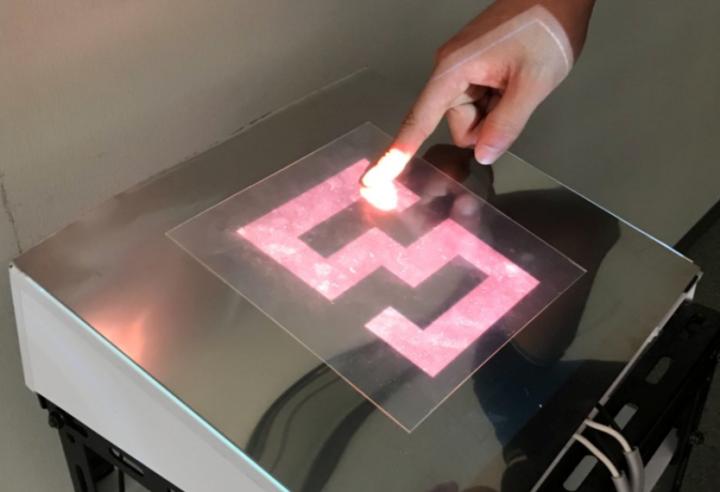
A group of researchers at Osaka University developed a novel two-dimensional (2D) graphical tactile display to which one-dimensional (1D) adhesive information could be added by controlling adhesion of designated portions of the display surface. (Fig.1)
Their research results were presented at SIGGRAPH ASIA 2019 Emerging Technologies, which was held in Australia from November 18 through November 20, 2019. The research team received the BEST DEMO VOTED BY COMMITTEE AWARD.
With conventional techniques, it was impossible to perform dynamic and interactive control by changing the shape or friction coefficient of an area on the surface of an electronic device, such as a paper-like screen, in order to enhance its operability. Thus, researchers have made efforts to present further information by using visual presentation that can also deliver other sensory (tactile) content.
In the entertainment industry, such as in video games, displays that give players a sense of temperature or shock have been proposed so that they can feel as if they were actually in the scene of a game. In particular, many haptic displays and element technologies that give players tactile feedback have been devised.
This group of researchers developed a display in which the sense of touch, i.e. a 1D “sticky” sensation, can be added to a 2D vision display. On their display is mounted a temperature sensitive adhesive sheet, a special polymer sheet whose adhesion (friction) can be changed by controlling the temperature of the display surface with a computer.
In order to present changes in adhesion in a range that does not bring a sense of discomfort to a user, the researchers used an adhesive sheet with a boundary temperature of 40°C. The sheet rapidly becomes sticky through heating to a temperature above 40°C, showing the largest adhesion of 2.6 [N/25mm] in the temperature range of 30°C ~ 48°C.
With this display, users can take in both visual and tactile information, something difficult to achieve through ordinary 2D displays. For example, one can feel a folder and learn its capacity by touching it while navigating the folder hierarchy, which can be preset to vary adhesion by folder capacity. It is also possible to impede the operability of a device to prevent users from carelessly swiping through content so that they can focus on sections containing important information, which are set to increased adhesion levels.
In addition, it is also possible to apply this technology to touchscreens for people with visual impairments and allow users who are looking at an image of a sticky object on the screen to feel the displayed object’s stickiness as if they were actually touching the object in the image.
Associate Professor Itoh says, “This graphical tactile system allows users to get ‘touch and feel’ information that would be difficult to perceive on a visual display. We will consider applications to entertainment and digital signage to pursue its commercial viability.”
###
About Osaka University
Osaka University was founded in 1931 as one of the seven imperial universities of Japan and now has expanded to one of Japan’s leading comprehensive universities. The University has now embarked on open research revolution from a position as Japan’s most innovative university and among the most innovative institutions in the world according to Reuters 2015 Top 100 Innovative Universities and the Nature Index Innovation 2017. The university’s ability to innovate from the stage of fundamental research through the creation of useful technology with economic impact stems from its broad disciplinary spectrum.
Website: https:/
Media Contact
Saori Obayashi
[email protected]
81-661-055-886
Original Source
https:/
Related Journal Article
http://dx.