• HOME
  • NEWS
  • EXPLORE
    • CAREER
      • Companies
      • Jobs
    • EVENTS
    • iGEM
      • News
      • Team
    • PHOTOS
    • VIDEO
    • WIKI
  • BLOG
  • COMMUNITY
    • FACEBOOK
    • INSTAGRAM
    • TWITTER
Tuesday, September 1, 2026
BIOENGINEER.ORG
No Result
View All Result
  • Login
  • HOME
  • NEWS
  • EXPLORE
    • CAREER
      • Companies
      • Jobs
        • Lecturer
        • PhD Studentship
        • Postdoc
        • Research Assistant
    • EVENTS
    • iGEM
      • News
      • Team
    • PHOTOS
    • VIDEO
    • WIKI
  • BLOG
  • COMMUNITY
    • FACEBOOK
    • INSTAGRAM
    • TWITTER
  • HOME
  • NEWS
  • EXPLORE
    • CAREER
      • Companies
      • Jobs
        • Lecturer
        • PhD Studentship
        • Postdoc
        • Research Assistant
    • EVENTS
    • iGEM
      • News
      • Team
    • PHOTOS
    • VIDEO
    • WIKI
  • BLOG
  • COMMUNITY
    • FACEBOOK
    • INSTAGRAM
    • TWITTER
No Result
View All Result
Bioengineer.org
No Result
View All Result
Home NEWS Science News

Novel silicon etching technique crafts 3-D gradient refractive index micro-optics

Bioengineer by Bioengineer
November 28, 2016
in Science News
Reading Time: 3 mins read
0
Share on FacebookShare on TwitterShare on LinkedinShare on RedditShare on Telegram
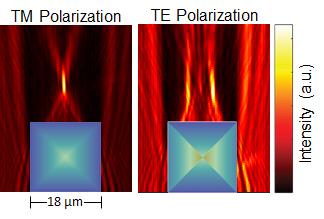
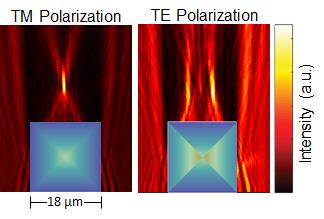
IMAGE

Credit: University of Illinois

A multi-institutional research collaboration has created a novel approach for fabricating three-dimensional micro-optics through the shape-defined formation of porous silicon (PSi), with broad impacts in integrated optoelectronics, imaging, and photovoltaics.

Working with colleagues at Stanford and The Dow Chemical Company, researchers at the University of Illinois at Urbana-Champaign fabricated 3-D birefringent gradient refractive index (GRIN) micro-optics by electrochemically etching preformed Si micro-structures, like square columns, PSi structures with defined refractive index profiles.

"The emergence and growth of transformation optics over the past decade has revitalized interest in using GRIN optics to control light propagation," explained Paul Braun, the Ivan Racheff Professor of Materials Science and Engineering at Illinois. "In this work, we have figured out how to couple the starting shape of the silicon micro-structure and the etch conditions to realize a unique set of desirable optical qualities. For example, these elements exhibit novel polarization-dependent optical functions, including splitting and focusing, expanding the use of porous silicon for a wide range of integrated photonics applications.

"The key is that the optical properties are a function of the etch current," Braun said. "If you change the etch current, you change the refractive index. We also think that the fact that we can create the structures in silicon is important, as silicon is important for photovoltaic, imaging, and integrated optics applications.

"Our demonstration using a three-dimensional, lithographically-defined silicon platform not only displayed the power of GRIN optics, but it also illustrated it in a promising form factor and material for integration within photonic integrated circuits," stated Neil Krueger, a former PhD student in Braun's research group and first author of the paper, "Porous Silicon Gradient Refractive Index Micro-Optics," appearing in Nano Letters.

"The real novelty of our work is that we are doing this in a three-dimensional optical element," added Krueger, who has recently joined Honeywell Aerospace as a Scientist in Advanced Technology. "This gives added control over the behavior of our structures given that light follows curvilinear optical paths in optically inhomogeneous media such as GRIN elements. The birefringent nature of these structures is an added bonus because coupled birefringent/GRIN effects provide an opportunity for a GRIN element to perform distinct, polarization-selective operations."

According to the researchers, PSi was initially studied due to its visible luminescence at room temperature, but more recently, as this and other reports have shown, has proven to be a versatile optical material, as its nanoscale porosity (and thus refractive index) can be modulated during its electrochemical fabrication.

"The beauty of this 3D fabrication process is that it is fast and scalable," commented Weijun Zhou at Dow. "Large scale, nanostructured GRIN components can be readily made to enable a variety of new industry applications such as advanced imaging, microscopy, and beam shaping."

"Because the etching process enables modulation of the refractive index, this approach makes it possible to decouple the optical performance and the physical shape of the optical element," Braun added. "Thus, for example, a lens can be formed without having to conform to the shape that we think of for a lens, opening up new opportunities in the design of integrated silicon optics."

###

Paul Braun is also the director of the Frederick Seitz Materials Research Laboratory at Illinois. In addition to Braun, Krueger, and Zhou, co-authors of the paper include Seung-Kyun Kang, Christian R. Ocier, Glennys Mensing, and John A. Rogers (University of Illinois), Aaron L. Holsteen and Mark L. Brongersma (Stanford University).

Media Contact

Paul Braun
[email protected]
217-244-7293
@EngineeringAtIL

http://engineering.illinois.edu/

############

Story Source: Materials provided by Scienmag

Share12Tweet8Share2ShareShareShare2

Related Posts

β-Sitosterol from Ipomoea carnea Jacq. As a promising anti-inflammatory agent: Evidence from in silico modeling and in vitro validation

β-Sitosterol from Ipomoea carnea Jacq. As a promising anti-inflammatory agent: Evidence from in silico modeling and in vitro validation

August 31, 2026
Design, fabrication and characterization of a wearable Fiber Bragg grating sensor for cardiorespiratory monitoring using finger plethysmography

Design, fabrication and characterization of a wearable Fiber Bragg grating sensor for cardiorespiratory monitoring using finger plethysmography

August 31, 2026

KAIST opens the era of industrial-scale microbial foods, proposing growth strategies for the next-generation protein market

August 31, 2026

Virologist awarded $2 million NIH grant to investigate how virus-infected cells live and die

August 31, 2026
Please login to join discussion

POPULAR NEWS

  • β-Sitosterol from Ipomoea carnea Jacq. As a promising anti-inflammatory agent: Evidence from in silico modeling and in vitro validation

    29 shares
    Share 12 Tweet 7
  • Design, fabrication and characterization of a wearable Fiber Bragg grating sensor for cardiorespiratory monitoring using finger plethysmography

    29 shares
    Share 12 Tweet 7
  • KAIST opens the era of industrial-scale microbial foods, proposing growth strategies for the next-generation protein market

    29 shares
    Share 12 Tweet 7
  • Virologist awarded $2 million NIH grant to investigate how virus-infected cells live and die

    29 shares
    Share 12 Tweet 7

About

We bring you the latest biotechnology news from best research centers and universities around the world. Check our website.

Follow us

Recent News

β-Sitosterol from Ipomoea carnea Jacq. As a promising anti-inflammatory agent: Evidence from in silico modeling and in vitro validation

Design, fabrication and characterization of a wearable Fiber Bragg grating sensor for cardiorespiratory monitoring using finger plethysmography

KAIST opens the era of industrial-scale microbial foods, proposing growth strategies for the next-generation protein market

Subscribe to Blog via Email

Success! An email was just sent to confirm your subscription. Please find the email now and click 'Confirm' to start subscribing.

Join 85 other subscribers
  • Contact Us

Bioengineer.org © Copyright 2023 All Rights Reserved.

Welcome Back!

Login to your account below

Forgotten Password?

Retrieve your password

Please enter your username or email address to reset your password.

Log In
No Result
View All Result
  • Homepages
    • Home Page 1
    • Home Page 2
  • News
  • National
  • Business
  • Health
  • Lifestyle
  • Science

Bioengineer.org © Copyright 2023 All Rights Reserved.