• HOME
  • NEWS
  • EXPLORE
    • CAREER
      • Companies
      • Jobs
    • EVENTS
    • iGEM
      • News
      • Team
    • PHOTOS
    • VIDEO
    • WIKI
  • BLOG
  • COMMUNITY
    • FACEBOOK
    • INSTAGRAM
    • TWITTER
Tuesday, June 30, 2026
BIOENGINEER.ORG
No Result
View All Result
  • Login
  • HOME
  • NEWS
  • EXPLORE
    • CAREER
      • Companies
      • Jobs
        • Lecturer
        • PhD Studentship
        • Postdoc
        • Research Assistant
    • EVENTS
    • iGEM
      • News
      • Team
    • PHOTOS
    • VIDEO
    • WIKI
  • BLOG
  • COMMUNITY
    • FACEBOOK
    • INSTAGRAM
    • TWITTER
  • HOME
  • NEWS
  • EXPLORE
    • CAREER
      • Companies
      • Jobs
        • Lecturer
        • PhD Studentship
        • Postdoc
        • Research Assistant
    • EVENTS
    • iGEM
      • News
      • Team
    • PHOTOS
    • VIDEO
    • WIKI
  • BLOG
  • COMMUNITY
    • FACEBOOK
    • INSTAGRAM
    • TWITTER
No Result
View All Result
Bioengineer.org
No Result
View All Result
Home NEWS Science News Chemistry

Novel photocatalytic method converts biopolyols and sugars into methanol and syngas

Bioengineer by Bioengineer
February 27, 2020
in Chemistry
Reading Time: 2 mins read
0
IMAGE
Share on FacebookShare on TwitterShare on LinkedinShare on RedditShare on Telegram

IMAGE

Credit: WANG Min

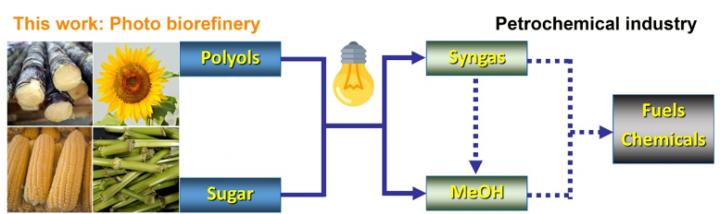
A research group led by Prof. WANG Feng from the Dalian Institute of Chemical Physics (DICP) of the Chinese Academy of Sciences recently developed a photocatalytic method for the conversion of biopolyols and sugars to methanol and syngas. The results were published in Nature Catalysis.

Methanol is considered to be the most promising clean liquid fuel for the future and one that can be deployed on a large scale. In addition, it’s a fundamental chemical material used for industrial production of ethylene and propylene. Currently, methanol is industrially produced from natural gas and coal. 

Production of methanol from renewable and abundant carbon resources rather than fossils is a promising route. The bio-derived syngas to fabricate biomethanol is traditionally produced via gasification at high temperature (700-1000 oC). The process usually generates a mixture of CO, CO2, hydrocarbons and deficient H2 as well as coke, char and tar. 

In the current study, the researchers converted biomass-derived polyols and sugars into methanol and syngas (CO+H2) via UV light irradiation at room temperature. The bio-syngas could be further used for the synthesis of methanol.

Cellulose and even raw wood sawdust can be converted into methanol or syngas after hydrogenolysis or hydrolysis pretreatment.

The researchers also found that Cu dispersed on titanium oxide nanorods (TNR) rich in defects effectively promoted selective C-C bond cleavage that produced methanol. Using this process, methanol was obtained from glycerol with co-production of H2. A syngas with CO selectivity up to 90% in the gas phase was obtained by controlling the energy band structure of Cu/TNR. The gas product could be facially tuned from CO2 to CO by controlling the energy band structure of Cu/TNR.

###

This work is supported by the National Natural Science Foundation of China, the Strategic Priority Research Program of the Chinese Academy of Sciences and the Fundamental Research Funds for the Central Universities.

Media Contact
CHEN Si
[email protected]

Related Journal Article

http://dx.doi.org/10.1038/s41467-020-14915-8

Tags: Chemistry/Physics/Materials SciencesEnergy/Fuel (non-petroleum)
Share12Tweet8Share2ShareShareShare2

Related Posts

AI and Physics Collaborate to Design Advanced Hydrogen Storage Materials

June 25, 2026

International Team Including Dresden Scientists Develops Novel Designer Proteins for Advanced Study of Living Tissue

June 25, 2026

New Study Uncovers Key Factors Driving Water Chemistry in Nanoscale Environments

June 25, 2026

Plasma Technology Extends Catalyst Lifespan in Hydrogen Production

June 24, 2026
Please login to join discussion

POPULAR NEWS

  • Saying Goodbye to PGY-6: Pediatric Fellowship Realities

    103 shares
    Share 41 Tweet 26
  • Multi-Hospital Study Reveals Long Covid Burden Is Twice as High as Current Estimates

    92 shares
    Share 36 Tweet 23
  • Detection of EDCs in Breast Milk and Infant Urine Up to Six Months Highlights Early Exposure Risks

    77 shares
    Share 31 Tweet 19
  • New Drug Candidate Developed at McMaster Shows Potential for Treating Brain Cancer

    58 shares
    Share 23 Tweet 15

About

We bring you the latest biotechnology news from best research centers and universities around the world. Check our website.

Follow us

Recent News

Tracking Lanthanide-Labeled Microplastics in Plants

POSTECH Researchers Slash Cost of Reconstituted Cell-Free Systems by 95%

AI and Physics Collaborate to Design Advanced Hydrogen Storage Materials

Subscribe to Blog via Email

Success! An email was just sent to confirm your subscription. Please find the email now and click 'Confirm' to start subscribing.

Join 82 other subscribers
  • Contact Us

Bioengineer.org © Copyright 2023 All Rights Reserved.

Welcome Back!

Login to your account below

Forgotten Password?

Retrieve your password

Please enter your username or email address to reset your password.

Log In
No Result
View All Result
  • Homepages
    • Home Page 1
    • Home Page 2
  • News
  • National
  • Business
  • Health
  • Lifestyle
  • Science

Bioengineer.org © Copyright 2023 All Rights Reserved.