• HOME
  • NEWS
  • EXPLORE
    • CAREER
      • Companies
      • Jobs
    • EVENTS
    • iGEM
      • News
      • Team
    • PHOTOS
    • VIDEO
    • WIKI
  • BLOG
  • COMMUNITY
    • FACEBOOK
    • INSTAGRAM
    • TWITTER
Monday, May 4, 2026
BIOENGINEER.ORG
No Result
View All Result
  • Login
  • HOME
  • NEWS
  • EXPLORE
    • CAREER
      • Companies
      • Jobs
        • Lecturer
        • PhD Studentship
        • Postdoc
        • Research Assistant
    • EVENTS
    • iGEM
      • News
      • Team
    • PHOTOS
    • VIDEO
    • WIKI
  • BLOG
  • COMMUNITY
    • FACEBOOK
    • INSTAGRAM
    • TWITTER
  • HOME
  • NEWS
  • EXPLORE
    • CAREER
      • Companies
      • Jobs
        • Lecturer
        • PhD Studentship
        • Postdoc
        • Research Assistant
    • EVENTS
    • iGEM
      • News
      • Team
    • PHOTOS
    • VIDEO
    • WIKI
  • BLOG
  • COMMUNITY
    • FACEBOOK
    • INSTAGRAM
    • TWITTER
No Result
View All Result
Bioengineer.org
No Result
View All Result
Home NEWS Science News Chemistry

Novel mix-charged nanofiltration membrane developed for wastewater treatment

Bioengineer by Bioengineer
November 30, 2022
in Chemistry
Reading Time: 3 mins read
0
Improving the separation selectivity of small organics/Na2SO4 of a polyamide nanofiltration membrane by deepening positive charge distribution and narrowing pore size via an “etching-swelling-planting” strategy
Share on FacebookShare on TwitterShare on LinkedinShare on RedditShare on Telegram

A research group led by Prof. WAN Yinhua from the Institute of Process Engineering (IPE) of the Chinese Academy of Sciences has developed a novel “etching-swelling-planting” strategy following interfacial polymerization (IP) to prepare a mix-charged nanofiltration (NF) membrane for wastewater treatment.
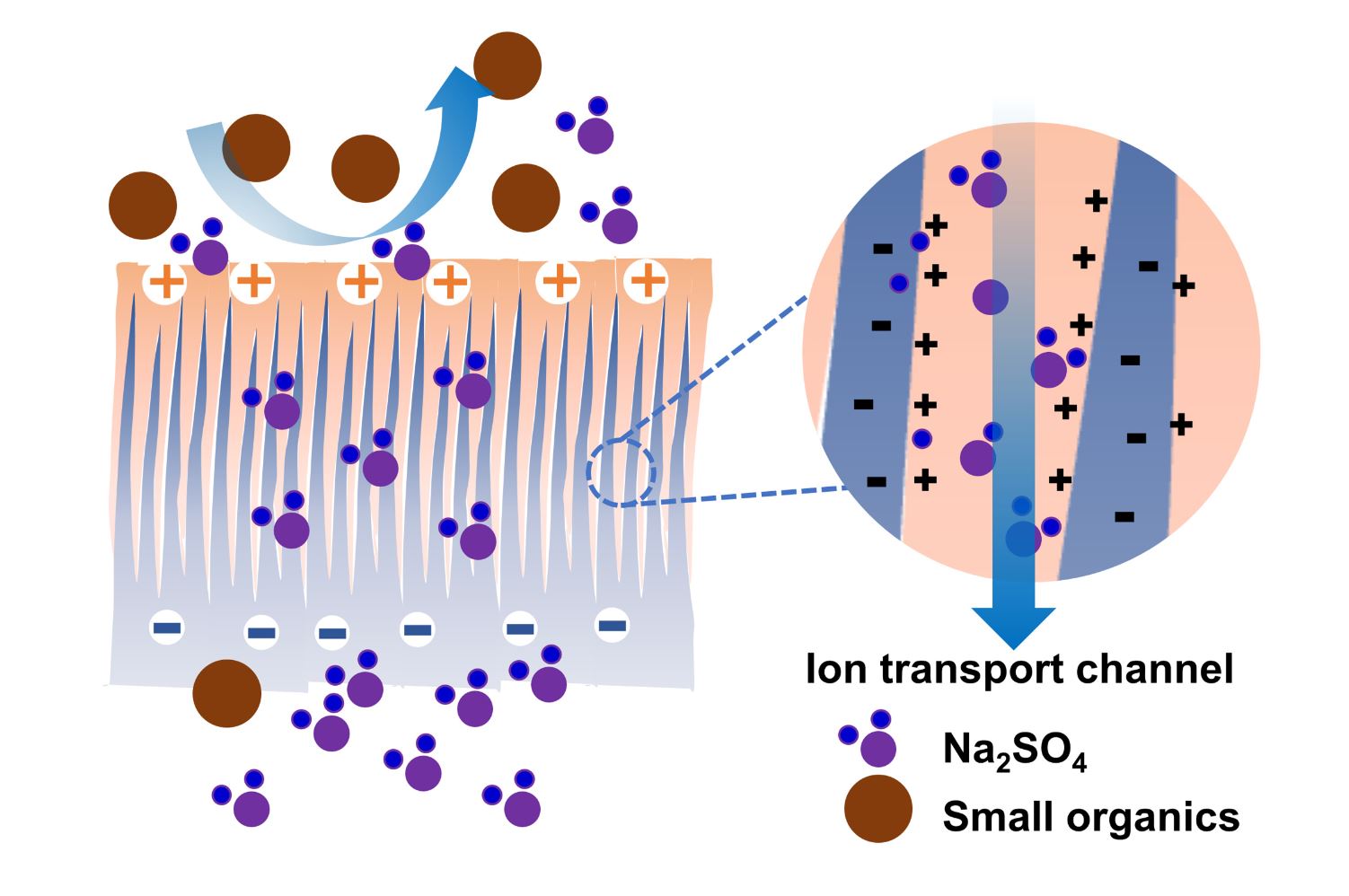
Improving the separation selectivity of small organics/Na2SO4 of a polyamide nanofiltration membrane by deepening positive charge distribution and narrowing pore size via an “etching-swelling-planting” strategy

Credit: REN Yuling

A research group led by Prof. WAN Yinhua from the Institute of Process Engineering (IPE) of the Chinese Academy of Sciences has developed a novel “etching-swelling-planting” strategy following interfacial polymerization (IP) to prepare a mix-charged nanofiltration (NF) membrane for wastewater treatment.

This type of membrane shows high permeation for inorganic salts while maintaining high retention for small organics, which is beneficial to realizing “zero discharge” in high-salinity organic wastewater reclamation.

The study was published in Environmental Science & Technology on Nov. 29.

Commercially available NF membranes are commonly negatively charged, showing high retention for divalent anions (e.g., SO42-). Due to suboptimal spatial charge distribution, current positively charged NF membranes still have a high retention for Na2SO4 and are more prone to be fouled by negatively charged organics in wastewater.

The researchers attempted to deepen the positive charge distribution and narrow the pore size of polyamide NF membranes via an “etching-swelling-planting” strategy to improve the separation selectivity of small organics/Na2SO4.

The pristine polyester (PE)-polyamide (PA) NF membranes were first prepared by the IP process using piperazine and tannic acid as aqueous monomers, and trimesoyl chloride and Fe(acac)3 in n-hexane as organic monomers. The PE structure was then etched and hydrolyzed into carboxyl groups and reactive phenolic hydroxyl groups in polyethyleneimine (PEI) alkaline solution, while simultaneously the PEI molecules diffused and were implanted into the swollen polymer network and covalently linked with tannic acid within the separation layer. Consequently, a unique mix-charged membrane with narrow pore size was formed by deeply inserting polyamine polymers into the negatively charged PA layer.

This finely regulated membrane structure reduces the retention of Na2SO4 (from 97% to 43%) and at the same time increases the retention of glucose (from 45% to 71%). Due to its high surface hydrophilicity and smoothness as well as the preservation of abundant negatively charged groups (i.e., -OH and -COOH) inside the PA layer, the resulting membrane exhibited excellent antifouling performance, even for coking wastewater.

“Based on mussel-inspired catecholamine chemistry, we developed a new scalable strategy for modification of PA NF membranes,” said Prof. LUO Jianquan from IPE, corresponding author of the study. “Our work also emphasizes the importance of charge distribution in precise separation of charged solutes.”


Journal

Environmental Science & Technology

DOI

10.1021/acs.est.2c06582

Article Title

Planting anion channels in a negatively charged polyamide layer for highly selective nanofiltration separation

Article Publication Date

29-Nov-2022
Share12Tweet8Share2ShareShareShare2

Related Posts

Using Epigenetics to Monitor Environmental Arsenic Exposure — Chemistry

Using Epigenetics to Monitor Environmental Arsenic Exposure

May 1, 2026
Innovative Nanoreactor Design Enhances Catalysis by Optimizing Transport and Reaction Kinetics — Chemistry

Innovative Nanoreactor Design Enhances Catalysis by Optimizing Transport and Reaction Kinetics

May 1, 2026

Swift Creation of Conductive Organic Compounds via Mechanochemistry

May 1, 2026

Scientists Reveal Atomic Mechanism Behind Water-Induced Hydroxylation in CoOx Nanostructures

May 1, 2026

POPULAR NEWS

  • Research Indicates Potential Connection Between Prenatal Medication Exposure and Elevated Autism Risk

    834 shares
    Share 334 Tweet 209
  • New Study Reveals Plants Can Detect the Sound of Rain

    716 shares
    Share 286 Tweet 179
  • Scientists Investigate Possible Connection Between COVID-19 and Increased Lung Cancer Risk

    67 shares
    Share 27 Tweet 17
  • Salmonella Haem Blocks Macrophages, Boosts Infection

    61 shares
    Share 24 Tweet 15

About

We bring you the latest biotechnology news from best research centers and universities around the world. Check our website.

Follow us

Recent News

Aging Suit Boosts Empathy in Long-Term Care Staff

TDP43 Mislocalization Drives Disc Degeneration and Aging

CD44+ Monocytes Drive Inflammation in Preemie Lung Disease

Subscribe to Blog via Email

Enter your email address to subscribe to this blog and receive notifications of new posts by email.

Join 82 other subscribers
  • Contact Us

Bioengineer.org © Copyright 2023 All Rights Reserved.

Welcome Back!

Login to your account below

Forgotten Password?

Retrieve your password

Please enter your username or email address to reset your password.

Log In
No Result
View All Result
  • Homepages
    • Home Page 1
    • Home Page 2
  • News
  • National
  • Business
  • Health
  • Lifestyle
  • Science

Bioengineer.org © Copyright 2023 All Rights Reserved.