Researchers working in Benin have isolated and characterized three previously unknown bacteriophages capable of killing multidrug-resistant and hypervirulent strains of Klebsiella pneumoniae, one of the pathogens for which the World Health Organization has called for urgent research into new treatments. The phages, named Kp1Bj_HH11_M23, Kp2Bj_LN294_M23 and Kp10Bj_LN54_14, were recovered from hospital effluent, farmers’ stools and pig droppings collected around Lake Nokoué. In laboratory tests, each phage lysed more than 40 of 58 clinical K. pneumoniae strains, spanning 22 different capsular serotypes, and all three significantly disrupted established bacterial biofilms in vitro.
The study, published in Frontiers in Microbiology, is described by its authors as the first characterization of K. pneumoniae phages isolated in Benin, and it was designed to address a specific gap: although phage therapy research is concentrated in high-income countries, the authors argue that locally sourced phages are more likely to match the strains actually circulating in the region. The clinical backdrop is stark. K. pneumoniae infections are among the deadliest for infants, elderly people and immunocompromised patients, and the emergence of strains that combine hypervirulence with multidrug resistance has narrowed treatment options further, particularly in low- and middle-income countries.
In early 2024, the WHO reported the global emergence of K. pneumoniae ST23 strains carrying carbapenemase genes, which confer resistance to last-resort antibiotics. Data from Benin paint a similar picture: one secondary hospital in the north of the country recorded K. pneumoniae as accounting for 77.6 percent of bacteria isolated from bloodstream infections, all of them multidrug resistant, while 68.9 percent of K. pneumoniae isolates associated with urinary tract infections between 2010 and 2022 produced extended-spectrum beta-lactamases, with carbapenem-resistant isolates rising from 0.9 percent to 14.5 percent. Against this background, the research team, led by Alidehou Jerrold Agbankpe of the Institut Pasteur de Guinée and the Becky Mayer Centre for Phage Research at the University of Leicester, set out to find phages capable of attacking these local strains.
The isolation process began with 50 environmental and clinical samples: 20 hospital effluents, 15 stool samples from farmers and 15 pig droppings from farms on Lake Nokoué. Each sample was centrifuged, filtered and enriched in culture with clinical multidrug-resistant and hypervirulent K. pneumoniae hosts before being plated to detect plaques, the clear zones that form where phages have lysed bacteria. Success rates varied by source: 15 percent for hospital effluents, 13.33 percent for pig droppings and 6.66 percent for stools, yielding three phages in total. The study was approved by the National Health Research Ethics Committee of Benin, and the farmers whose samples were used provided written informed consent.
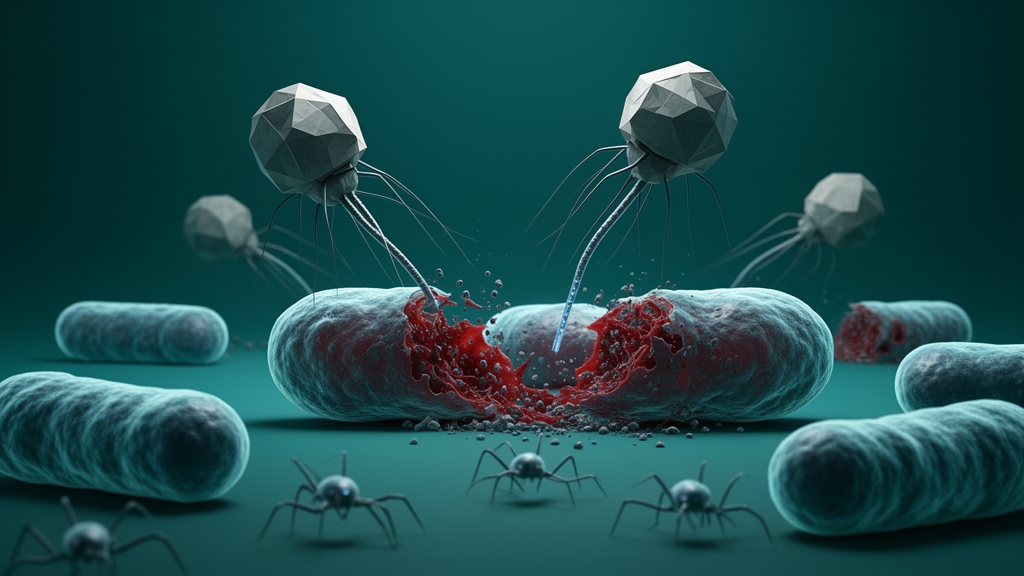
Transmission electron microscopy performed at the University of Leicester revealed that all three belong to the Myoviridae family, with icosahedral heads measuring roughly 87 to 93 nanometers in diameter and long contractile tails of about 126 nanometers, the classic morphology of tailed, double-stranded DNA phages of the order Caudovirales. Whole-genome sequencing on an Illumina NovaSeq 6000 confirmed that the phages are genuinely novel. Kp1Bj_HH11_M23 and Kp2Bj_LN294_M23 belong to the genus Marfavirus, while Kp10Bj_LN54_14 is a Jiaodavirus. The two Marfavirus isolates showed more than 99 percent average nucleotide identity to each other, while Kp10Bj_LN54_14 was clearly distinct.
Their genomes are approximately 170 kilobase pairs long with a GC content of about 40 percent, and each encodes several hundred predicted proteins, many of them of unknown function. Crucially for therapeutic prospects, bioinformatic screening found no genes encoding virulence factors or antimicrobial resistance, and no recombinases, integrases or repressors, supporting the conclusion that all three phages follow a strictly lytic life cycle rather than a temperate one. Host-range testing on a panel of 58 clinical strains, isolated from urine, blood, rectal swabs, sputum and endotracheal secretions, showed that Kp2Bj_LN294_M23 lysed 74.14 percent of the strains, Kp1Bj_HH11_M23 70.69 percent and Kp10Bj_LN54_14 68.97 percent, with titers ranging from 7 x 10^9 to 2 x 10^10 plaque-forming units per milliliter.
The strains attacked included capsular types KL114, KL53, KL8, KL62, KL64, KL124, KL102, KL57, KL39, KL48, KL17, KL20, KL2, KL30, KL51, KL105, KL146, KL28, KL122, KL38, KL3 and KL163. This breadth matters because the polysaccharide capsule of K. pneumoniae is highly diverse and serves as the receptor for many phages; a single phage often infects only one or a few of the many known capsular serotypes, which is a major obstacle to developing broad-spectrum phage cocktails. The authors suggest that the two Marfavirus isolates likely carry depolymerases active against several capsule types, since they showed high efficiency of plaquing on strains of types KL17, KL28, KL38, KL48, KL122 and KL124. By comparison, the authors note that some previously characterized Klebsiella phages infected far smaller fractions of the strains they were tested against, such as 22.95 percent for vB_Kpn_F48 and 3.03 percent for vB_KpnS_SCNJ1.
Growth experiments underlined how aggressive these phages are. Adsorption assays showed that Kp1Bj_HH11_M23 and Kp2Bj_LN294_M23 attached completely to their hosts within 30 minutes, while Kp10Bj_LN54_14 was not fully adsorbed even after 60 minutes. One-step growth curves revealed latency periods of 10 minutes for the two Marfavirus isolates and just 5 minutes for Kp10Bj_LN54_14, with burst sizes of 402, 2,208 and 119 plaque-forming units per infected cell respectively. The burst size of Kp2Bj_LN294_M23 exceeds those reported for several previously described Klebsiella phages, including vB_Kpn_ZC2 at 650 and IME183 at 135 plaque-forming units per cell. The optimal multiplicity of infection differed among the three phages, at 10, 0.1 and 0.001 respectively, reflecting their different replication kinetics; the authors note that phages achieving high titers at low multiplicities, such as Kp2Bj_LN294_M23 and Kp10Bj_LN54_14, could be cheaper to manufacture at scale.
The antibiofilm results are among the study’s most striking findings. Biofilms, communities of bacteria embedded in a self-produced matrix of extracellular polymeric substances, proteins and DNA, make K. pneumoniae infections persistent and shield the bacteria from antibiotics and immune defenses. In a multi-day in vitro assay combining crystal violet staining and viable counts, all three phages significantly reduced established biofilms as well as planktonic cells. Kp1Bj_HH11_M23 disrupted 98.46 percent of a 48-hour biofilm formed by a multidrug-resistant, hypervirulent ST48 strain of capsular type KL124, reducing counts from about 1.3 x 10^10 to 2 x 10^8 colony-forming units per milliliter, with a reported p-value of 0.0170. Kp10Bj_LN54_14 achieved 99.96 percent disruption of a 48-hour biofilm formed by a clinical strain, reducing counts from 7.7 x 10^10 to 2.7 x 10^7 colony-forming units per milliliter, and Kp2Bj_LN294_M23 disrupted 65.56 percent of a 24-hour biofilm with a p-value below 0.0001. The proposed mechanism is two-step: phage depolymerases first degrade the biofilm matrix and the protective capsule, then the phages gain direct access to the exposed cells and initiate their lytic cycle, with the final extent of disruption depending on each phage’s adsorption time, latency period and burst size.
Stability testing suggests the phages could withstand the conditions typically encountered during production, storage and delivery. All three retained activity across pH 3 to 11, with titers of 10^7 to 10^9 plaque-forming units per milliliter comparable to their initial titers, though they were inactivated at pH 1 and 2, and Kp10Bj_LN54_14 also lost activity at pH 12 to 14. Kp1Bj_HH11_M23 and Kp2Bj_LN294_M23 remained stable from 4 to 60 degrees Celsius, and Kp10Bj_LN54_14 from 4 to 50 degrees, with all three losing lytic activity above 70 degrees. The authors point out that this range covers the temperature and pH values typically involved in industrial phage processing and could allow the phages to survive in the intestine and adapt to the microenvironments of different infection sites.
The authors are careful about the limits of the work. All experiments were performed in vitro, and the study did not test combinations of the phages with antibiotics, the emergence of phage resistance, in vivo antibiofilm activity in animal models or in vivo safety, all questions the team says must be addressed before any preclinical or clinical development. They also observed that biofilms treated with Kp2Bj_LN294_M23 regrew after 48 hours, possibly because surviving bacteria increased extracellular matrix production under phage pressure or because partial destruction of the biofilm released substances that fueled new attachment, an observation that reinforces the case for phage cocktails rather than single-phage treatment. Even so, the combination of broad host range, rapid replication, large burst sizes, genomes free of resistance and virulence genes, and strong biofilm disruption leads the authors to propose that a cocktail of the three Beninese phages is a candidate for preclinical and clinical testing against infections caused by multidrug-resistant, hypervirulent and biofilm-forming K. pneumoniae, a pathogen for which new options are urgently needed, particularly in low- and middle-income countries where roughly 90 percent of worldwide deaths from antimicrobial resistance are projected to occur.
Subject of Research: Isolation and characterization of three novel lytic Klebsiella phages from Benin with antibiofilm activity against multidrug-resistant and hypervirulent Klebsiella pneumoniae
Article Title: Isolation and characterization of novel Klebsiella phages from Benin and their antibiofilm activities on multidrug resistant and hypervirulent Klebsiella pneumoniae strains
Article References: Agbankpe, A. J., Fabiyi, K., Hounmanou, Y. M. G., Nougbologni, G. R., Balarabe, R., Michniewski, S., Hougbenou, J. B.-G., Deguenon, E., Dougnon, V., Bankolé, H., Baba-Moussa, L., Nazir, R., & Clokie, M. R. J. (2026). Isolation and characterization of novel Klebsiella phages from Benin and their antibiofilm activities on multidrug resistant and hypervirulent Klebsiella pneumoniae strains. Frontiers in Microbiology, 17, Article 1948708. https://doi.org/10.3389/fmicb.2026.1948708
Image Credits: AI Generated
DOI: 10.3389/fmicb.2026.1948708
Keywords: bacteriophages, Klebsiella pneumoniae, antimicrobial resistance, phage therapy, biofilms, Benin, Myoviridae, hypervirulent strains, whole-genome sequencing, hospital effluent, capsular serotypes, in vitro
News Source: Kristina Jarvis. (October 26, 2026). Novel Benin phages show broad lytic reach against drug-resistant Klebsiella. Scienmag.