• HOME
  • NEWS
  • EXPLORE
    • CAREER
      • Companies
      • Jobs
    • EVENTS
    • iGEM
      • News
      • Team
    • PHOTOS
    • VIDEO
    • WIKI
  • BLOG
  • COMMUNITY
    • FACEBOOK
    • INSTAGRAM
    • TWITTER
Saturday, February 7, 2026
BIOENGINEER.ORG
No Result
View All Result
  • Login
  • HOME
  • NEWS
  • EXPLORE
    • CAREER
      • Companies
      • Jobs
        • Lecturer
        • PhD Studentship
        • Postdoc
        • Research Assistant
    • EVENTS
    • iGEM
      • News
      • Team
    • PHOTOS
    • VIDEO
    • WIKI
  • BLOG
  • COMMUNITY
    • FACEBOOK
    • INSTAGRAM
    • TWITTER
  • HOME
  • NEWS
  • EXPLORE
    • CAREER
      • Companies
      • Jobs
        • Lecturer
        • PhD Studentship
        • Postdoc
        • Research Assistant
    • EVENTS
    • iGEM
      • News
      • Team
    • PHOTOS
    • VIDEO
    • WIKI
  • BLOG
  • COMMUNITY
    • FACEBOOK
    • INSTAGRAM
    • TWITTER
No Result
View All Result
Bioengineer.org
No Result
View All Result
Home NEWS Science News Biology

Novel bacterial acid tolerance system sheds light on development of antimicrobials

Bioengineer by Bioengineer
March 20, 2020
in Biology
Reading Time: 2 mins read
0
IMAGE
Share on FacebookShare on TwitterShare on LinkedinShare on RedditShare on Telegram

IMAGE

Credit: ZHAO Mohan


Growth ability at acidic conditions is important to bacteria. Enteric bacteria such as Escherichia coli and Salmonella can colonize and cause disease in the host’s intestinal tract, but they have to combat acidic environments during the whole process of invading the host.

The stomach, with pH value as low as 1.5-2.5, is recognized as a natural antibiotic barrier. After entering into the small intestine, E. coli will encounter a less acidic environment (with pH value of 4-6), reproduce rapidly, and cause disease to the host ultimately.

Recently, a research team led by Prof. XIAN Mo and Prof. ZHAO Guang from the Qingdao Institute of Bioenergy and Bioprocess Technology (QIBEBT) of the Chinese Academy of Sciences (CAS) discovered a novel bacterial acid tolerance system, which confers the growth capability to E. coli at pH of 4.2.

Up to now, five acid resistance systems have been reported. These acid resistance systems can enable E. coli to survive in gastric acid for hours, but they play no role in rapid multiplication of E. coli under moderate acidic conditions.

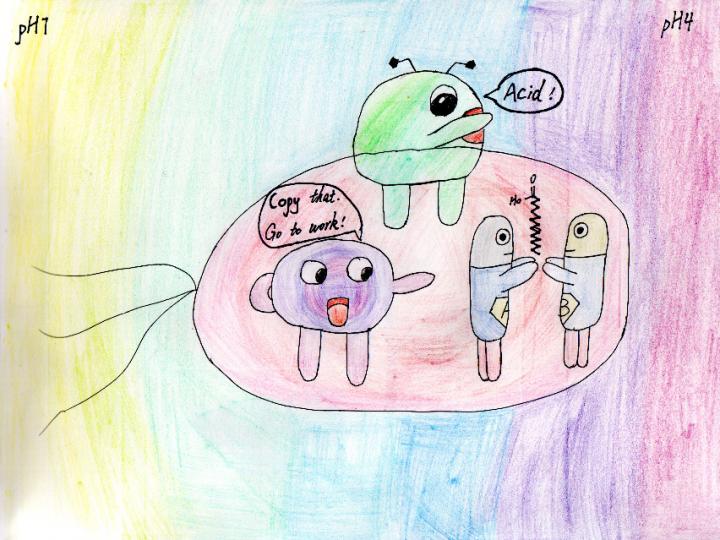
CpxA, the newly discovered system, can sense acidification directly through protonation of histidine residues. It will also activate its cognate regulator protein CpxRx to stimulate the expression of fabA and fabB genes for biosynthesis of unsaturated fatty acids, increasing unsaturated fatty acid contents in membrane lipid.

Changes in membrane lipid composition lower the fluidity and proton permeability of cell membrane, increasing the intracellular pH homeostasis.

Experiment results showed that E. coli mutant deficient in this system cannot grow in mouse intestine. Besides E. coli, this acid tolerance system also exists in pathogenic bacteria including Salmonella, Shigella, Vibrio cholerae, Yersinia pestis and Pseudomonas aeruginosa, which may be a new target for the development of antimicrobials.

The related findings were published in Nature Communications on Mar. 20.

###

This work was supported by the National Natural Science Foundation of China and the Natural Science Foundation of Shandong Province.

Media Contact
CHENG Jing
[email protected]

Related Journal Article

http://dx.doi.org/10.1038/s41467-020-15350-5

Tags: BacteriologyBiologyBiomedical/Environmental/Chemical Engineering
Share12Tweet8Share2ShareShareShare2

Related Posts

Florida Cane Toad: Complex Spread and Selective Evolution

Florida Cane Toad: Complex Spread and Selective Evolution

February 7, 2026
New Study Uncovers Mechanism Behind Burn Pit Particulate Matter–Induced Lung Inflammation

New Study Uncovers Mechanism Behind Burn Pit Particulate Matter–Induced Lung Inflammation

February 6, 2026

DeepBlastoid: Advancing Automated and Efficient Evaluation of Human Blastoids with Deep Learning

February 6, 2026

Navigating the Gut: The Role of Formic Acid in the Microbiome

February 6, 2026
Please login to join discussion

POPULAR NEWS

  • Robotic Ureteral Reconstruction: A Novel Approach

    Robotic Ureteral Reconstruction: A Novel Approach

    82 shares
    Share 33 Tweet 21
  • Digital Privacy: Health Data Control in Incarceration

    63 shares
    Share 25 Tweet 16
  • Study Reveals Lipid Accumulation in ME/CFS Cells

    57 shares
    Share 23 Tweet 14
  • Breakthrough in RNA Research Accelerates Medical Innovations Timeline

    53 shares
    Share 21 Tweet 13

About

We bring you the latest biotechnology news from best research centers and universities around the world. Check our website.

Follow us

Recent News

Florida Cane Toad: Complex Spread and Selective Evolution

Exploring Decision-Making in Dementia Caregivers’ Mobility

Succinate Receptor 1 Limits Blood Cell Formation, Leukemia

Subscribe to Blog via Email

Enter your email address to subscribe to this blog and receive notifications of new posts by email.

Join 73 other subscribers
  • Contact Us

Bioengineer.org © Copyright 2023 All Rights Reserved.

Welcome Back!

Login to your account below

Forgotten Password?

Retrieve your password

Please enter your username or email address to reset your password.

Log In
No Result
View All Result
  • Homepages
    • Home Page 1
    • Home Page 2
  • News
  • National
  • Business
  • Health
  • Lifestyle
  • Science

Bioengineer.org © Copyright 2023 All Rights Reserved.