UC Riverside scientists are taking a modern approach to studying a murky subject — the quantity, quality, and sources of microplastics in Los Angeles County’s urban streams.
Credit: Andrew Gray/UCR
UC Riverside scientists are taking a modern approach to studying a murky subject — the quantity, quality, and sources of microplastics in Los Angeles County’s urban streams.
Microplastics are particles with a maximum diameter of 5 millimeters, roughly the size of a pencil eraser. The category can include nanoplastics, which are far smaller than the width of an average human hair.
Scientists have been aware that these particles have been filtering through the environment for decades, but concern about them has only started to ramp up more recently.
“There is mounting evidence that these materials are toxic,” said Andrew Gray, UCR assistant professor of watershed hydrology.
Recent studies indicate microplastics can have negative impacts on reproductive health, particularly for males.
Small microplastics and nanoplastics can also cross organ boundaries and infiltrate cell walls. As they do so, they may be carrying other compounds that were added during manufacturing or picked up as they traveled through the environment, like heavy metals or PFOS, chemicals used in products like fire-fighting foams, stain-resistant fabrics, and food packaging.
In addition, microplastics cause problems for animals whose airways and digestive tracts can become blocked with them when they’re mistaken for food.
In order to manage these materials in our water, scientists need to understand the kinds of plastics that are present and where they’re coming from. Gray’s group at UCR has secured almost $1 million from Los Angeles County’s Safe Clean Water Program to learn this information.
“Microplastics are a complex suite of contaminants with a wide range of particle sizes and shapes, and different ramifications for aquatic and human health,” Gray said.
“We not only want a baseline of what’s there at a given point in time, but to understand how it got there, where it is being discharged from, and how it is being transported through our urban waterways,” he said. “We expect that stormwater moves most of the microplastics through rivers and streams and into the coastal ocean.”
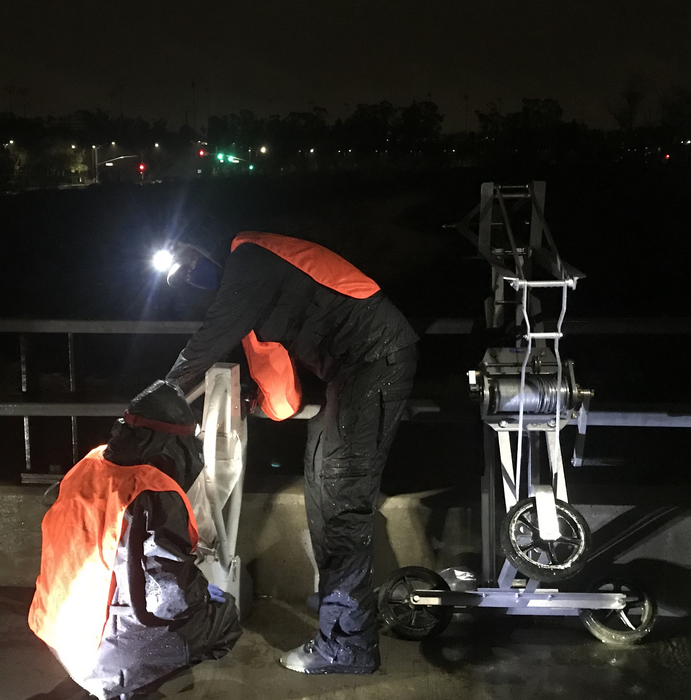
The three-year microplastics project will focus on the lower Los Angeles River, lower San Gabriel River, Ballona Creek and the Dominguez Channel. In collaboration with LA County Public Works, UCR will collect samples of storm water from stations already established for other types of water quality measurements. The samples will then be analyzed in Gray’s laboratory.
Gray’s group intends to use what they learn about these four streams to help standardize the ways that microplastics are monitored in streamflow, especially under storm conditions. They also want to develop models of the ways that plastics move through waterways. They’ll then apply these models to guide monitoring efforts in additional streams where monitoring stations do not already exist, and where it would be costly to establish them.
Ultimately, more advanced monitoring systems can inform a variety of management strategies that could be used for specific compounds. For example, one type of plastic frequently found in water samples analyzed in Gray’s laboratory comes from tires and streets.
“We tend to think about emissions from combustion, but there are a lot of non-combustion vehicle-related emissions as well. Brakes, fluids, tires, and roads — all these things contain plastics that leach out, break down, and get washed into our waterways,” Gray said. “Tires used to be relatively simple concoctions, but that is no longer the case. Today’s tires are mixed with a lot of petroleum-based plastics and additives.”
Tire and road particles have toxic effects on commercial varieties of fish, including salmon and trout, as well as other aquatic animals. If researchers can identify points of entry into waterways, they can create strategies in those locations to help decrease runoff and clean it before it travels into municipal drains and moves downstream.
There are various strategies to reduce plastic waste that can be implemented every day by consumers. People can begin to reject single-use plastic containers and items in favor of materials that are safer and more sustainable. Gray also hopes that in the future there will be more pressure applied to parts of the economy that produce plastic goods.
Since a lot of microplastics are produced by the breakdown of larger plastic particles that have already entered the environment, the issue is likely to persist.
“Even if we stop producing all plastics today, the legacy of pollution will go on for decades. But not all microplastics may be toxic, and for those that are, we have the opportunity to decrease their manufacture and impact,” Gray said. “Improved monitoring will definitely help guide those efforts.”