• HOME
  • NEWS
  • EXPLORE
    • CAREER
      • Companies
      • Jobs
    • EVENTS
    • iGEM
      • News
      • Team
    • PHOTOS
    • VIDEO
    • WIKI
  • BLOG
  • COMMUNITY
    • FACEBOOK
    • INSTAGRAM
    • TWITTER
Wednesday, April 1, 2026
BIOENGINEER.ORG
No Result
View All Result
  • Login
  • HOME
  • NEWS
  • EXPLORE
    • CAREER
      • Companies
      • Jobs
        • Lecturer
        • PhD Studentship
        • Postdoc
        • Research Assistant
    • EVENTS
    • iGEM
      • News
      • Team
    • PHOTOS
    • VIDEO
    • WIKI
  • BLOG
  • COMMUNITY
    • FACEBOOK
    • INSTAGRAM
    • TWITTER
  • HOME
  • NEWS
  • EXPLORE
    • CAREER
      • Companies
      • Jobs
        • Lecturer
        • PhD Studentship
        • Postdoc
        • Research Assistant
    • EVENTS
    • iGEM
      • News
      • Team
    • PHOTOS
    • VIDEO
    • WIKI
  • BLOG
  • COMMUNITY
    • FACEBOOK
    • INSTAGRAM
    • TWITTER
No Result
View All Result
Bioengineer.org
No Result
View All Result
Home NEWS Science News Chemistry

Not only in information technology: restart also works in chemical simulations

Bioengineer by Bioengineer
February 12, 2024
in Chemistry
Reading Time: 2 mins read
0
(Left to right): Prof. Shlomi Reuveni, Ph.D. student Ofir Blumer & Dr. Barak Hirshberg.
Share on FacebookShare on TwitterShare on LinkedinShare on RedditShare on Telegram

A new study from Tel Aviv University discovered that a known practice in information technology can also be applied to chemistry. Researchers found that to enhance the sampling in chemical simulations, all you need to do is stop and restart.
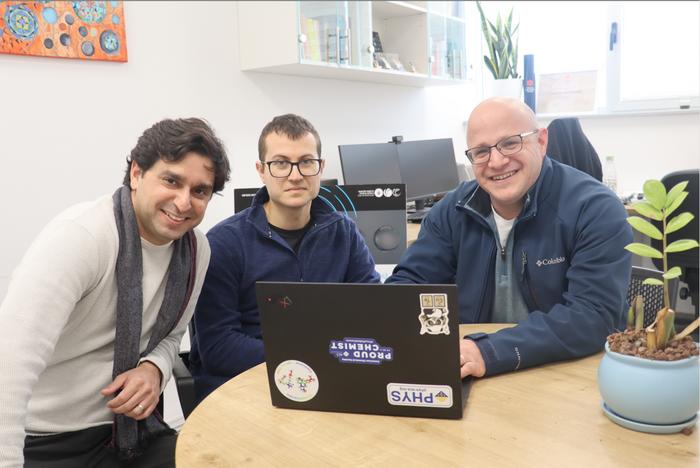
(Left to right): Prof. Shlomi Reuveni, Ph.D. student Ofir Blumer & Dr. Barak Hirshberg.

Credit: Courtesy of Tel Aviv University
(Tel Aviv University grants permission for the use of these photos/images for stories on TAU research).

A new study from Tel Aviv University discovered that a known practice in information technology can also be applied to chemistry. Researchers found that to enhance the sampling in chemical simulations, all you need to do is stop and restart.


The research was led by Ph.D. student Ofir Blumer, in collaboration with Professor Shlomi Reuveni and Dr. Barak Hirshberg from the Sackler School of Chemistry at Tel Aviv University. The study was published in the journal Nature Communications.


The researchers explain that molecular dynamics simulations are like a virtual microscope. They track the motion of all atoms in chemical, physical, and biological systems such as proteins, liquids, and crystals. They provide insights into various processes and have different technological applications, including drug design. However, these simulations are limited to processes slower than one-millionth of a second, and thus cannot describe slower processes such as protein folding and crystal nucleation. This limitation, known as the timescale problem, is a great challenge in the field.


Ph.D. student Ofir Blumer: “In our new study we show that the timescale problem can be overcome by stochastic resetting of the simulations. It seems counterintuitive at first glance – how can the simulations end faster when restarted? Yet, it turns out that reaction times vary considerably between simulations. In some simulations, reactions occur rapidly, but other simulations get lost in intermediate states for long periods. Resetting prevents the simulations from getting stuck in such intermediates and shortens the average simulation time.”


The researchers also combined stochastic resetting with Metadynamics, a popular method to expedite the simulations of slow chemical processes. The combination allows greater acceleration than either method separately. Moreover, Metadynamics relies on prior knowledge: the reaction coordinates must be known to expedite the simulation. The combination of Metadynamics with resetting reduces the dependency on prior knowledge significantly, saving time for practitioners of the method. Finally, the researchers showed that the combination provides more accurate predictions of the rate of slow processes. The combined method was used to enhance simulations of a protein folding in water successfully and it is expected to be applied to more systems in the future.


Link to the article:

https://www.nature.com/articles/s41467-023-44528-w


Journal

Nature Communications

DOI

10.1038/s41467-023-44528-w

Share12Tweet8Share2ShareShareShare2

Related Posts

Creating Desktop Particle Accelerators to Open New Frontiers in Scientific Research

Creating Desktop Particle Accelerators to Open New Frontiers in Scientific Research

April 1, 2026
Photochargeable Semiconductor Powers Efficient Amine Coupling

Photochargeable Semiconductor Powers Efficient Amine Coupling

April 1, 2026

From Cells to Smart Gels: Advancing Frontiers in Motion Science

March 31, 2026

Tides Amplify Biochar’s Carbon Capture Efficiency in Coastal Wetlands

March 31, 2026

POPULAR NEWS

  • blank

    Revolutionary AI Model Enhances Precision in Detecting Food Contamination

    96 shares
    Share 38 Tweet 24
  • Imagine a Social Media Feed That Challenges Your Views Instead of Reinforcing Them

    1006 shares
    Share 398 Tweet 249
  • Promising Outcomes from First Clinical Trials of Gene Regulation in Epilepsy

    51 shares
    Share 20 Tweet 13
  • Popular Anti-Aging Compound Linked to Damage in Corpus Callosum, Study Finds

    43 shares
    Share 17 Tweet 11

About

We bring you the latest biotechnology news from best research centers and universities around the world. Check our website.

Follow us

Recent News

Cutting-Edge “Smart” Drugs Revolutionize Cancer Treatment

KIST-IAE Collaborative Team Surpasses Performance Limits in Lithium-Air Batteries with Innovative Two-Dimensional Catalyst

Brain Metastases Show Unique Macrophage Spatial Patterns

Subscribe to Blog via Email

Enter your email address to subscribe to this blog and receive notifications of new posts by email.

Join 78 other subscribers
  • Contact Us

Bioengineer.org © Copyright 2023 All Rights Reserved.

Welcome Back!

Login to your account below

Forgotten Password?

Retrieve your password

Please enter your username or email address to reset your password.

Log In
No Result
View All Result
  • Homepages
    • Home Page 1
    • Home Page 2
  • News
  • National
  • Business
  • Health
  • Lifestyle
  • Science

Bioengineer.org © Copyright 2023 All Rights Reserved.