• HOME
  • NEWS
  • EXPLORE
    • CAREER
      • Companies
      • Jobs
    • EVENTS
    • iGEM
      • News
      • Team
    • PHOTOS
    • VIDEO
    • WIKI
  • BLOG
  • COMMUNITY
    • FACEBOOK
    • INSTAGRAM
    • TWITTER
Saturday, July 11, 2026
BIOENGINEER.ORG
No Result
View All Result
  • Login
  • HOME
  • NEWS
  • EXPLORE
    • CAREER
      • Companies
      • Jobs
        • Lecturer
        • PhD Studentship
        • Postdoc
        • Research Assistant
    • EVENTS
    • iGEM
      • News
      • Team
    • PHOTOS
    • VIDEO
    • WIKI
  • BLOG
  • COMMUNITY
    • FACEBOOK
    • INSTAGRAM
    • TWITTER
  • HOME
  • NEWS
  • EXPLORE
    • CAREER
      • Companies
      • Jobs
        • Lecturer
        • PhD Studentship
        • Postdoc
        • Research Assistant
    • EVENTS
    • iGEM
      • News
      • Team
    • PHOTOS
    • VIDEO
    • WIKI
  • BLOG
  • COMMUNITY
    • FACEBOOK
    • INSTAGRAM
    • TWITTER
No Result
View All Result
Bioengineer.org
No Result
View All Result
Home NEWS Science News Chemistry

Nonlinear ionization dynamics of hot dense plasma observed in a laser-plasma amplifier

Bioengineer by Bioengineer
November 19, 2020
in Chemistry
Reading Time: 3 mins read
0
IMAGE
Share on FacebookShare on TwitterShare on LinkedinShare on RedditShare on Telegram

Researchers have succeeded in directly observing the formation and interaction of highly ionized krypton plasma
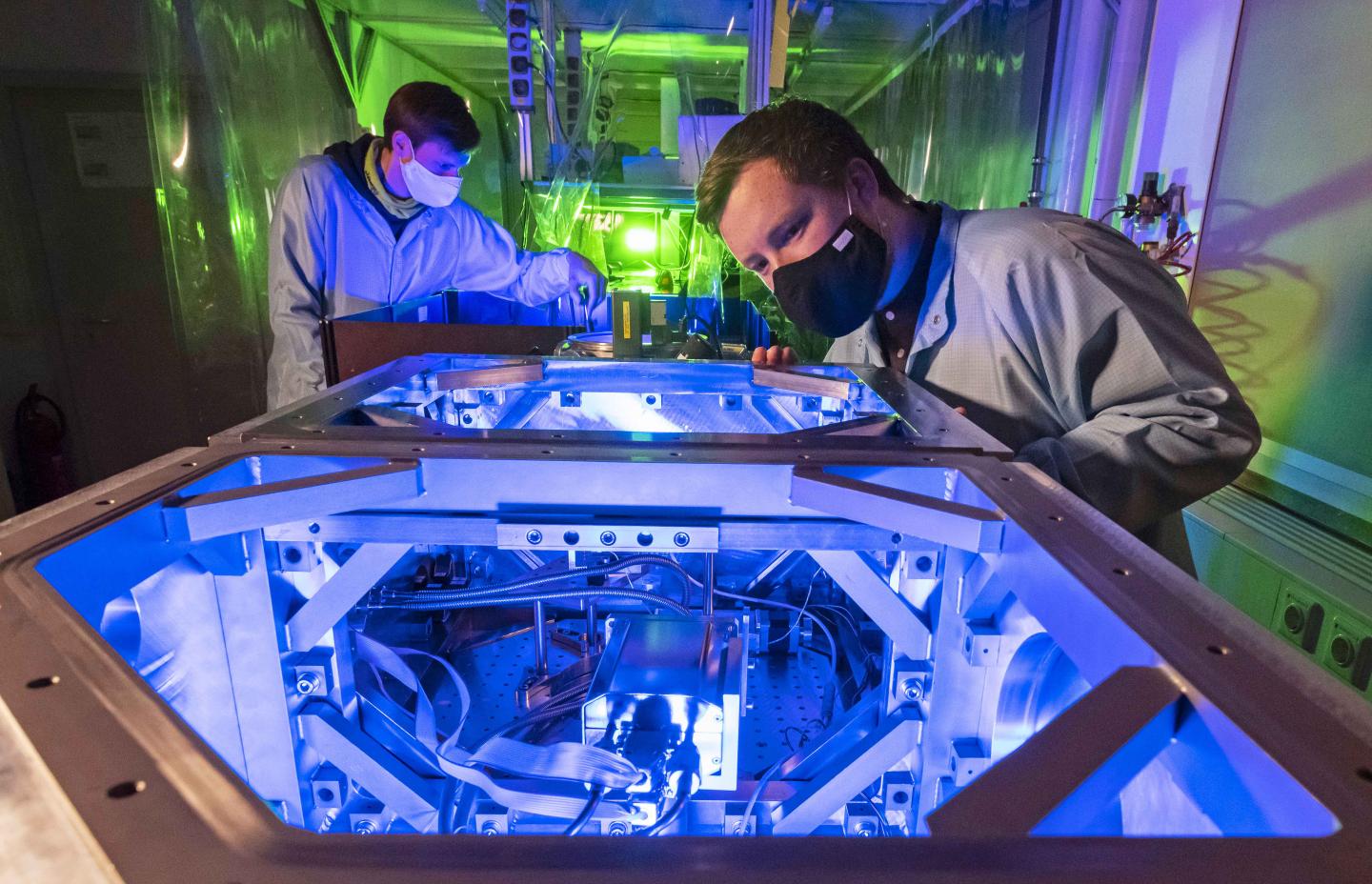
IMAGE

Credit: Image: Jens Meyer/University of Jena

The last decade has been marked by a series of remarkable discoveries identifying how the universe is composed. It is understood that the mysterious substance dark matter makes up 85 % of the matter in the universe. Observable matter in the universe consists of ionized particles. Thus, a profound understanding of ionized matter and its interaction with light, could lead to a deeper understanding of the relationships at play that formed the universe. While ionized matter, or plasma, is relatively easy to generate in the lab, studying it is extremely challenging as methods that can capture ionization states and density are virtually non-existant.

In a new paper published in “Light Science & Application“, a team of scientists has succeeded in directly observing the formation and interaction of highly ionized krypton plasma using femtosecond coherent ultraviolet light and a novel four-dimensional model.

Eight-fold ionized krypton ions as laser medium

In their work, the researchers employ a laser-plasma amplifier, that uses eight-fold ionized krypton ions as laser medium. Then they launch a coherent extreme ultraviolet probe pulse into this plasma that picks up signatures of the plasma conditions as it propagates through the laser-generated plasma column. This extreme ultraviolet probe pulse is then analyzed by diffracting it off a well-characterized nanoscale target. This method, known as coherent diffraction imaging, allows for measurement of the properties of the probe pulse carrying information about the plasma with very high resolution. “Using an extreme ultraviolet probe pulse with a wavelength short enough so that the plasma becomes transparent to interrogate the formed plasma is key,” explains Prof. Dr Michael Zuerch from the University of California in Berkeley.

Unexpected discovery

“Surprisingly, we found a non-trivial spatial modulation pattern that is unexpected in a waveguide geometry. Using an adapted ab initio theory modelling the plasma-light interaction in four dimensions across multiple scales we can find excellent agreement with our experimental data. This has allowed us to ascribe the observed signal to a strongly nonlinear behavior in laser-plasma interaction generating the highly-ionized krypton plasma,” elaborates Zuerch.

The experimental approach, that can be easily adopted to other relevant scenarios, validates the advanced ab initio models used to simulate the laser-plasma interaction and more generally the formation of highly-ionized plasma. An important ramification of the findings shows that you cannot create arbitrarily ionized plasmas using optical techniques. “The developed model will allow for predicting achievable conditions accurately and gives hope that very defined plasma conditions can be created by appropriate laser beam shaping,” says Prof. Dr Christian Spielmann from the University of Jena. Zuerch summarized the outlook of the work: “Beyond a more profound understanding of laser-plasma interactions, our findings have impacts, for example, on the upscaling of plasma-based X-ray light sources or plasma-based fusion experiments.”

###

Media Contact
Michael Zürch
[email protected]

Original Source

https://www.uni-jena.de/en/201119_Plasmaionisation

Related Journal Article

http://dx.doi.org/10.1038/s41377-020-00424-2

Tags: Chemistry/Physics/Materials SciencesParticle Physics
Share12Tweet8Share2ShareShareShare2

Related Posts

Blue Light and Chemistry Simplify Complex Drug Production Steps

Blue Light and Chemistry Simplify Complex Drug Production Steps

July 10, 2026
New Discovery Promises Brighter, More Energy-Efficient Digital Displays

New Discovery Promises Brighter, More Energy-Efficient Digital Displays

July 10, 2026

New Crystalline 3D Frameworks Linked by Spiroborates Developed

July 10, 2026

IBEC Joins Major European Grant on Living Matter Physics

July 10, 2026
Please login to join discussion

POPULAR NEWS

  • Detection of EDCs in Breast Milk and Infant Urine Up to Six Months Highlights Early Exposure Risks

    77 shares
    Share 31 Tweet 19
  • New Drug Candidate Developed at McMaster Shows Potential for Treating Brain Cancer

    58 shares
    Share 23 Tweet 15
  • KTU Researchers Explore Ultrasound’s Role in Enhancing Blood Flow Beyond Diagnostics

    53 shares
    Share 21 Tweet 13
  • 高齢者の骨粗鬆症治療の持続性比較

    51 shares
    Share 20 Tweet 13

About

BIOENGINEER.ORG

We bring you the latest biotechnology news from best research centers and universities around the world. Check our website.

Follow us

Recent News

Study Finds Dopamine System Damage in Long COVID Patients’ Brains

HMGA Proteins Linked to Brain Tumors and Neurodegenerative Diseases

Physical Activity Lowers Frailty Risk in Older Adults: Review and Analysis

Subscribe to Blog via Email

Success! An email was just sent to confirm your subscription. Please find the email now and click 'Confirm' to start subscribing.

Join 84 other subscribers
  • Contact Us

Bioengineer.org © Copyright 2023 All Rights Reserved.

Welcome Back!

Login to your account below

Forgotten Password?

Retrieve your password

Please enter your username or email address to reset your password.

Log In
No Result
View All Result
  • Homepages
    • Home Page 1
    • Home Page 2
  • News
  • National
  • Business
  • Health
  • Lifestyle
  • Science

Bioengineer.org © Copyright 2023 All Rights Reserved.