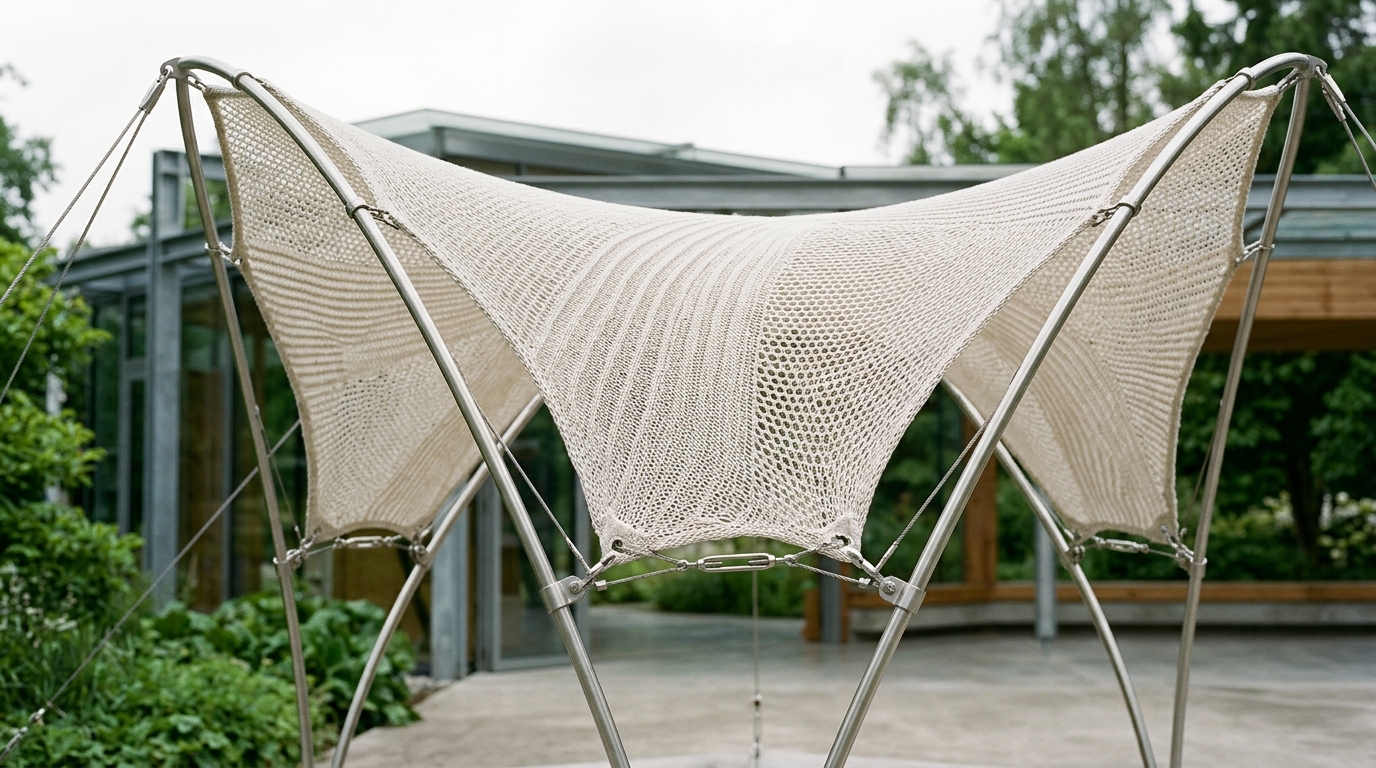
Published in Architectural Intelligence, the study demonstrates how structural form-finding principles can guide unit-level stitch selection across a fabric surface to achieve complex doubly curved equilibrium geometries under predefined loading conditions. By abstracting target shapes into discrete quadrilateral networks and calculating required internal force distributions using gradient-based numerical optimisation, the investigators established a direct pipeline between structural equilibrium calculations and automated textile manufacturing. Their proof-of-concept prototype successfully produced a continuous membrane possessing tailored local stiffness zones, offering an empirical bridge between digital architectural design intent and physical material behaviour.
Contemporary architectural and construction practices increasingly demand resource-efficient material systems that reduce waste during translation from concept to finished structure. Knitted textiles produced on industrial Computer Numerical Control machines offer significant promise in membrane structures and flexible formwork due to their lightweight nature, geometric flexibility, and unit-scale customisability. However, predicting and programming their mechanical response remains inherently difficult because fabric deformation depends simultaneously on yarn material characteristics, machine tension settings, and the specific interlooping pattern of yarns known as the knit architecture. Until now, deploying knitted membranes in architectural projects has predominantly relied on empirical trial-and-error, domain-specific intuition, and iterative physical testing rather than automated computational design frameworks.
To overcome these manufacturing hurdles, the researchers formulated an inverse design approach based on the Force Density Method, a structural form-finding technique originally established for discrete cable nets and lightweight shell structures. In standard forward form-finding, engineers prescribe force-to-length ratios along network edges to determine an unknown equilibrium geometry under load. In this inverse implementation, the workflow begins with the desired target geometry treated as an equilibrium state under known loads, while treating the underlying force density distribution as an unknown decision variable. The textile surface is represented as a quad-based mesh, aligning with the course and wale directional grid of knitted fabrics and corresponding directly to the pixel bitmap instructions parsed by industrial knitting equipment.
Selecting an appropriate mesh representation required balancing geometric accuracy against numerical optimisation runtime. The investigators evaluated undeformed average edge lengths ranging from 0.005 metres to 0.05 metres, discovering that refinement beyond 0.015 metres substantially increased computation time without yielding proportional gains in physical precision. While coarser grids lowered the calculated root mean square error due to reduced degrees of freedom, intermediate grid dimensions between 0.02 metres and 0.025 metres achieved optimal numerical convergence and geometric fidelity. Based on these evaluations, a uniform quad resolution of 0.02 metres by 0.02 metres was selected for the inverse design modelling and the remeshing of physical scan data.
Because direct mathematical models correlating individual knit loop geometries with structural force density values are currently unavailable, the researchers incorporated an intermediate empirical characterisation stage. Two contrasting uniform knit architectures were selected based on preliminary mechanical evaluations of twenty-one distinct stitch patterns: cross-miss, which demonstrated high stiffness and low stretch under dead load, and double half cardigan, which exhibited high elasticity and substantial compliance. Prototype specimens measuring 0.3 metres by 0.3 metres were fabricated on a 10.2-gauge Steiger Vega flat-bed weft-knitting machine using a 550 dtex recycled polyethylene terephthalate yarn, mounted on a wooden frame with edge-tensioning weights, and coated with a uniform 126 Newton per square metre cement paste to simulate distributed dead loads during curing.
Once the cement paste hardened over twenty-four hours at twenty-three degrees Celsius and fifty to sixty percent relative humidity, the resulting thin shells were digitised with three-dimensional scanning and retopologised into clean quad meshes. Constrained form-finding using the open-source JAX FDM package and an extended L-BFGS-B optimisation algorithm calculated the corresponding force density distributions under the recorded specimen loads.
These experimental characterisations defined discrete operational thresholds to guide automated knit assignment for an inverse target geometry. wale-wise columns exhibiting average force densities between 0 and 14 Newtons per metre were mapped to the highly deformable double half cardigan architecture, whereas columns requiring force densities between 14 and 32 Newtons per metre were assigned the stiffer cross-miss pattern. The researchers applied this mapping scheme to an asymmetrical doubly curved target surface featuring two quasi-paraboloid regions connected across a central saddle section. Subjected to an equivalent vertical load of 126 Newtons per metre squared across a 15 by 15 quad mesh, the optimiser assigned double half cardigan across the outer seven and five columns and placed cross-miss across the central three columns.
The resulting one-dimensional assignment array was translated into a fabrication bitmap comprising 114 pixels across and 272 pixels high, adjusting pixel widths to 54, 33, and 43 pixels to account for stitch dimension differences between the two architectures while preserving nominal zone widths of 140, 60, and 100 millimetres. The heterogeneous prototype was knitted, mounted under identical boundary conditions, coated with cement paste at an actual load of 118 Newtons per square metre, and allowed to cure. Three-dimensional scanning of the finished cement shell confirmed clear structural differentiation: the central cross-miss zone restricted maximum vertical deflection to 62 millimetres, while the flanking double half cardigan sections deflected up to 93 millimetres and 74 millimetres in the wider and narrower segments, respectively.
Quantitative surface comparison between the scanned physical prototype and the digital target mesh revealed a global root mean square error of 0.013 metres, with a maximum recorded deviation of 0.031 metres. Approximately 54 percent of target mesh vertices fell within 10 millimetres of the physical surface, and 30 percent registered deviations within 5 millimetres. Discrepancies were concentrated primarily in the central cross-miss zone, where the prototype deflected less than predicted.
The authors noted several operational constraints in this initial validation, including reliance on a binary knit architecture pairing, a single yarn material, and the specificity of force density values to the tested geometric dimensions and loading configurations. They emphasized that the workflow provides an adaptable foundation for more sophisticated material systems, proposing future research directions that incorporate automated parameter tuning, machine learning models trained on expanded textile libraries, and iterative feedback loops to recalibrate stiffness assignments against empirical measurements. By demonstrating that discrete fabrication inputs can be systematically derived from inverse structural equilibrium models, the study provides a viable computational pathway toward deploying tailored CNC-knitted textiles in large-scale architectural formwork and self-supporting membrane systems.
Subject of Research: Computational inverse design and fabrication of functionally graded CNC-knitted architectural textiles using the nonlinear Force Density Method
Article Title: Designing tailored knitted textiles using nonlinear Force Density Method
Article References: Christidi, N., Louter, C., & Popescu, M. (2026). Designing tailored knitted textiles using nonlinear Force Density Method. Architectural Intelligence, 5(1), Article 3. https://doi.org/10.1007/s44223-025-00111-5
Image Credits: AI Generated
DOI: 10.1007/s44223-025-00111-5
Keywords: Architectural Intelligence, Force Density Method, CNC knitting, computational design, inverse form-finding, functionally graded materials, flexible formwork, structural membranes, Designing, tailored, knitted, textiles
News Source: Denise Maddox. (November 7, 2026). Nonlinear Force Density Method Tailors Knitted Textiles for Architectural Membrane Structures. Scienmag.