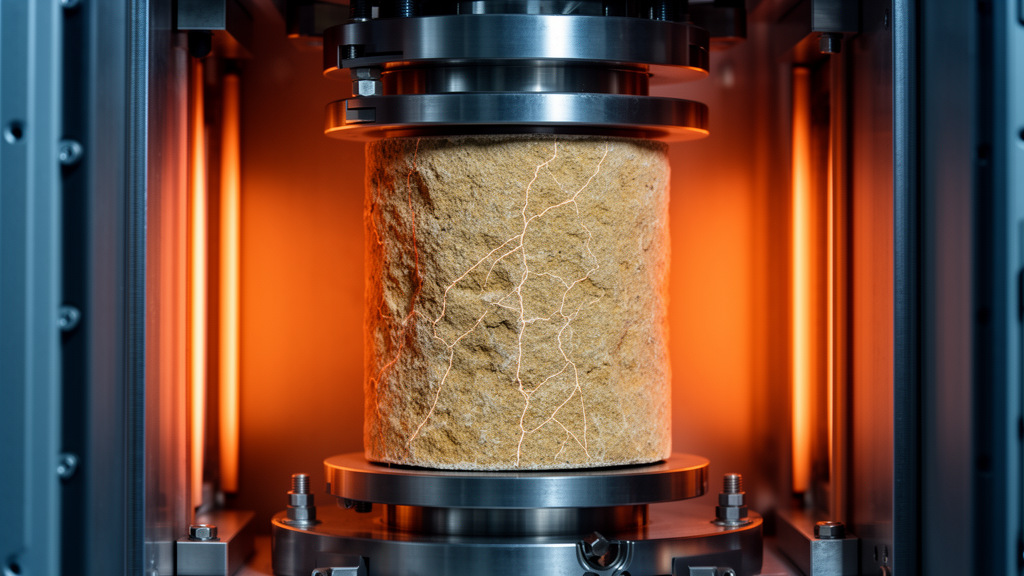
A research team investigating the thermo-mechanical stability of subterranean excavations has developed and validated a physically grounded nonlinear constitutive damage model that accurately tracks the full stress-strain trajectory of sandstones subjected to thermal preconditioning up to 400 degrees Celsius. In laboratory evaluations under unconfined compressive loading, the newly formulated analytical framework achieved coefficients of determination exceeding 0.998 across two distinct sandstone lithologies, outperforming selected established models from previous literature. The investigation demonstrates that thermal exposure exerts a dual influence on rock mechanics, wherein moderate heating initially enhances load-bearing capacity through thermal expansion and void closure before subsequent microstructural breakdown initiates severe strength loss. Understanding these temperature-dependent transitions is crucial for engineering safety across deep-buried tunnels, geothermal energy facilities, coal gasification operations, and nuclear waste storage repositories where structural rock mass experiences intense thermal stress.
Subterranean engineering works regularly confront elevated operating temperatures that fundamentally alter surrounding geologic formations. When minerals within intact rock masses experience intense heating, unequal coefficients of thermal expansion generate substantial differential thermal stresses along intergranular boundaries. These localized stress concentrations nucleate microscopic cracks that degrade both physical compactness and macroscopic mechanical competence. Prior experimental research across various rock types, including granite, shale, marble, and claystone, has demonstrated that extreme thermal loading induces crystal phase transformations, mineral dehydration, and significant alterations in density, primary wave velocity, and porosity. Consequently, accurately predicting how rock formations respond to moderate and severe thermal exposure remains essential for assessing structural stability, preventing catastrophic wall collapse, and ensuring long-term maintenance in deep mining and tunneling environments.
Despite previous advances in theoretical geomechanics, existing constitutive formulations for thermally altered rock frequently fail to capture the complete mechanical response observed during experimental compression. Earlier models frequently relied upon empirical temperature correction factors or curve-fitting coefficients that lacked direct microstructural grounding, restricting their predictive reliability beyond specific test calibrations. Furthermore, many conventional formulations employed single-function representations that conflated initial pore closure with post-peak softening, leading to systematic discrepancies during early loading and final failure stages. Other statistical formulations rooted in Weibull distributions or modified Hoek-Brown criteria successfully reflected residual compressive strength but omitted nonlinear elastic corrections or cyclic thermal variables. To overcome these limitations, an improved constitutive framework required separate mathematical functions directly tied to distinct physical deformation processes occurring within the rock fabric.
To investigate these thermo-mechanical phenomena, researchers examined two distinct Australian sandstone varieties, designated SS-1 and SS-2, quarried from Jimboomba on the Gold Coast. Room-temperature X-ray diffraction indicated substantial mineralogical differences between the two materials. The SS-1 rock mass comprised 36.5 percent albite, 36.2 percent quartz, 12.6 percent microcline, 6.3 percent laumontite, and 5.1 percent muscovite, accompanied by trace quantities of chlorite, calcite, and anatase. In contrast, the SS-2 sandstone consisted primarily of 70.8 percent quartz, 20.5 percent albite, 4.1 percent microcline, 1.4 percent sodalite, and 1.2 percent cancrinite, with minor accessories of kaolinite, goethite, hematite, and muscovite aggregating to 2.0 percent. Physical characterization revealed a mean baseline porosity of 7.24 percent and bulk density of 2.42 grams per cubic centimeter for SS-1, whereas SS-2 exhibited an initial porosity of 11.0 percent and density of 2.26 grams per cubic centimeter. Forty cylindrical test specimens measuring 50 millimeters in diameter and 100 millimeters in height were machined following standard ISRM procedures.
Thermal preconditioning was performed within an electric muffle furnace capable of reaching 1000 degrees Celsius, using a slow, controlled heating ramp of 5 degrees Celsius per minute to avoid thermal shock. Test groups of specimens were systematically elevated to target temperatures of 25, 100, 200, and 400 degrees Celsius. Once target temperatures were attained, samples were soaked for two hours to ensure thermal equilibrium throughout each cylinder core. The furnace was subsequently switched off, allowing the specimens to cool slowly overnight inside the closed enclosure down to room temperature. This gradual cooling protocol minimized secondary thermal shock cracking that frequently occurs during rapid fluid quenching. Macroscopic inspection revealed that heating to 400 degrees Celsius induced a distinct color transformation, shifting SS-1 from initial grey to dark reddish-brown and SS-2 from yellow to reddish-brown, an alteration attributed to the thermal oxidation of trace iron-bearing hematite and goethite within the cementing matrix.
Mechanical evaluations were performed under unconfined uniaxial compression using an automated test apparatus with a maximum axial capacity of 2000 kilonewtons. Five cylindrical specimens were tested per thermal condition at an axial displacement rate of 0.1 millimeters per minute, corresponding to a quasi-static strain rate of 1.67 times ten to the negative fifth per second. Statistical evaluation of the experimental data indicated high consistency, with unconfined compressive strength coefficients of variation ranging from 4.0 percent to 15.0 percent, well within standard thresholds for rock mechanics investigations. Higher scatter occurred in SS-1 specimens exposed to 100 and 400 degrees Celsius, reflecting thermally induced microstructural heterogeneity, whereas SS-2 displayed relatively uniform variability across all temperatures. Density and porosity measurements conducted via buoyancy and saturation methods confirmed that porosity increased progressively with temperature, expanding from roughly 7 percent to 10 percent in SS-1 and 11 percent to 13 percent in SS-2, while bulk density decreased systematically.
X-ray diffraction and scanning electron microscopy provided direct physical evidence of thermal alteration within the rock fabrics. The dominant quartz phase remained thermally stable throughout heating to 400 degrees Celsius in both sandstones. However, hydrous clay minerals underwent significant structural degradation. In SS-1, muscovite and laumontite underwent dehydration and alteration between 100 and 200 degrees Celsius, followed by complete breakdown of kaolinite by 400 degrees Celsius. Digital image analysis using the Pore and Crack Analysis System on 50-times magnification micrographs demonstrated that crack density in SS-1 rose from 1.10 times ten to the negative third per millimeter at 25 degrees Celsius to 4.17 times ten to the negative third per millimeter at 100 degrees Celsius, before declining to 3.16 times ten to the negative third per millimeter at 400 degrees Celsius as microcracks coalesced into wider voids. In SS-2, crack density dropped from 3.48 times ten to the negative third per millimeter initially to 9.79 times ten to the negative fourth per millimeter at 100 degrees Celsius due to initial mineral expansion, before increasing to 1.44 times ten to the negative third per millimeter at 400 degrees Celsius.
The mechanical stress-strain responses reflected these complex microstructural transformations through clear phases of moderate strengthening followed by high-temperature deterioration. For SS-1, unconfined compressive strength rose from 73.95 megapascals at 25 degrees Celsius to 82.57 megapascals at 100 degrees Celsius, representing a 12 percent gain in load capacity, while elastic modulus rose from 5.46 gigapascals to 5.77 gigapascals. Beyond 100 degrees Celsius, strength declined by 4 percent at 200 degrees Celsius and 9 percent at 400 degrees Celsius, accompanied by an elastic modulus drop to 4.75 gigapascals. The SS-2 specimens reached their peak strength at 200 degrees Celsius, where compressive strength improved by 11.27 percent over baseline to 28.63 megapascals and modulus climbed 16.5 percent to 6.14 gigapascals, before plunging by 16 percent in strength and 13 percent in modulus at 400 degrees Celsius. Macroscopic failure modes mirrored this transition, as SS-1 shifted from axial tensile splitting between 25 and 200 degrees Celsius to shear-plane failure at 400 degrees Celsius, whereas SS-2 maintained shear-dominated fracture across all thermal increments.
To simulate this deformation mathematically, the researchers formulated a constitutive damage model based on Lemaître’s strain equivalence principle, which asserts that strain in a damaged material under nominal stress equals strain in an undamaged material subjected to effective stress. The formulation decomposes total axial response into two independent functions representing competing physical processes: a power-law term capturing initial pore compaction and strain hardening, and an exponential decay term describing progressive damage accumulation and post-peak softening. The complete stress relationship defines stress as the product of initial undamaged modulus, axial strain raised to the power of compaction exponent plus one, and the exponential of normalized strain scaled by characteristic strain and brittleness index. Mathematical verification confirmed that the model strictly satisfies boundary conditions, yielding zero stress at zero strain and asymptotically approaching zero stress at infinite deformation, while parameter sensitivity analysis established that compaction exponent controls pre-peak curvature, characteristic strain governs damage initiation, and brittleness index dictates post-peak degradation rate.
Model validation confirmed remarkable predictive fidelity across all tested temperature ranges, generating coefficients of determination between 0.998 and 0.999 and root mean square error values between 0.254 and 0.761 megapascals for SS-1, and 0.254 to 0.364 megapascals for SS-2. When evaluated against previously published constitutive models by Cao and Pan, the newly proposed formulation provided consistently superior agreement with experimental curves, particularly during early nonlinear pore compaction. The authors noted several key limitations: the model was calibrated under unconfined uniaxial compression up to 400 degrees Celsius, meaning higher-temperature mineral transitions such as the alpha-to-beta quartz phase alteration at 573 degrees Celsius were not incorporated. Furthermore, field excavations involve complex three-dimensional confining pressures and cooling-induced thermal shocks caused by groundwater ingress, requiring future extensions that integrate stress invariants and thermo-hydro-mechanical coupling.
Subject of Research: Thermo-mechanical behavior and constitutive damage modeling of sandstone after high-temperature treatment
Article Title: Experimental and nonlinear constitutive damage model for sandstones after high-temperature treatment
Article References: Akosah, S., Gratchev, I., & Tang, Q. (2026). Experimental and nonlinear constitutive damage model for sandstones after high-temperature treatment. Bulletin of Engineering Geology and the Environment, 85(12), Article 726. https://doi.org/10.1007/s10064-026-05385-1
Image Credits: AI Generated
DOI: 10.1007/s10064-026-05385-1
Keywords: sandstone mechanics, constitutive damage model, high-temperature rock mechanics, unconfined compressive strength, elastic modulus, Lemaitre strain equivalence, pore compaction, scanning electron microscopy, X-ray diffraction, microcrack propagation, Pore and Crack Analysis System, thermal strengthening, brittleness index, characteristic strain, compaction exponent, rock damage evolution, underground engineering safety
News Source: Denise Maddox. (November 23, 2026). Nonlinear Constitutive Damage Model Accurately Predicts Sandstone Behavior Under High Temperatures. Scienmag.