Optical physicists have demonstrated that circular polarization asymmetry can spontaneously emerge within a completely nonchiral random fiber laser, overturning the long-standing assumption that circular polarization in disordered lasers requires chiral materials or asymmetric resonators. In a study published in Light: Science & Applications, an international research team investigated light emission from a five-centimeter polymer optical fiber doped with PM597 laser dye and achiral core-shell nanoparticles. By reconstructing the complete Stokes parameters across spectral, spatial, and angular coordinates, the researchers revealed that discrete lasing modes above the excitation threshold spontaneously acquire positive and negative circular Stokes components. This polarization asymmetry develops without any intrinsic molecular handedness or chiral cavity geometry. Instead, the circular polarization arises as a self-organized collective phenomenon driven by gain saturation, modal competition, and the optical interference of spectrally overlapping transverse modes that possess differing residual gains.
Random lasers differ fundamentally from conventional lasers because optical feedback is generated by multiple elastic scattering throughout a disordered medium rather than by aligned cavity mirrors. First theorized by Vladilen Letokhov in 1968 and experimentally verified in scattering dye solutions in the 1990s, random lasers have traditionally been characterized as weakly polarized or unpolarized light sources. Because propagating photons undergo thousands of random scattering events along convoluted trajectories, any initial polarization memory was historically assumed to be thoroughly randomized and lost. Although subsequent experiments revealed that linear polarization could persist in media with anisotropic absorption or birefringent liquid crystal matrices, the generation of circularly polarized laser emission remained strictly tied to chiral architectures. Researchers seeking circularly polarized luminescence routinely relied on chiral nematic liquid crystals, cholesteric polymer networks, chiral metal-organic frameworks, or engineered chiral plasmonic nanoparticles to enforce preferential feedback for a single optical handedness.
The research team directly challenged whether material or structural chirality is truly indispensable for generating circular polarization asymmetry in active disordered media. In conventional chiral systems, circular polarization is quantified using the luminescence dissymmetry factor, where values reflect differential emission between left-handed and right-handed states. Previous investigations documented dissymmetry factors approaching theoretical limits in cholesteric liquid crystals or values around 0.23 in random systems containing chiral gold nanoparticles, reinforcing the belief that an underlying structural asymmetry must break optical mirror symmetry. The authors designed an experimental platform completely devoid of chiral constituents to test whether a disordered, nonchiral feedback network could spontaneously select circular polarization states through intrinsic nonlinear mode interactions. By isolating the optical feedback provided by disordered scattering from any molecular chirality, the experiment explored whether polarization can emerge purely as a dynamic property of laser oscillation.
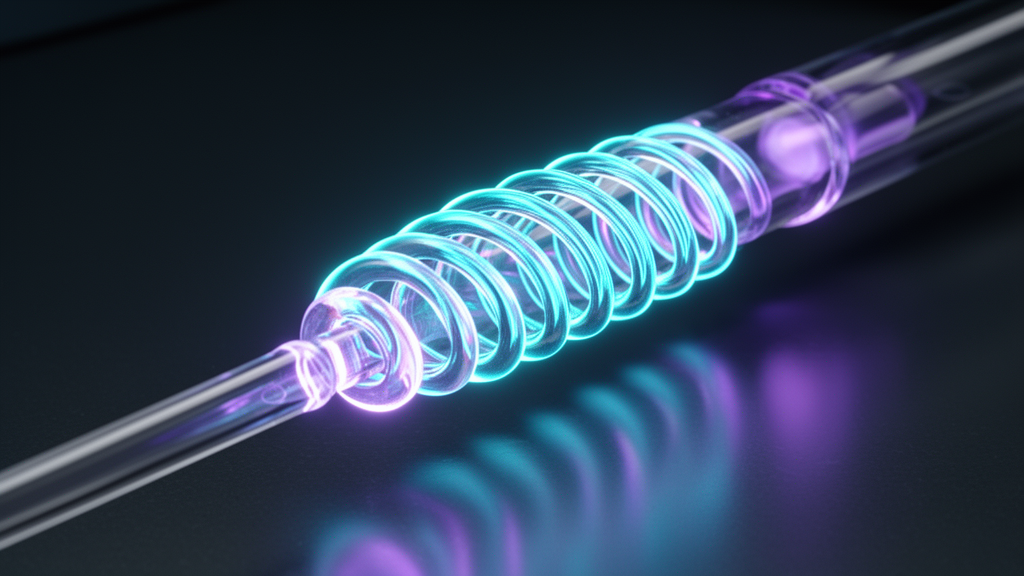
The experimental random laser consisted of a five-centimeter polymer optical fiber doped with the laser dye PM597 and core-shell iron oxide and silica nanoparticles. The polymer optical fiber functioned as a multimode waveguide that weakly confined propagating light along its length while remaining structurally nonchiral. Inside the core, the embedded iron oxide and silica nanoparticles provided strong elastic multiple scattering, establishing closed and quasi-closed optical feedback loops without mirrors. PM597 is an achiral laser dye characterized by a well-defined linear transition dipole moment oriented along its molecular axis. While PM597 exhibits anisotropic gain under linearly polarized excitation when embedded in rigid polymer hosts where rotational diffusion is restricted, the molecule possesses no chiral centers and cannot intrinsically generate circular polarization. Control measurements conducted on pure PM597 dye solutions lacking scattering nanoparticles exhibited broadband spontaneous emission and amplified spontaneous emission with negligible circular Stokes components, confirming that the dye alone cannot produce circular polarization.
To evaluate the polarization state of the emitted radiation, the investigators implemented a comprehensive polarimetric detection system to measure all four Stokes parameters: total intensity, orthogonal linear components, and the circular component. The circular polarization asymmetry was primarily quantified through the normalized circular Stokes parameter, which directly relates to the conventional luminescence dissymmetry factor by a factor of two. Reference calibrations using a helium-neon laser and standard silica optical fibers established a detection noise floor of approximately 0.1 for the circular Stokes component, while setting upper bounds on the total degree of polarization near unity for the gas laser and 0.8 for silica fibers. In the nanoparticle-doped polymer fiber under multiple scattering conditions, the total degree of polarization settled near 0.6 due to modal mixing across the spectrometer collection aperture. These calibrations verified that any measured circular Stokes signal exceeding 0.1 represented an authentic physical feature of the random fiber laser.
Spectrally resolved polarimetric measurements revealed a dramatic transition in the polarization behavior across the lasing threshold under both linear and circular optical pumping. Below the lasing threshold, emission from the nanoparticle-doped fiber was spectrally broad and smooth, with the circular Stokes component remaining confined within the experimental noise floor below 0.1. Once the pump energy exceeded the lasing threshold, sharp and discrete random lasing peaks abruptly emerged across the spectrum, accompanied by the spontaneous appearance of finite positive and negative circular Stokes values exceeding 0.1. Crucially, the circular polarization was mode-resolved: adjacent spectral modes within the same emission spectrum exhibited opposite signs of circular handedness. When the fiber was excited with circularly polarized pump pulses, the overall magnitude of the circular Stokes component increased, but the emitted handedness continued to alternate across wavelength rather than copying the pump helicity. This proved that the emitted polarization was not simply transferred from the excitation beam.
To explain how circular polarization emerges from nonchiral components, the authors developed a non-Hermitian theoretical model describing two coupled lasing modes. Formulated in a circular polarization basis, the effective Hamiltonian incorporated an intermodal coupling parameter arising from multiple scattering alongside distinct residual gains for each mode above threshold. Solving the eigenvalue problem revealed that each individual non-Hermitian eigenmode is strictly linearly polarized. However, when evaluating the frequency-resolved circular Stokes parameter using the spectral representation of the Green operator, the diagonal terms corresponding to isolated eigenmodes vanished completely. Instead, circular polarization originated entirely from off-diagonal interference terms between spectrally overlapping modes. The resulting analytical expression demonstrated that the normalized circular Stokes component is proportional to the difference between the squared residual gains of the two modes, divided by their sum and detuning terms. Gain saturation and modal competition select coexisting modes whose finite linewidths overlap, allowing mutual interference to generate net circular polarization.
The physical mechanism was further corroborated by investigating how transverse excitation geometry influences modal selection and polarization output. By shifting the lateral position of the pump beam across the fiber end face—moving from an intermediate offset to the fiber edge—the researchers observed marked changes in the lasing threshold and the spectral positions of active modes. Because the spatial overlap between the pumped gain volume and the transverse profiles of guided fiber modes varies with pump position, shifting the excitation redistributed the effective gains and scattering paths available to individual modes. Consequently, the circular Stokes spectra displayed distinct peak positions, altered amplitudes, and reversed signs between different pumping positions. Off-center excitation produced notably larger circular Stokes values than centered pumping, demonstrating that local excitation alignment actively dictates the residual gain differences and interference conditions among competing modes.
Spatial polarimetry in the back focal plane of the collection objective provided momentum-space imaging of the emitted laser modes. Analyzing intensity percentiles revealed that the highest emission intensities were concentrated within discrete filamentary channels, with the top ten percent of pixels forming localized radial paths that broadened smoothly into surrounding channels at the twenty percent threshold. Spatially resolved polarization maps demonstrated that linear and circular polarization states were organized along these radial filaments. While the degree of linear polarization remained positive and relatively stable between 0.2 and 0.4 along azimuthal trajectories at fixed radial momentum, the circular Stokes parameter exhibited rapid oscillations and frequent sign reversals across adjacent angular sectors. This spatial decoupling between linear and circular components confirmed that circular polarization is not generated by uniform linear-to-circular birefringence conversion, but by localized modal interference distributed heterogeneously across the active disordered network.
Statistical evaluation of the normalized Stokes vectors on the Poincaré sphere illustrated the macroscopic self-organization of polarization states as pump energy increased across eight experimental groups. Below the lasing threshold, the reconstructed Stokes point cloud remained tightly confined to the equatorial plane of the Poincaré sphere, reflecting negligible circular polarization and an anisotropy parameter exceeding 4.0. As the pump power surpassed the threshold, the point cloud expanded markedly into three dimensions along the polar axis, driving the anisotropy parameter down toward 2.0 as the distribution became more isotropic. Concurrently, both the maximum and ninety-fifth percentile values of the circular Stokes magnitude increased substantially from lower to higher pump groups. The mean degree of polarization peaked at intermediate pump powers near 0.31 before decreasing slightly at the highest energies, reflecting enhanced coherence at threshold followed by increased intermodal mixing and competition at elevated pumping levels.
The authors emphasized that these findings do not describe a globally circularly polarized laser, because spatial and spectral integration across the entire fiber output averages positive and negative contributions to near zero. Instead, the study establishes that circular polarization asymmetry can self-organize locally within discrete spectral modes and spatial channels of a nonchiral active system. Mode selection enforced by gain saturation, combined with the phase-sensitive interference of quasi-degenerate vector modes possessing unequal residual gains, provides an autonomous mechanism for breaking polarization symmetry in disordered media. By proving that circular polarization does not require structural or material chirality, this research establishes modal dynamics as a versatile degree of freedom for controlling vectorial light states in complex photonic systems, opening new possibilities for channel-selective polarization control and speckle-free active illumination.
Subject of Research: Spontaneous emergence of circular polarization asymmetry in nonchiral random fiber lasers
Article Title: Mode resolved self-organized circular polarization asymmetry in a nonchiral random fiber laser
Article References: Du, W., Tommasi, F., Cavalieri, S., Cherroret, N., Wiersma, D. S., & Riboli, F. (2026). Mode resolved self-organized circular polarization asymmetry in a nonchiral random fiber laser. Light: Science & Applications, 15(1), Article 403. https://doi.org/10.1038/s41377-026-02534-9
Image Credits: AI Generated
DOI: 10.1038/s41377-026-02534-9
Keywords: random lasers, circular polarization, nonchiral optics, polymer optical fibers, laser modes, optical scattering, Stokes parameters, non-Hermitian physics, mode competition, laser dye PM597, scattering nanoparticles, Poincare sphere, polarimetry, gain saturation, optical feedback, degree of polarization, k-space imaging
News Source: Denise Maddox. (November 20, 2026). Nonchiral Random Fiber Laser Generates Self-Organized Circular Polarization Through Mode Interference. Scienmag.