• HOME
  • NEWS
  • EXPLORE
    • CAREER
      • Companies
      • Jobs
    • EVENTS
    • iGEM
      • News
      • Team
    • PHOTOS
    • VIDEO
    • WIKI
  • BLOG
  • COMMUNITY
    • FACEBOOK
    • INSTAGRAM
    • TWITTER
Monday, October 5, 2026
BIOENGINEER.ORG
No Result
View All Result
  • Login
  • HOME
  • NEWS
  • EXPLORE
    • CAREER
      • Companies
      • Jobs
        • Lecturer
        • PhD Studentship
        • Postdoc
        • Research Assistant
    • EVENTS
    • iGEM
      • News
      • Team
    • PHOTOS
    • VIDEO
    • WIKI
  • BLOG
  • COMMUNITY
    • FACEBOOK
    • INSTAGRAM
    • TWITTER
No Result
View All Result
Bioengineer.org
No Result
View All Result
Home NEWS Science News Chemistry

Noble metal aerogels enabled by freezing

Bioengineer by Bioengineer
May 13, 2020
in Chemistry
Reading Time: 2 mins read
0
IMAGE
Share on FacebookShare on TwitterShare on LinkedinShare on RedditShare on Telegram

Multi-scale structured materials for electrocatalysis and photoelectrocatalysis
IMAGE

Credit: Wiley-VCH

As a new class of porous materials, noble metal aerogels (NMAs) have drawn tremendous attention because of their combined features including self-supported architectures, high surface areas, and numerous optically and catalytically active sites, enabling their impressive performance in diverse fields. However, current fabrication methods suffer from long fabrication periods, unavoidable impurities, and uncontrolled multiscale structures, discouraging their fundamental and application-orientated studies.

Dr. Ran Du from China has been an Alexander von Humboldt research fellow at TU Dresden since 2017. In collaboration with the Dresden chemists Dr. Jan-Ole Joswig and Professor Alexander Eychmüller, they recently crafted a novel freeze-thaw method capable of acquiring various multi-scale structured noble metal aerogels as superior photoelectrocatalysts for electro-oxidation of ethanol, promoting the application for fuel cells. Their work has now been published as cover story in the prestigious journal Angewandte Chemie International Edition.

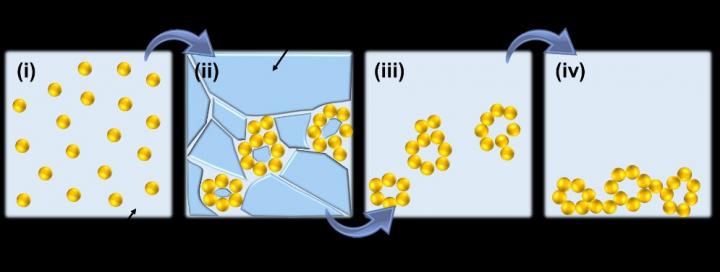
Ran Du and his team have found unusual self-healing properties of noble metal gels in their previous works. Inspired by this fact, a freeze-thaw method was developed as an additive-free approach to directly destabilise various dilute metal nanoparticle solutions (concentration of 0.2?0.5 mM). Upon freezing, large aggregates were generated due to the intensified salting-out effects incurred by the dramatically raised local solute concentration; meanwhile, they were shaped at micrometer scale by in situ formed ice crystals. After thawing, aggregates settled down and assembled to monolithic hydrogels as a result of their self-healing properties. Purified and dried, clean hydrogels and the corresponding aerogels were obtained.

Due to the hierarchically porous structures, the cleanliness, and the combined catalytic/optical properties, the resulting gold-palladium (Au-Pd) aerogels were found to display impressive light-driven photoelectrocatalytic performance, delivering a current density of up to 6.5 times higher than that of commercial palladium-on-carbon (Pd/C) for the ethanol oxidation reaction.

“The current work provides a new idea to create clean and hierarchically structured gel materials directly from dilute precursor solutions, and it should adapt to various material systems for enhanced application performance for catalysis and beyond”, assumes chemist Ran Du.

###

Original Publication:

Du, R., Joswig, J.-O., Hübner, R., Zhou, L., Wei, W., Hu, Y., Eychmüller, A. (2020). Freeze-Thaw-Promoted Fabrication of Clean and Hierarchically-Structured Noble Metal Gels for Electrocatalysis and Photoelectrocatalysis. Angew. Chem. Int. Ed., DOI: 10.1002/anie.201916484.

Media Contact
Nicole Gierig
[email protected]

Related Journal Article

http://dx.doi.org/10.1002/anie.201916484

Tags: Chemistry/Physics/Materials Sciences
Share12Tweet8Share2ShareShareShare2

Related Posts

Clove-Derived Flame Retardant Gives Polyester Fabrics a Fire-Resistant, Eco-Friendly Coat

Clove-Derived Flame Retardant Gives Polyester Fabrics a Fire-Resistant, Eco-Friendly Coat

October 5, 2026
Castor Plant Chemistry Shows Surprising Anti-Inflammatory Power in Lab Tests

Castor Plant Chemistry Shows Surprising Anti-Inflammatory Power in Lab Tests

October 5, 2026

Physicists Use Rotating Light to Reveal Hidden Eight-Pole Magnetism in Crystals

October 5, 2026

Graphene-Anchored Bismuth-Antimony Sulfide Nanorods Boost Lithium and Sodium Battery Anodes

October 5, 2026
Please login to join discussion

POPULAR NEWS

  • Alloys That Shrink Their Own Grains: New PIX Mechanism Refines Metals With Heat Alone

    Alloys That Shrink Their Own Grains: New PIX Mechanism Refines Metals With Heat Alone

    29 shares
    Share 12 Tweet 7
  • Endurance Exercise Reshapes the Liver in Males and Females Through Distinct Molecular Routes

    29 shares
    Share 12 Tweet 7
  • Single Transcription Factor PU.1 Rapidly Converts Fibroblasts into Macrophage-Lineage Cells

    29 shares
    Share 12 Tweet 7
  • New Scale Measures How Ready Nurse Educators Really Are for the AI Era

    29 shares
    Share 12 Tweet 7

About

We bring you the latest biotechnology news from best research centers and universities around the world. Check our website.

Follow us

Recent News

Alloys That Shrink Their Own Grains: New PIX Mechanism Refines Metals With Heat Alone

Endurance Exercise Reshapes the Liver in Males and Females Through Distinct Molecular Routes

Single Transcription Factor PU.1 Rapidly Converts Fibroblasts into Macrophage-Lineage Cells

Subscribe to Blog via Email

Success! An email was just sent to confirm your subscription. Please find the email now and click 'Confirm' to start subscribing.

Join 85 other subscribers
  • Contact Us

Bioengineer.org © Copyright 2023 All Rights Reserved.

Welcome Back!

Login to your account below

Forgotten Password?

Retrieve your password

Please enter your username or email address to reset your password.

Log In
No Result
View All Result
  • Homepages
    • Home Page 1
    • Home Page 2
  • News
  • National
  • Business
  • Health
  • Lifestyle
  • Science

Bioengineer.org © Copyright 2023 All Rights Reserved.