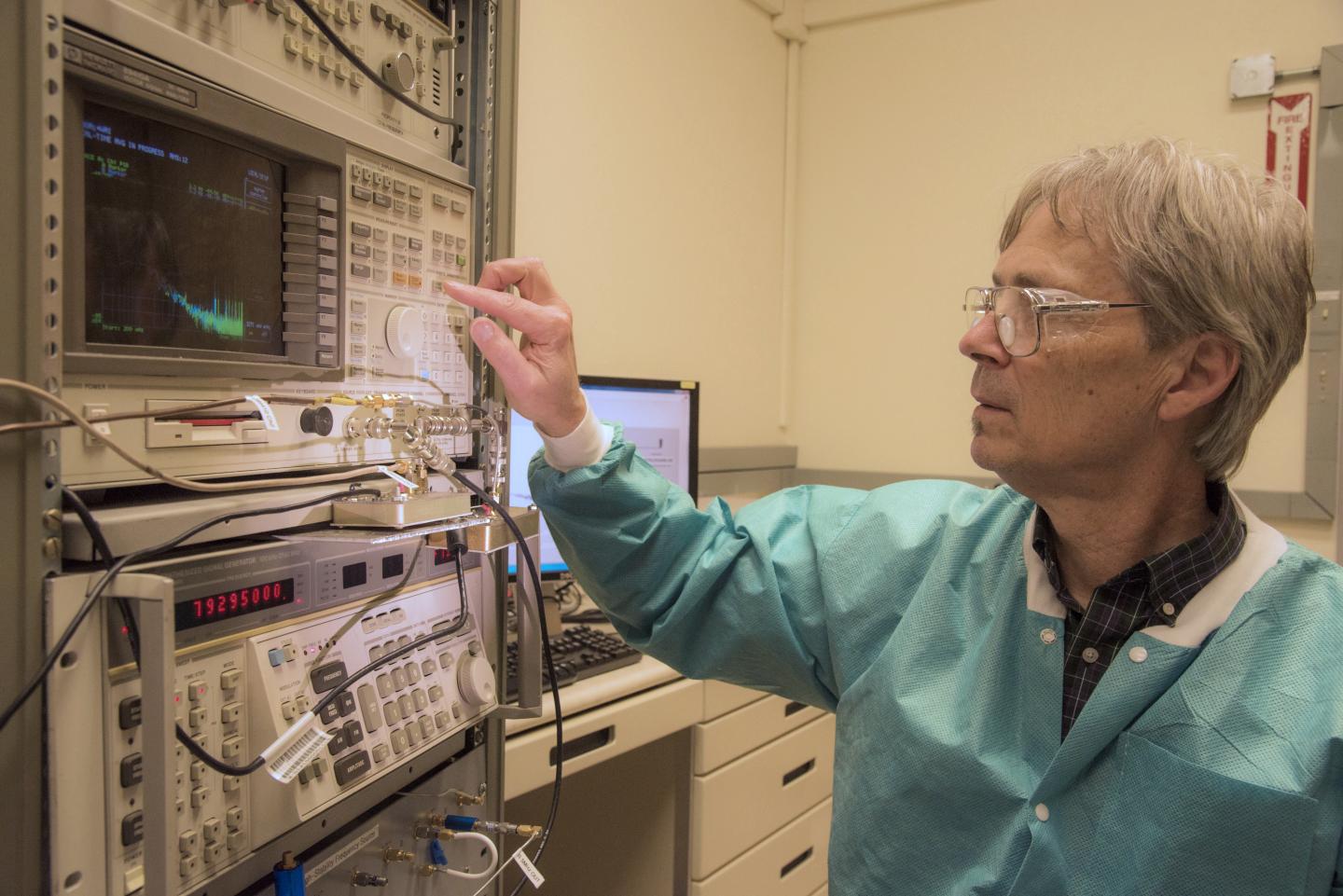
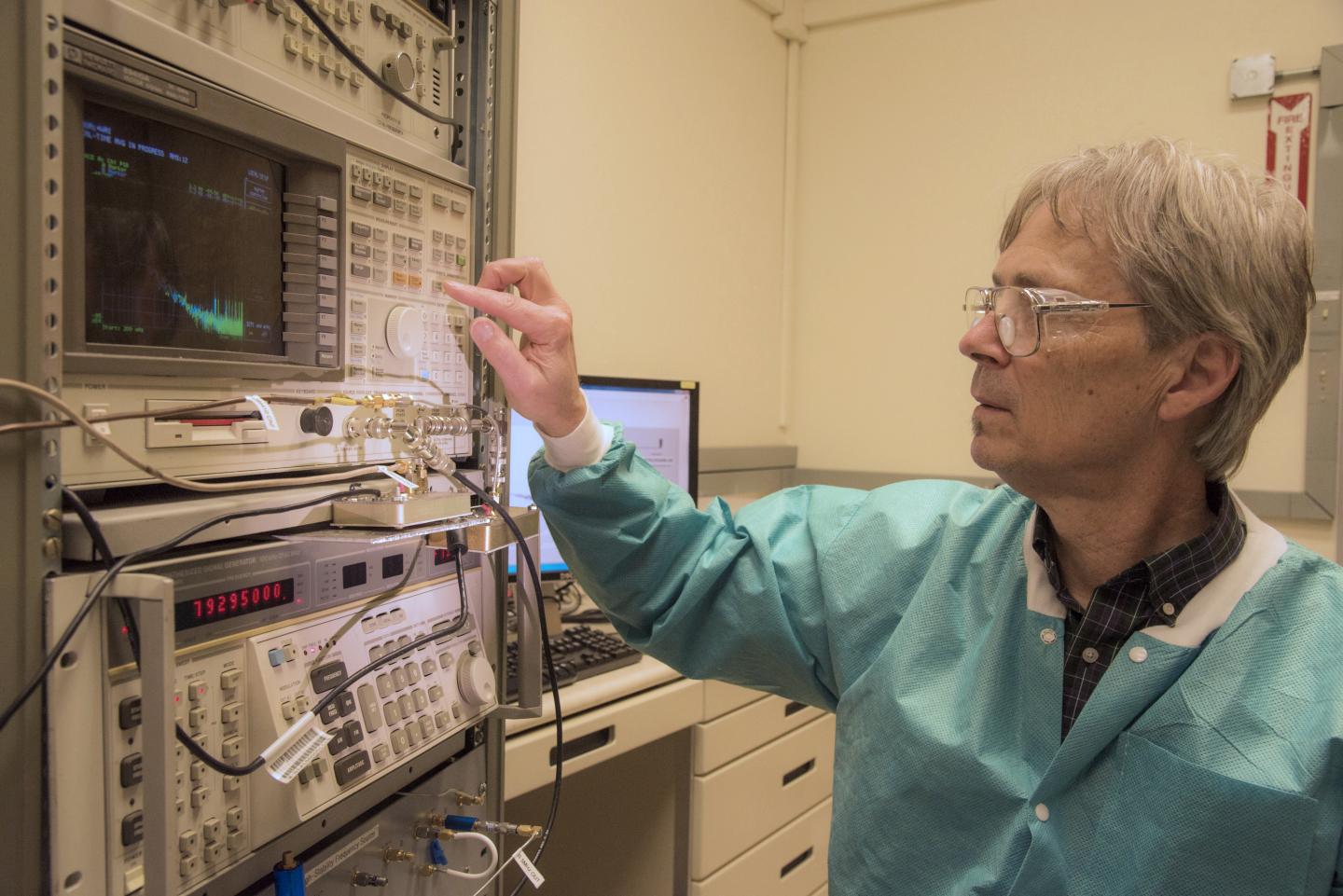
Credit: Burrus/NIST
BOULDER, Colo.–Researchers at the National Institute of Standards and Technology (NIST) have demonstrated a potential new tactic for rapidly determining whether an antibiotic combats a given infection, thus hastening effective medical treatment and limiting the development of drug-resistant bacteria. Their method can quickly sense mechanical fluctuations of bacterial cells and any changes induced by an antibiotic.
Described in Scientific Reports, NIST's prototype sensor provides results in less than an hour, much faster than conventional antimicrobial tests, which typically require days to grow colonies of bacterial cells. Delayed results from conventional tests allow dangerous infections to progress before effective treatments can be found and provides a time window for bacteria to develop drug resistance.
Improperly prescribed antibiotics and antibiotic-resistant bacteria pose serious threats to public health. At least 2 million illnesses and 23,000 deaths are attributed to antibiotic-resistant bacterial infections in the United States each year, according to a 2013 report from the Centers for Disease Control and Prevention.
One solution may be the new NIST sensing approach, based on a quartz-crystal resonator whose vibrations vary in measurable ways when particles on the surface change. The approach, which involves bacterial cells adhered to a resonator, represents a new way of using these super-sensitive crystals, which NIST researchers previously demonstrated for applications such as measuring carbon nanotube purity.
The new NIST technique senses the mechanical motion of microbes and their response to antibiotics. Other researchers previously found that some bacterial motion becomes weaker in the presence of some antibiotics, but until now such changes have been detected only with microscale sensors and generally in motile bacteria (propelled by threadlike appendages called flagella). The NIST method may be more useful in clinical settings because it collects electronic data cost-effectively and, since it senses large bacterial colonies, can be macroscopic and robust.
The sensor is piezoelectric, which means its dimensions change when exposed to an electric field. A thin piezoelectric quartz disk is sandwiched between two electrodes. An alternating voltage at a stable frequency near the crystal's resonant frequency is applied to one electrode to excite crystal vibrations. From another electrode on the opposite side of the crystal, researchers record oscillating voltages of the crystal response, a signal that shows fluctuations in the resonant frequency (or frequency noise) arising from microbial mechanical activity coupled to the crystal surface.
Proof of concept tests at NIST used two quartz-crystal resonators coated with several million bacterial cells. One resonator was used to test the effect of an antibiotic on the cells, while the second resonator was used as a control without the antibiotic.
The ultra-sensitive approach enabled detection of cell-generated frequency fluctuations at a level of less than one part in 10 billion. The experiments showed that the amount of frequency noise was correlated with the density of living bacterial cells. When the bacteria were then exposed to antibiotics, frequency noise sharply decreased. Bacteria with paralyzed flagella were used in the experiments to eliminate effects of swimming motion. This enabled the researchers to conclude that the detected cell-generated frequency fluctuations arise from vibrations of cell walls.
NIST researchers sensed the response of Escherichia coli (E. coli) to two antibiotics, polymyxin B (PMB) and ampicillin. Cell-generated frequency noise dropped close to zero within 7 minutes after the introduction of PMB. Frequency noise began decreasing within 15 minutes of adding ampicillin and then dropped more rapidly as cells broke apart and died. These time scales reflect the normal speeds at which these antibiotics work.
After the sensor measurements, the effectiveness of the antibiotics was confirmed by growth of colonies from the remaining bacteria. Both antibiotics greatly reduced the numbers of live cells.
To determine how broadly useful the technique might be, further studies will be needed using a number of bacterial species and antibiotics that work in different ways. NIST researchers have been granted a patent on the technique: RESONATOR AND PROCESS FOR PERFORMING BIOLOGICAL ASSAY, U. S. Patent No. 9,725,752, issued August 8, 2017. Companies interested in licensing the patent may contact Don Archer of NIST's Technology Partnerships Office at [email protected] or 301-975-2522. Ultimately, the NIST sensor may be suitable for rapid antimicrobial susceptibility testing (called AST) in clinical settings and drug development.
###
Paper: W.L. Johnson, D.C. France, N.S. Rentz, W.T. Cordell, and F.L. Walls. 2017. Sensing bacterial vibrations and early response to antibiotics with phase noise of a resonant crystal. Scientific Reports. Sept. 22.
Media Contact
Laura Ost
[email protected]
@usnistgov
http://www.nist.gov