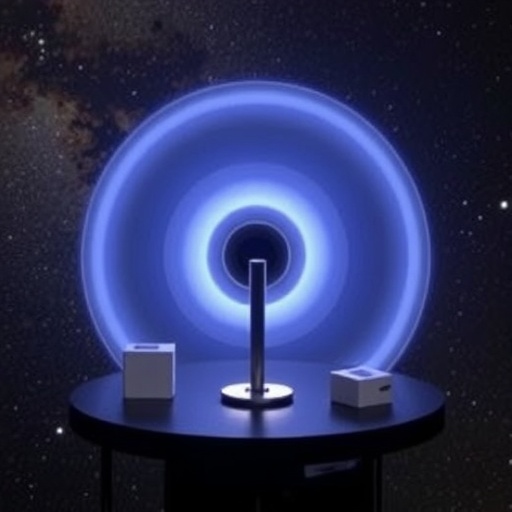
In the annals of physics, few constants hold as much intrigue as the universal gravitational constant, commonly referred to as “big G.” Despite its foundational role in quantifying the gravitational attraction between masses, the precise measurement of big G has remained one of the most stubborn challenges in the scientific community. Now, after a decade-long experimental pursuit, researchers at the National Institute of Standards and Technology (NIST) have offered fresh insight, delivering a new measurement of big G that deepens the enigma surrounding this fundamental quantity.
Big G governs the gravitational force between objects, quantitatively describing how bodies attract each other across the vast expanses of space. Newton’s law of gravitation, formulated over three centuries ago, expresses this force as proportional to the product of two masses and inversely proportional to the square of their separation, with big G as the constant of proportionality. Yet, despite gravity’s pervasive influence—from holding planets in orbit to shaping galaxies—the exact value of big G has proven remarkably elusive to pinpoint with absolute precision.
One of the core reasons big G resists precise measurement lies in the inherent weakness of gravity compared to other fundamental forces. While electromagnetic and nuclear forces exhibit strengths that allow easy detection and manipulation on a laboratory scale, gravitational interactions between small masses are vanishingly tiny. To appreciate this contrast, one might consider that a diminutive magnet can effortlessly levitate a paper clip, generating a force far more potent than the gravitational pull exerted by the entire Earth. This intrinsic feebleness compounds the difficulty of detecting gravitational effects in controlled experiments, where the masses involved are minuscule compared to celestial bodies.
Over the last two centuries, physicists have deployed increasingly sophisticated apparatuses to measure big G, yet their efforts have yielded a perplexing scatter of results. Slight deviations—on the order of a few parts in 10,000—persist between different experimental values, a divergence too great to be dismissed as mere random error. This variability has prompted an ongoing scientific debate: are these discrepancies due to hidden systematic errors, or do they hint at unforeseen physics beyond our current grasp?
Stephan Schlamminger, a physicist at NIST, undertook a meticulous approach to address this conundrum by independently replicating a highly precise but contentious 2007 experiment conducted by the International Bureau of Weights and Measures (BIPM) in France. Employing a device known as a torsion balance—a technique that dates back to Henry Cavendish’s 18th-century experiments—Schlamminger and his team created a sophisticated setup to detect the infinitely small torques resulting from gravitational attraction between carefully measured masses.
The torsion balance leverages the twisting of a fiber holding a suspended mass as a sensitive gauge of force. In this study, NIST scientists used an array of eight cylindrical metal masses arranged meticulously on and within a rotating carousel, with the twist imparted by gravitational forces measured against twisting induced electrostatically through electric voltages applied to specific electrodes. This dual-measurement technique provided two independent determinations of gravitational torque, enhancing the robustness of the results and reducing uncertainties caused by mechanical imperfections.
Innovation extended beyond equipment design to the data analysis process itself. To avoid biasing outcomes toward previously published values, Schlamminger enlisted a colleague to scramble the experimental data by introducing unknown offsets into the measured masses. This blinding ensured that he could not inadvertently tune the experiment to confirm expected outcomes, a rigorous practice that adds significant credibility to the findings once the “secret number” is revealed.
When the results were finally unveiled at a conference in 2024, they painted a nuanced picture. The value for big G obtained by the NIST team, 6.67387 × 10^−11 m³/kg/s², was measurably lower—by about 0.0235%—than the earlier BIPM measurement. While this discrepancy is minor in practical terms, such as routine weighing or engineering calculations, it is substantial in the realm of fundamental constants, where most are known to several parts per million or better precision. This persistent disagreement underscores how gravity remains the most enigmatic of nature’s fundamental interactions.
The implications extend beyond mere number crunching. Throughout scientific history, minute inconsistencies in fundamental constants have presaged revolutionary insights. Whether signaling undiscovered phenomena or prompting refinements in experimental technique, these anomalies challenge physicists to refine their understanding of nature’s underlying framework.
The heritage of this scientific saga traces back to Henry Cavendish’s pioneering experiment in 1798. Cavendish employed a wooden beam suspended by a thin wire with small and large lead spheres arranged so that gravitational forces caused measurable torsion. Modern iterations have preserved the core principle but introduced remarkable improvements in materials, instrumentation sensitivity, and control of extraneous variables such as air flow, temperature, and electromagnetic interference.
To dig deeper, Schlamminger’s team tested whether differing material compositions affected results, conducting measurements with both copper and sapphire masses. Their findings revealed no significant difference in the measured gravitational constant, helping to rule out potential confounding effects of mass composition on gravitational interactions at laboratory scales.
Though the decade-long effort by NIST scientists has not resolved the riddle of big G once and for all, it provides a crucial addition to the collective corpus of evidence. Schlamminger himself remarked on the importance of the endeavor, emphasizing that regardless of whether the new measurement corroborated or challenged earlier values, the pursuit of precise knowledge serves to “bring order to the universe.” As he steps back from this quest, he invites successive generations of physicists to tackle the mysteries that stubbornly surround gravity.
Finally, it is important to distinguish big G from the more familiar little g. While big G is universal and constant throughout the cosmos, little g is the local acceleration due to gravity at a planet’s surface, varying with location and planetary body. For example, little g on the Moon is roughly one-sixth that on Earth, reflecting the Moon’s lower mass. In Newton’s gravitational formula, big G bridges the theoretical relationship, while little g manifests as the measurable force we experience daily. Together, these parameters illuminate the nature and scale of gravity, from laboratory torsion balances to planetary orbits.
This meticulous redetermination of the gravitational constant exemplifies the tenacity of experimental physics and the delicate complexities involved in studying a force that governs the cosmos but is surprisingly difficult to quantify with absolute precision here on Earth. The quest for big G is far from over, but each incremental advance paves the way for deeper insight into the invisible threads that weave the fabric of our universe.
Subject of Research: Not applicable
Article Title: Redetermination of the gravitational constant with the BIPM torsion balance at NIST
News Publication Date: April 16, 2026
Web References: https://doi.org/10.1088/1681-7575/ae570f
References: S. Schlamminger et al., Metrologia, 2026
Image Credits: R. Eskalis/NIST, S. Kelley/NIST
Keywords
Physical sciences, Physics, Research methods, Gravitational constant, Torsion balance, Fundamental constants, Experimental physics
Tags: advances in gravitational constant determinationbig G physics challengeschallenges in measuring big Gexperimental gravitational physicsfundamental forces comparisonfundamental physics constantsgravitational constant measurementgravitational force between massesgravity force quantificationNewton’s law of gravitation experimentsNIST gravitational researchuniversal gravitational constant precision