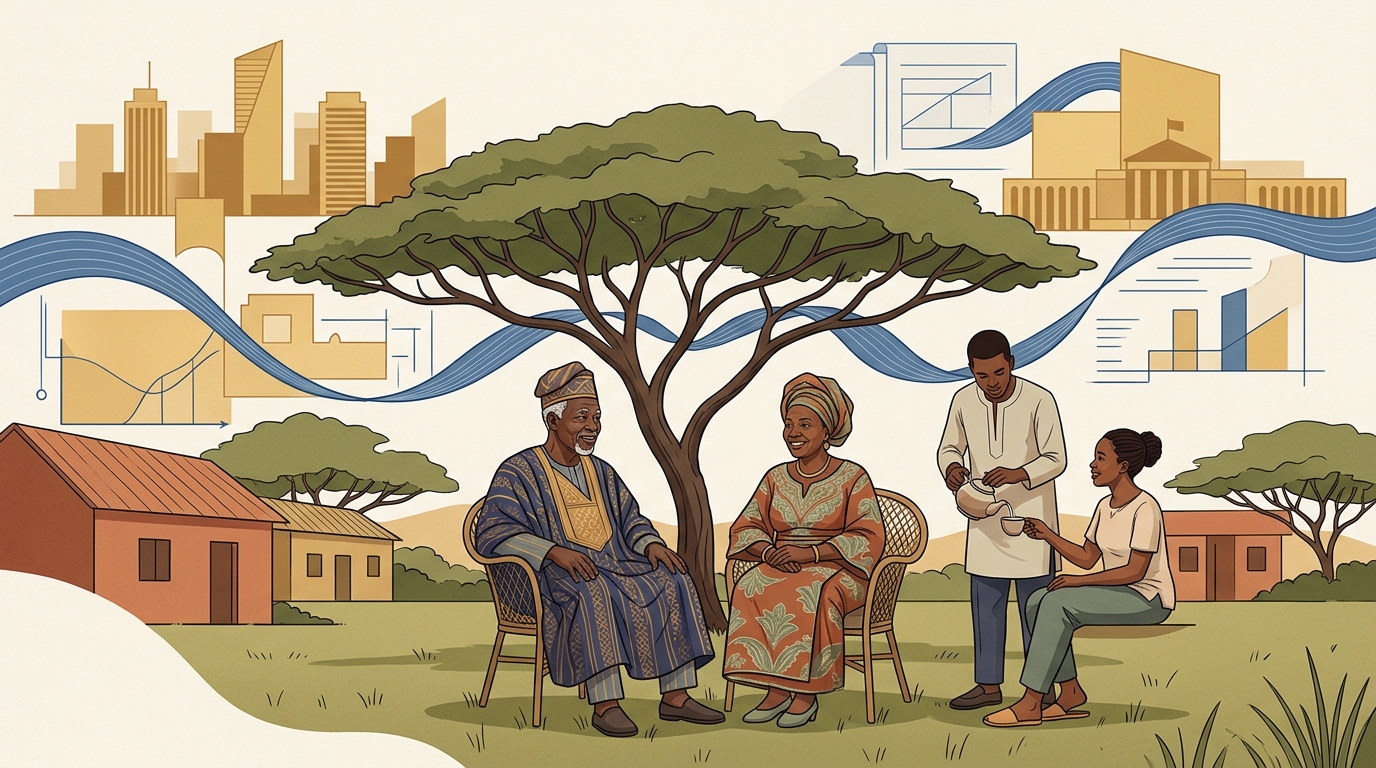
Nigeria has built an increasingly substantial set of laws and policies for its growing older population, yet the services those documents promise have not followed at the same pace. A desk-based policy analysis published in Frontiers in Aging examined why policy recognition of ageing has expanded over two decades while older Nigerians still face fragmented services, weak financial protection, and substantial barriers to healthcare. The study applied Walt and Gilson’s Health Policy Triangle, a framework that analyses policy through four interacting domains: context, actors, content, and process. Researchers purposively identified legislation, policy documents, institutional reports, and peer-reviewed literature, paying particular attention to five major national developments enacted or approved between 2004 and 2022.
The demographic backdrop is stark. By 2020, approximately 9.4 million Nigerians were aged 60 years or older, and this ageing is occurring alongside high out-of-pocket healthcare expenditure, limited income protection, a growing chronic disease burden, and inequalities in healthcare access. Specialist geriatric capacity remains limited, primary healthcare is not consistently equipped for age-responsive care, and formal long-term care remains underdeveloped. Globally, the number of people aged 65 and above is projected to rise from roughly 761 million in 2021 to 1.6 billion by 2050, with growth particularly substantial in low- and middle-income countries whose health systems often face considerable constraints in responding to changing patterns of disease and care needs.
The five core policy instruments form an expanding architecture. The Pension Reform Act of 2004, replaced in 2014, established a Contributory Pension Scheme to strengthen retirement income security for covered public and private sector employees. The National Health Act 2014 created the legal framework for regulating and coordinating Nigeria’s health system and introduced the Basic Healthcare Provision Fund to strengthen primary healthcare and advance universal health coverage. The National Senior Citizens Centre Act 2017 established a centre to coordinate programmes and services promoting the healthcare, welfare, participation, and wellbeing of older people. The National Policy on Ageing, approved in 2021, set out a comprehensive national framework addressing health, dignity, participation, security, rights, and social protection of older persons. The National Health Insurance Authority Act 2022 established the NHIA and a Vulnerable Group Fund, strengthening the legal basis for subsidised healthcare and financial protection for vulnerable populations.
Yet the analysis found a persistent gap between commitment and delivery. Healthcare provision remains insufficiently adapted to older adults’ needs: many rely on general outpatient and primary healthcare services with gaps in geriatric competencies, age-appropriate infrastructure, screening, outreach, and continuity of care. Formal long-term care is underdeveloped, leaving families and informal caregivers with substantial responsibility at a time when migration, urbanisation, changing household structures, and economic pressures are weakening traditional support arrangements. Pension coverage remains limited, particularly among people who have worked in the informal economy, and financial vulnerability continues to affect healthcare affordability. Implementation capacity, sustainable financing, and effective coverage of vulnerable populations remain important concerns, although the National Pension Commission has more recently advanced a free healthcare initiative for low-income retirees under the Contributory Pension Scheme.
The Health Policy Triangle analysis traced the implementation gap to interacting constraints across all four domains. In the context domain, demand for chronic, continuing, and age-responsive care is rising within a system that must simultaneously address infectious diseases, maternal and child health priorities, workforce shortages, and persistent underfunding, so ageing competes for institutional attention and resources in an already constrained environment. On the actor side, responsibility is dispersed across the Federal Ministry of Health, the NHIA, the National Primary Healthcare Development Agency, the National Senior Citizens Centre, state authorities, and social protection institutions, creating a governance challenge in which implementation requires coordination across institutions that do not operate within a single delivery structure. Older adults and caregivers, despite having the greatest direct stake in outcomes, remain comparatively weakly represented in health governance and decision-making.
Content and process revealed complementary weaknesses. The principal content problem is not an absence of policy but the limited translation of broad commitments into sufficiently detailed delivery mechanisms: long-term care, age-responsive primary healthcare, geriatric workforce development, rehabilitation, home-based support, and coordinated management of chronic and complex conditions remain underdeveloped. In the process domain, policy formulation has advanced more rapidly than operationalisation, with implementation affected by fragmented execution, weak coordination, inadequate monitoring, and limited evaluation. Financing pathways exist in principle through the Basic Healthcare Provision Fund and the NHIA Vulnerable Group Fund, but ageing-related programmes operate within wider fiscal constraints and do not consistently benefit from predictable, adequately costed resources. Limited age-disaggregated information further restricts needs assessment, resource allocation, monitoring, and accountability. The study concluded that these factors are mutually reinforcing: fragmented responsibility complicates coordination, uncertain financing restricts operationalisation, and limited information weakens the ability to assess whether commitments are being implemented.
To identify possible responses, the researchers examined four participatory health system innovations elsewhere in Africa, treating them as sources of potentially transferable principles rather than models for direct replication. Zimbabwe’s Friendship Bench demonstrates how trained lay health workers can extend access to structured psychosocial support through primary healthcare; its broader relevance lies in task sharing, in which selected functions are delivered by appropriately trained and supervised nonspecialists when specialist capacity is limited. However, the programme was developed for adults with common mental disorders rather than older populations specifically, and its effectiveness for dementia, frailty, multimorbidity, or functional decline is not established. A community-based peer support intervention in Cape Town, South Africa, positioned older adults as active contributors to care through home visits and social support, with reported improvements in wellbeing, physical activity, and loneliness among vulnerable low-income older adults, but it was small, geographically restricted, used relatively short follow-up, and focused primarily on wellbeing and social outcomes.
The two remaining cases illustrate organisational integration. Ghana’s Community Based Health Planning and Services programme provides an established example of decentralised primary healthcare embedded within local communities, where community health compounds, local governance structures, and community involvement in planning and oversight have supported accessibility, local ownership, and accountability; it was developed for general primary healthcare rather than older adults specifically, and existing evaluations provide limited evidence on age-disaggregated outcomes, multimorbidity, dementia, or functional decline. Rwanda’s community health worker system shows how community-based functions can be incorporated within formal health system structures through defined roles, supervision, referral pathways, and national planning, with digitally supported screening programmes demonstrating community health workers’ potential role in triage and referral coordination; much of its established evidence derives from broader population programmes, and effectiveness for complex age-related needs such as frailty, dementia, falls, multimorbidity, and functional decline remains uncertain.
Across the four cases, three principles were particularly consistent. Community-based approaches appear more sustainable when integrated within formal health system structures rather than organised as parallel initiatives. Community actors require defined roles, training, supervision, and referral pathways connecting them to formal services. And participation can extend beyond consultation to include service delivery, peer support, governance, and accountability. The authors stress that transferability is bounded: the interventions differ in populations, objectives, financing arrangements, workforce structures, and institutional environments, and evidence remains particularly limited for frailty, dementia, multimorbidity, functional decline, and long-term care, while community participation does not automatically produce equitable or sustainable outcomes. Socioeconomic disadvantage, geographical barriers, and weak financial protection may also influence who participates and who benefits. The appropriate lesson for Nigeria is therefore adaptation rather than replication, with innovations introduced progressively and evaluated through phased implementation before wider scale-up.
The study translates these findings into seven interrelated priorities: institutionalising older adult participation and co-design in health governance, developing community-based long-term care, expanding task sharing for older adults’ care, institutionalising age-friendly primary healthcare, strengthening financial protection, improving monitoring and accountability through age-disaggregated indicators, and strengthening intersectoral coordination. Participation and co-design, selected task sharing, age-disaggregated monitoring, and strengthened coordination are framed as practical early entry points that can build on existing structures, while community-based long-term care and expanded financial protection will require more progressive development and resource mobilisation. As a desk-based analysis relying on purposively identified documentary evidence, the study collected no primary data from older adults, caregivers, health workers, or policymakers, did not estimate causal policy effects, and did not assess the cost-effectiveness, affordability, or implementation feasibility of the proposed reforms. The authors therefore present the recommendations as policy-informed options requiring empirical testing and contextual adaptation, arguing that the central challenge is not formulating additional commitments but converting existing ones into coordinated and responsive systems of care.
Subject of Research: A desk-based policy analysis of why Nigeria's expanding ageing policy architecture has not translated into healthcare implementation, drawing transferable principles from participatory health system innovations in Zimbabwe, South Africa, Ghana and Rwanda.
Article Title: Strengthening older adults’ healthcare reform in Nigeria through policy analysis and lessons from participatory health system innovations in Africa
Article References: Anokwuru, C. C., Nwuzoh, M. I., Edeh, G. C., Ogbet, R. B., Udoewah, S. A., Achor, C. V., Ekwebene, O. C., Eneh, S., Obi, C. G., Onukansi, F., Ikhuoria, O. V., Oluh, C., Nwokocha, G. C., Dozie, U. W., & Chukwuocha, U. M. (2026). Strengthening older adults’ healthcare reform in Nigeria through policy analysis and lessons from participatory health system innovations in Africa. Frontiers in Aging, 7, Article 1932016. https://doi.org/10.3389/fragi.2026.1932016
Image Credits: AI Generated
DOI: 10.3389/fragi.2026.1932016
Keywords: Nigeria, population ageing, health policy analysis, Health Policy Triangle, older adults' healthcare, universal health coverage, financial protection, long-term care, community health workers, primary healthcare, Friendship Bench, implementation gap
News Source: Beatrice Stafford. (November 4, 2026). Nigeria’s ageing policies outpace delivery, African models offer lessons. Scienmag.