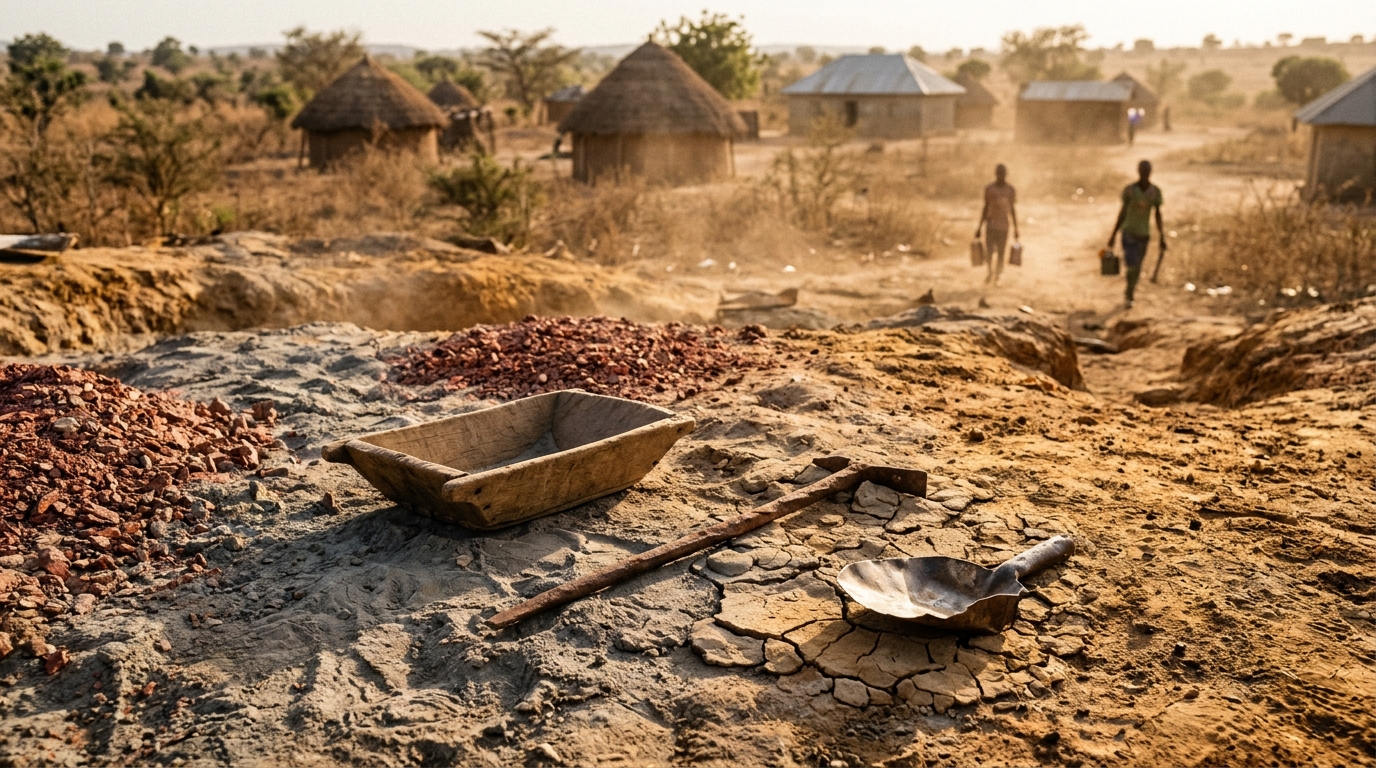
A new study published in Environmental Geochemistry and Health assesses the probabilistic health risks associated with potentially toxic metals in two artisanal mining fields in Kwara State, North-Central Nigeria. The research focuses on a gold mining field at Moro and a beryllium mining field at Ifelodun, aiming to quantify exposure in host communities where such risks are rarely evaluated using probabilistic methods. The study assessed potentially toxic element contamination and health risk on the working faces and tailings aprons of the mining fields.
The investigation involved the collection and analysis of seventy-two surface soil samples from the two mining sites. These samples were analysed by flame atomic absorption spectrophotometry after aqua regia digestion. The analysis revealed significant levels of contamination, with cadmium exceeding world-soil background levels by a factor of 113 at the Moro site and by a factor of 73 at the Ifelodun site.
Lead concentrations were also notably high, averaging 448.75 mg kg−1 at the Moro mining field. This average exceeds the 2024 United States Environmental Protection Agency residential screening level for lead, which is set at 200 mg kg−1, in every single sample collected from that site.
To evaluate the health implications of these metal concentrations, the researchers employed Monte Carlo simulation with 100,000 iterations. The simulation results indicated that adult hazard indices were below unity, with values of 0.38 at Moro and 0.20 at Ifelodun. However, the hazard indices for children reached 3.49 at Moro and 1.77 at Ifelodun, both exceeding unity.
The probability that the child hazard index exceeded unity was calculated to be 99.0% at Moro, with a 95% confidence interval of 98.3 to 99.5, and 82.4% at Ifelodun, with a confidence interval of 75.9 to 88.0. The study further noted that cancer risk estimates for all receptor groups fell between 10−6 and 10−4, with arsenic and chromium contributing over 95% of this risk. The persistence of these elevated child hazard indices was robust to various assumptions tested, including scenarios where hexavalent chromium was set to 1% of total chromium, which only lowered the Moro child index to 1.75.
Variance decomposition analysis revealed that the soil ingestion rate was the most influential factor in determining the hazard index, ranking first in every scenario and explaining 19–57% of the output variance. In contrast, the combined effect of the seven soil concentrations explained a smaller portion of the variance. This finding suggests that understanding and characterizing childhood soil ingestion behavior is more critical for reducing uncertainty in risk assessments than improving the analytical precision of metal concentration measurements. Neither correlation structure (KMO 0.47, 0.50) nor spatial analysis supported source apportionment.
The study highlights the broader context of artisanal and small-scale mining, which supports an estimated 44.75 million people directly worldwide. In Nigeria alone, approximately 260,000 artisanal gold miners rely on this sector for their livelihoods, with a further 1.3 million people dependent on the industry. However, exposure in host communities is rarely quantified probabilistically.
Subject of Research: Probabilistic health risk assessment of potentially toxic metals in Nigerian artisanal mining soils
Article Title: Variance decomposition of probabilistic health risk of potentially toxic metals at two Nigerian artisanal mining fields
Article References: Orosun, M. M., Djedidi, S., Salawu, J. O., Bello, S., Ibrahim, K. O., Ajibade, O. A., Fagbenro, M. W., & Kumar, Y. A. (2026). Variance decomposition of probabilistic health risk of potentially toxic metals at two Nigerian artisanal mining fields. Environmental Geochemistry and Health, 48(17), Article 675. https://doi.org/10.1007/s10653-026-03563-4
Image Credits: AI Generated
DOI: 10.1007/s10653-026-03563-4
Keywords: artisanal mining, health risk, toxic metals, Nigeria, soil contamination, Monte Carlo simulation, cadmium, lead, child health, environmental geochemistry, Variance, decomposition
News Source: Bethany Barker. (November 7, 2026). Nigerian Mining Study Finds High Metal Health Risks for Children. Scienmag.