The two centers will be part of a new Human Genome Reference Program
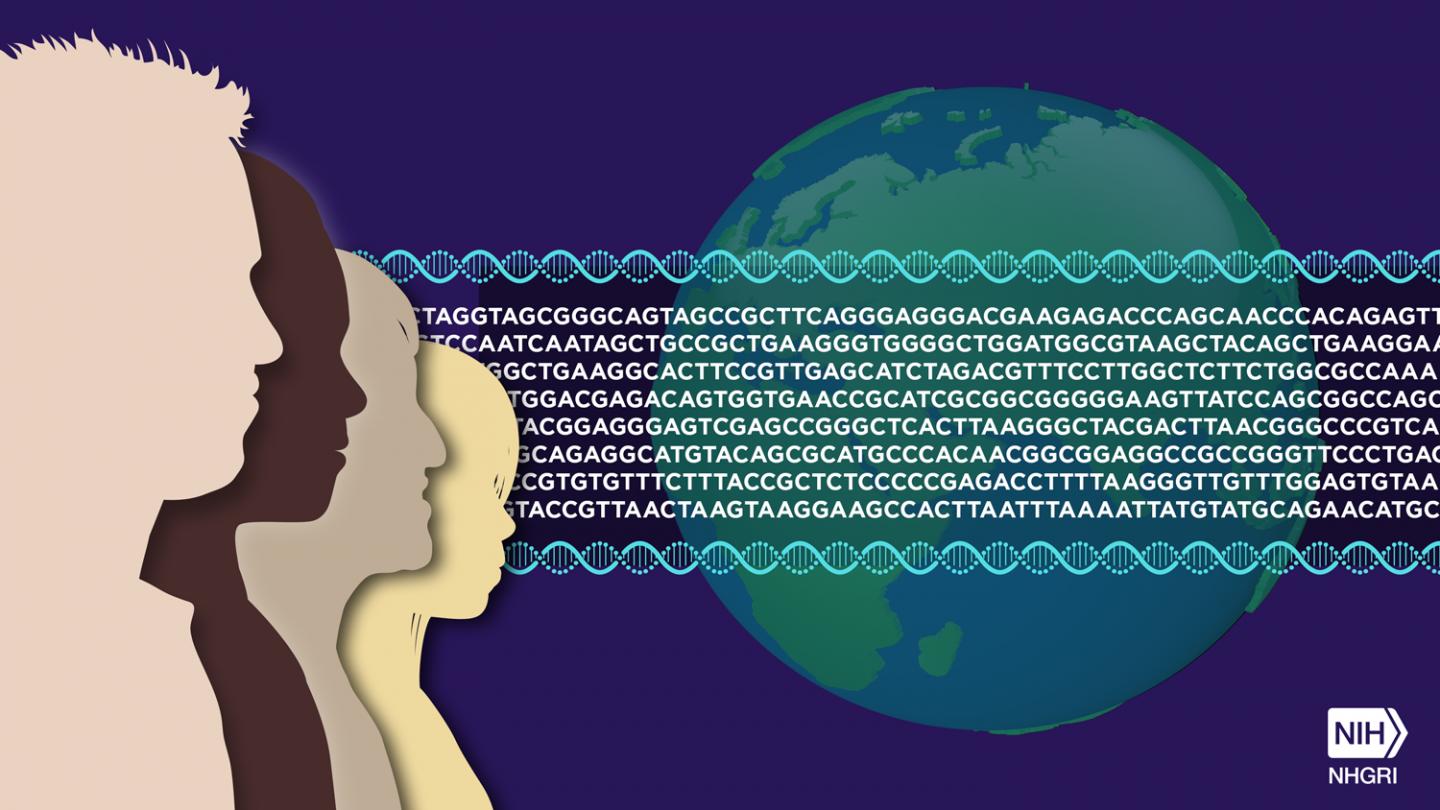
Credit: Ernesto Del Aguila III, NHGRI.
New grants totaling approximately $29.5 million will enable scientists to generate and maintain the most comprehensive reference sequence of the human genome. The awards, made over five years pending the availability of funds, are managed by the National Human Genome Research Institute (NHGRI), part of the National Institutes of Health.
The currently available reference sequence of the human genome is becoming obsolete. The funds are necessary for making advances in DNA sequencing technology and computational methods possible. As a result, NHGRI will fund two centers as a part of a new Human Genome Reference Program (HGRP).
“It has grown more and more important to have a high-quality, highly usable human genome reference sequence that represents the diversity of human populations. The proposed improvements will serve the growing basic and clinical genomics research communities by helping them interpret both research and patient genome sequences,” said Adam Felsenfeld, Ph.D., NHGRI program director in the Division of Genome Sciences.
Almost all biomedical research studies that use or analyze human genomic data rely on the established reference sequence of the human genome. In the same way that people use the puzzle picture to help assemble jigsaw puzzles, researchers use the reference genome sequence to assemble genome sequences from individuals. By advancing the quality of the available reference sequence of the human genome, the HGRP will enable researchers to find disease-causing variants and specify their genomic locations with markedly increased accuracy. An improved reference sequence will also allow scientists to report results in a way that other scientists can use in their analyses of genome sequence data.
The two centers will work with international collaborators and develop a multi-genome reference sequence that is as universal and complete as possible. Known as a ‘pan-genome,’ the more-complete reference sequence will represent 350 genomes from the human population. Over time, researchers hope that the pan-genome will reflect all human diversity, enabling analyses of any human DNA sequence.
The sequencing of the human genome was a landmark achievement in the history of science. The Human Genome Project provided a near-complete human genome sequence as a public reference. This reference has been maintained and improved since the end of the Human Genome Project by an international group, the Genome Reference Consortium. The consortium is now poised to take a bold step forward as part of the new program.
NHGRI has awarded $2.5 million per year for five years to Washington University in St. Louis (WashU), University of California, Santa Cruz (UCSC) and the European Bioinformatics Institute (EBI), which will coordinate with the National Center for Biotechnology Information, to form the WashU-UCSC-EBI Human Genome Reference Center. The center will provide a next-generation reference sequence of the human genome as a resource for the scientific community and support interactions within the genomics community.
The second component – the Human Reference Genome Sequencing Center – aims to sequence up to 350 additional diverse human genomes using state-of-the-art technologies to incorporate high-quality sequences that are more broadly representative. The amount of support will be approximately $3.5 million per year over five years. This award is being made to UCSC, with U.S. and international collaborators including Washington University in St Louis, University of Washington School of Medicine, The Rockefeller University, Mt. Sinai, Harvard University, Broad Institute, Coriell Institute for Medical Research, McGill University, University of Cambridge and the Max Planck Institute.
###
Media Contact
Prabarna Ganguly
[email protected]
Original Source
https:/