• HOME
  • NEWS
  • EXPLORE
    • CAREER
      • Companies
      • Jobs
    • EVENTS
    • iGEM
      • News
      • Team
    • PHOTOS
    • VIDEO
    • WIKI
  • BLOG
  • COMMUNITY
    • FACEBOOK
    • INSTAGRAM
    • TWITTER
Tuesday, July 7, 2026
BIOENGINEER.ORG
No Result
View All Result
  • Login
  • HOME
  • NEWS
  • EXPLORE
    • CAREER
      • Companies
      • Jobs
        • Lecturer
        • PhD Studentship
        • Postdoc
        • Research Assistant
    • EVENTS
    • iGEM
      • News
      • Team
    • PHOTOS
    • VIDEO
    • WIKI
  • BLOG
  • COMMUNITY
    • FACEBOOK
    • INSTAGRAM
    • TWITTER
  • HOME
  • NEWS
  • EXPLORE
    • CAREER
      • Companies
      • Jobs
        • Lecturer
        • PhD Studentship
        • Postdoc
        • Research Assistant
    • EVENTS
    • iGEM
      • News
      • Team
    • PHOTOS
    • VIDEO
    • WIKI
  • BLOG
  • COMMUNITY
    • FACEBOOK
    • INSTAGRAM
    • TWITTER
No Result
View All Result
Bioengineer.org
No Result
View All Result
Home NEWS Science News Biology

Newly discovered pathogen in NY apples causes bitter rot disease

Bioengineer by Bioengineer
July 6, 2020
in Biology
Reading Time: 2 mins read
0
IMAGE
Share on FacebookShare on TwitterShare on LinkedinShare on RedditShare on Telegram

IMAGE

Credit: Srdjan Goran Acimovic

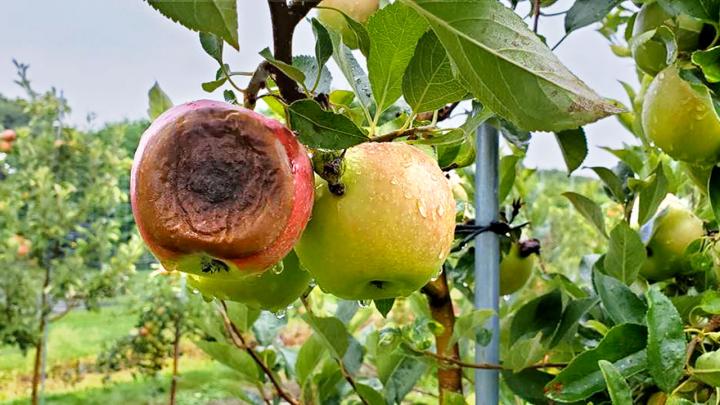
ITHACA, N.Y. – In a study of New York state apple orchards, Cornell University plant pathologists have identified a new fungal pathogen that causes bitter rot disease in apples. In addition, a second related fungus known to cause rot disease in other fruits was found for the first time in apples.

“We were shocked by what we found, just dumbfounded,” said Srdjan Acimovic, a senior extension associate at the Hudson Valley Research Laboratory (part of Cornell AgriTech) and the paper’s senior author. “We found these two species, one that has never been described before and one that has been described before but never on this host.”

Both pathogens belong to the genus Colletotrichum, which contains 189 species of fungi that cause devastating rot diseases in a wide variety of fruit crops, including banana, strawberry, citrus, avocado, papaya, mango and apple.

If protective practices are not applied in a timely manner, apple losses from bitter rot in New York state can average up to 25% per year, with reports of some organic farms losing up to 100% of their crop. Bitter rot also accounts for up to 5% additional loss of marketable fruit in storage post-harvest.

This damage is costly for farmers; the farm gate value for New York apples was roughly $260 million in 2018, according to U.S. Department of Agriculture statistics.

The dominant species found in the apples was C. fioriniae, followed by C. chrysophilum, which is found in other fruits but not apples until now, and the newly discovered C. noveboracense, named after New York state in Latin.

Colletotrichum fungi that infect apple fruit can largely be divided in two main groups. One group called the C. gloeosporioides complex thrives in warmer growing regions than the other group, the C. acutatum complex, which is more frequently reported in cooler apple growing regions. And based on the group they belong to, species can react differently to fungicides, which the researchers also tested. For this reason, identifying and characterizing the fungi is important for bitter rot management.

“When we know which species are dominant in our area, we know how environmental conditions will affect them and which control method is best in an orchard,” said study first author Fatemeh Khodadadi, a postdoctoral researcher in Acimovic’s lab.

In the future, the researchers plan to work with other plant pathologists and apple breeders to identify possible genes that confer natural resistance to Colletotrichum fungi that may be bred into apple cultivars.

###

The study, “Identification and Characterization of Colletotrichum Species Causing Apple Bitter Rot in New York and Description of C. noveboracense sp. nov.,” was published July 6 in the journal Scientific Reports.

Media Contact
Lindsey Hadlock
[email protected]

Original Source

https://news.cornell.edu/stories/2020/07/scientists-identify-new-pathogen-ny-apples

Related Journal Article

http://dx.doi.org/10.1038/s41598-020-66761-9

Tags: AgricultureMolecular BiologyPlant Sciences
Share12Tweet8Share2ShareShareShare2

Related Posts

Here are a few rewritten headlines for a science magazine post, each with a slightly different tone: Intriguing & poetic: How do organs sculpt themselves? Sea stars hold the secret Direct & research-focused: Sea stars reveal the hidden rules of organ formation Metaphorical & inviting: Tiny architects beneath the waves: What sea stars teach us about building organs Short & punchy: Star-shaped clues to how our organs take shape Question-led: Could a sea star show us how organs form? Elegant & feature-style: The body’s blueprint, glimpsed in a sea star’s arm

July 6, 2026
Bacteria evolve faster with unconventional gene copies — Biology

Bacteria evolve faster with unconventional gene copies

July 6, 2026

Neighbours rewire soil feedback via root microbiome shifts

July 6, 2026

Evolution-Inspired Biosensors Revolutionize Lipid Tracking in Real Time

July 2, 2026
Please login to join discussion

POPULAR NEWS

  • Detection of EDCs in Breast Milk and Infant Urine Up to Six Months Highlights Early Exposure Risks

    77 shares
    Share 31 Tweet 19
  • New Drug Candidate Developed at McMaster Shows Potential for Treating Brain Cancer

    58 shares
    Share 23 Tweet 15
  • Saying Goodbye to PGY-6: Pediatric Fellowship Realities

    103 shares
    Share 41 Tweet 26
  • KTU Researchers Explore Ultrasound’s Role in Enhancing Blood Flow Beyond Diagnostics

    53 shares
    Share 21 Tweet 13

About

We bring you the latest biotechnology news from best research centers and universities around the world. Check our website.

Follow us

Recent News

Flame retardant BDE-209 targets molecularly linked to ulcerative colitis

Ultra-high frequency particle impacts mimic rockbursts to shatter hard rock

Kidney transplant outcomes in older adults studied by German researchers

Subscribe to Blog via Email

Enter your email address to subscribe to this blog and receive notifications of new posts by email.

Join 83 other subscribers
  • Contact Us

Bioengineer.org © Copyright 2023 All Rights Reserved.

Welcome Back!

Login to your account below

Forgotten Password?

Retrieve your password

Please enter your username or email address to reset your password.

Log In
No Result
View All Result
  • Homepages
    • Home Page 1
    • Home Page 2
  • News
  • National
  • Business
  • Health
  • Lifestyle
  • Science

Bioengineer.org © Copyright 2023 All Rights Reserved.