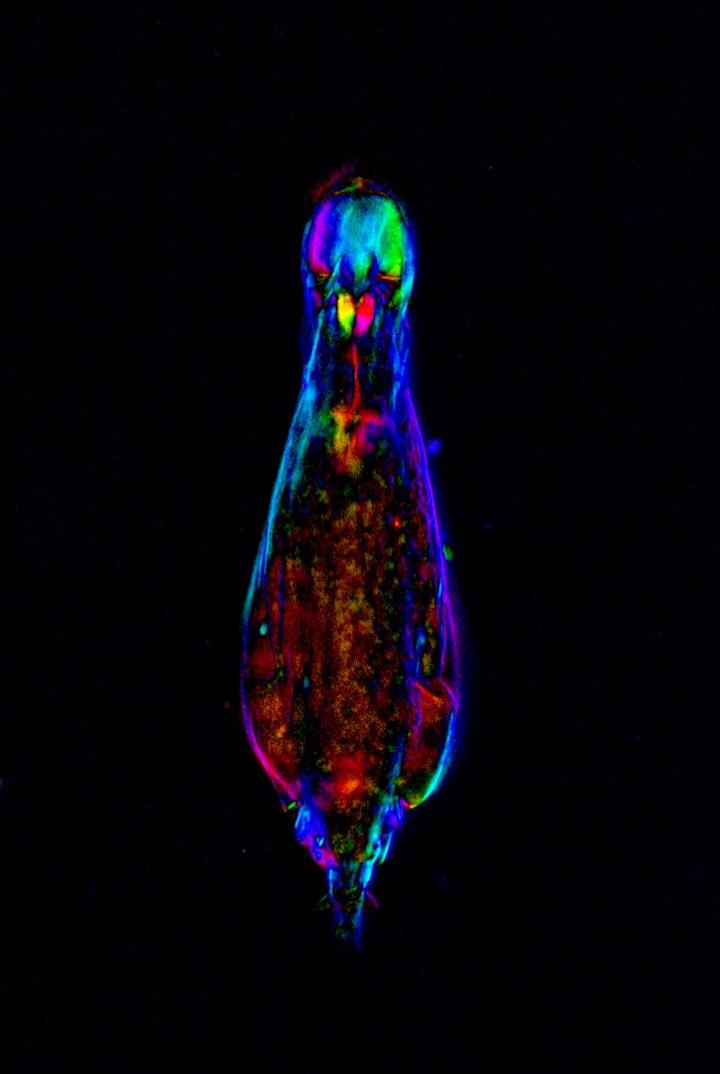
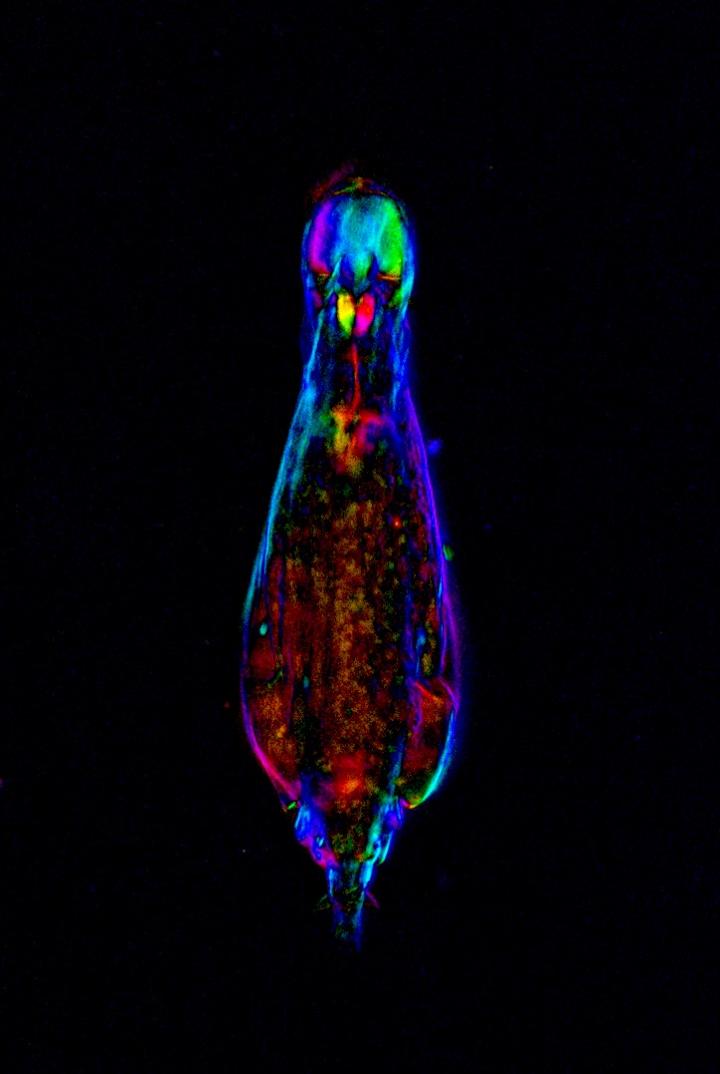
Credit: Michael Shribak, Irina Arkhipova
WOODS HOLE, Mass. — Rotifers are tough, microscopic organisms highly resistant to radiation and repeated cycles of dehydration and rehydration. Now Irina Arkhipova, Irina Yushenova, and Fernando Rodriguez of the Marine Biological Laboratory (MBL) have discovered another protective mechanism of this hardy organism: the Terminons. Their findings, which can have implications for research on aging and genome evolution, are published this week in Molecular Biology and Evolution.
Terminons are a type of retrotransposon, DNA sequences that can copy themselves from RNA and relocate within the genome. While most transposons insert between DNA sequences, Terminons are unusual in that they attach at the end of chromosomes. Arkhipova first came across transposable elements that insert at chromosome ends in 2007 but only now has the size of these transposons been determined.
Chromosomes in eukaryotic cells (which make up all multicellular organisms) are capped with DNA sequences called telomeres, which protect the ends from degradation. By attaching to telomeres, Terminons provide even more buffer against chromosome degradation, which has been associated with aging. The discovery of Terminons could have substantial impact for research on the mechanisms of aging.
The Terminon is a giant transposon, approximately six times the size of the typical retrotransposon. Terminons reach this giant size because they seem to pick up additional genes, either from viral or cellular origins, Arkhipova says. While Terminons may be involved in capturing foreign genes — a highly unusual property of bdelloid rotifers discovered in Arkhipova's lab — it is unclear how this happens. Depending on what genes they acquire, some retrotransposons have evolved into viruses. So could Terminons evolve into viruses?
"That would be a very interesting question we hope to address, but these would be totally new types of viruses that haven't been described before," Arkhipova says.
Absent from all other life forms, Terminons are found in only the bdelloid rotifers. Members of this rotifer class span tens of millions of years of evolutionary history, suggesting this protective mechanism for their chromosomes is ancient. With so many undiscovered organisms occupying every niche of our globe, it is possible there are other unknown types of transposable elements that have potential for tremendous impacts on their hosts.
Several MBL scientists are actively developing the rotifer as a model system to study transposable elements in the genome, the mechanisms of aging, DNA repair strategies, and evolution without sexual reproduction.
###
Citation:
Arkhipova, I., Yushenova, I.A., and Rodriguez, F. (2017) Giant reverse transcriptase-encoding transposable elements at telomeres. Mol. Biol. Evol. DOI: 10.1093/molbev/msx159
The Marine Biological Laboratory (MBL) is dedicated to scientific discovery – exploring fundamental biology, understanding marine biodiversity and the environment, and informing the human condition through research and education. Founded in Woods Hole, Massachusetts in 1888, the MBL is a private, nonprofit institution and an affiliate of the University of Chicago.
Media Contact
Diana Kenney
[email protected]
508-289-7139
@mblscience
http://www.mbl.edu
Original Source
http://www.mbl.edu/blog/newly-discovered-dna-sequences-can-protect-chromosomes-in-rotifers-findings-may-have-implications-for-aging-research/ http://dx.doi.org/10.1093/molbev/msx159
############
Story Source: Materials provided by Scienmag