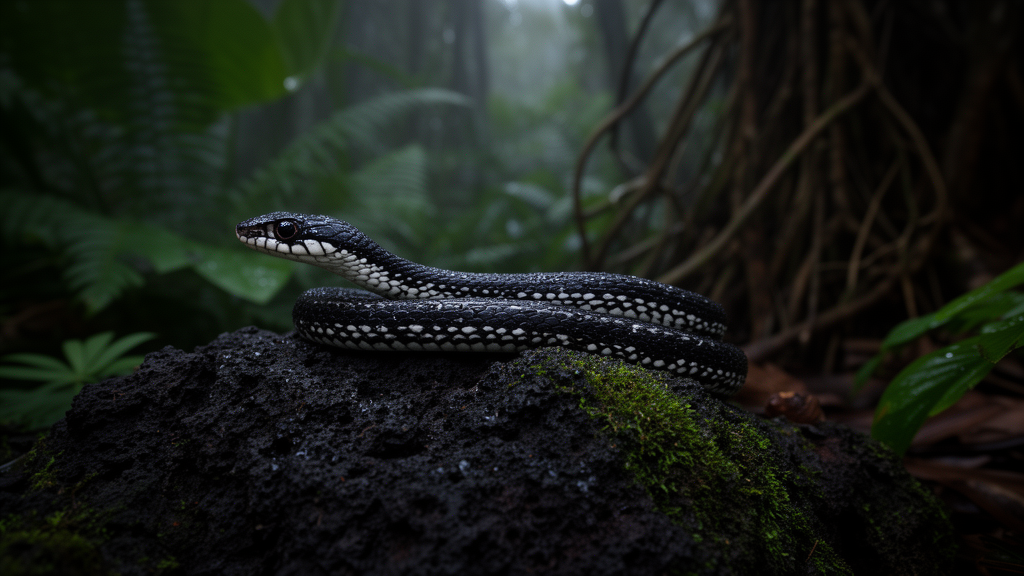
Deep in the evergreen forests of Great Nicobar Island, one of India’s most remote and least-studied corners, a glossy black snake has been quietly slipping through the undergrowth, unknown to science under its own name. Now, after more than a decade of taxonomic detective work, researchers have confirmed that this insular serpent is not the widespread species it was long assumed to be, but an entirely new one. The snake has been formally described as Lycodon irwini, a name honouring the late Australian conservationist Steve Irwin, whose famous enthusiasm for wildlife made him a household figure worldwide.
The discovery, published in the journal Evolutionary Systematics, resolves a puzzle that has lingered since 2010, when researchers first recorded a single specimen of a wolf snake on Great Nicobar Island and identified it as Lycodon subcinctus, the banded wolf snake, a species then thought to range widely across Southeast Asia and Indonesia. That lone specimen, deposited at the Zoological Survey of India in Port Blair, was all anyone had to go on. Recent taxonomic revisions of the Lycodon subcinctus group raised doubts about whether the Nicobar population truly belonged to the mainland species, but with no additional specimens and no genetic data, its identity remained unresolved.
Wolf snakes of the genus Lycodon are small to medium-sized nocturnal hunters that form an integral part of the Oriental snake fauna. Over the past two decades, the genus has undergone substantial taxonomic upheaval, with revisions of several widespread species and the description and revalidation of numerous old names. This has made Lycodon the second-most speciose snake genus in Asia, with 74 recognised species. The group at the centre of the new study, the Lycodon subcinctus group, was historically treated as a single, morphologically variable species distributed across much of mainland Southeast Asia and the Indonesian islands, but recent work has split it apart piece by piece.
That splitting process has been remarkably productive. Populations from Palawan and Borneo were elevated to full species status as Lycodon sealei. A population from southern China, once attributed to the name Lycodon maculatus, was found to bear a name that actually belonged to a Mexican species, prompting researchers to coin a new name, Lycodon neomaculatus, for the Chinese mainland population. Most recently, a neotype was designated for Lycodon subcinctus itself from Penang in peninsular Malaysia, anchoring the true identity of the species. With the taxonomy of the group largely settled, one glaring exception remained: the insular population from the Nicobar Islands, India.
To settle the question, the research team re-examined the original 2010 specimen, traced a second uncatalogued specimen from the same population held at the Zoological Survey of India, and collected a fresh adult female from Great Nicobar Island. The three specimens, all adult females, were subjected to detailed morphological examination, with measurements taken using digital calipers and scale counts following standard protocols. The fresh specimen, collected near Gandhi Nagar at an elevation of 140 metres, was designated the holotype and housed at Pondicherry University’s Department of Ocean Studies and Marine Biology in Port Blair.
The molecular analysis proved decisive. Genomic DNA was extracted from preserved tissue of the holotype, and fragments of the mitochondrial cytochrome b gene and the nuclear c-mos gene were amplified and sequenced. Maximum likelihood phylogenetic analysis, run with 100,000 bootstrap replicates, placed the Nicobar snake firmly within the Lycodon subcinctus group, as the sister lineage to Lycodon subcinctus itself with strong statistical support. Crucially, the uncorrected pairwise sequence divergence at cytochrome b was 6 percent from Lycodon subcinctus and between 6 and 17 percent from other members of the group, thresholds well within the range used to delineate species in this genus and related colubrid snakes.
The morphology tells the same story. Lycodon irwini is a fairly large, slender wolf snake, with the largest known specimen measuring nearly 1.2 metres in total length. Its dorsum is a uniform glossy black, lacking the white bands seen in some relatives, and its ventral surface is greyish black with a cream-coloured ventrolateral ridge. It can be distinguished from all other members of the group by a combination of traits: a preocular scale that is occasionally present, a prefrontal scale that never touches the eye, a higher count of ventral scales ranging from 223 to 238, and more subcaudal scales than any of its closest relatives. These are not trivial differences but the kind of anatomical characters routinely used to separate species in this group.
What makes the discovery especially striking is the snake’s apparent rarity. Only four records of Lycodon irwini are known, three of them based on the specimens described in the study, and all from Great Nicobar Island. Despite targeted surveys on other islands in the archipelago, the species has not been recorded anywhere else, suggesting it is likely endemic to Great Nicobar. The holotype was found on a road in moist evergreen forest, and another specimen was observed crossing a road in similar habitat. The researchers believe the snake may be naturally scarce, highly cryptic, and possibly confined to the island’s evergreen forests, which makes every encounter precious.
This rarity, combined with the restriction to a single island and the potential threats from ongoing development activities that could impact its only known habitat, has led the authors to recommend that Lycodon irwini be classified as Endangered on the IUCN Red List. Great Nicobar Island, part of the Sundaland biodiversity hotspot, covers a small area but hosts a remarkable variety of habitats, including mangrove marshlands, grasslands, and dense evergreen forests. The herpetofauna of the Nicobar Islands is exceptionally diverse, with many endemic species, yet the archipelago has a long history of misidentified records and incomplete surveys, meaning new species continue to emerge from collections and fieldwork alike.
The confirmation of Lycodon irwini adds to a growing body of evidence that the diversity and endemism of vertebrate species in tropical regions, particularly on islands, are significantly underestimated. Although herpetological research in the Nicobar Islands has been ongoing since the mid-1800s, the archipelago continues to reveal unique, previously unknown lineages. The islands, biogeographically linked to Sundaland yet isolated across the Ten Degree Channel, may harbour distinct lineages shaped by their isolation, underscoring the need for focused taxonomic work and conservation efforts. For now, a snake named after one of the world’s most beloved wildlife educators has taken its place in the catalogue of life, a reminder that even in the twenty-first century, remote islands can still guard secrets worth discovering.
Subject of Research: Biodiversity
Article Title: A ‘Crikey’ new snake: An insular Lycodon Fitzinger, 1826 ( Squamata , Colubridae ) from the Nicobar Archipelago, India
Article References: Naveen, R. S., Mirza, Z. A., Choure, G., & Chandramouli, S. R. (2025). A ‘Crikey’ new snake: An insular Lycodon Fitzinger, 1826 (Squamata, Colubridae) from the Nicobar Archipelago, India. Evolutionary Systematics, 9(2), 221-228. https://doi.org/10.3897/evolsyst.9.170645
Image Credits: AI Generated
DOI: 10.3897/evolsyst.9.170645
Keywords: Lycodon irwini, Great Nicobar Island, new species, wolf snake, taxonomy, herpetology, biodiversity, IUCN Red List, Nicobar Islands, Steve Irwin, Crikey, snake
News Source: Margaret Porter. (October 17, 2026). New wolf snake species named after Steve Irwin discovered on remote Indian island. Scienmag.