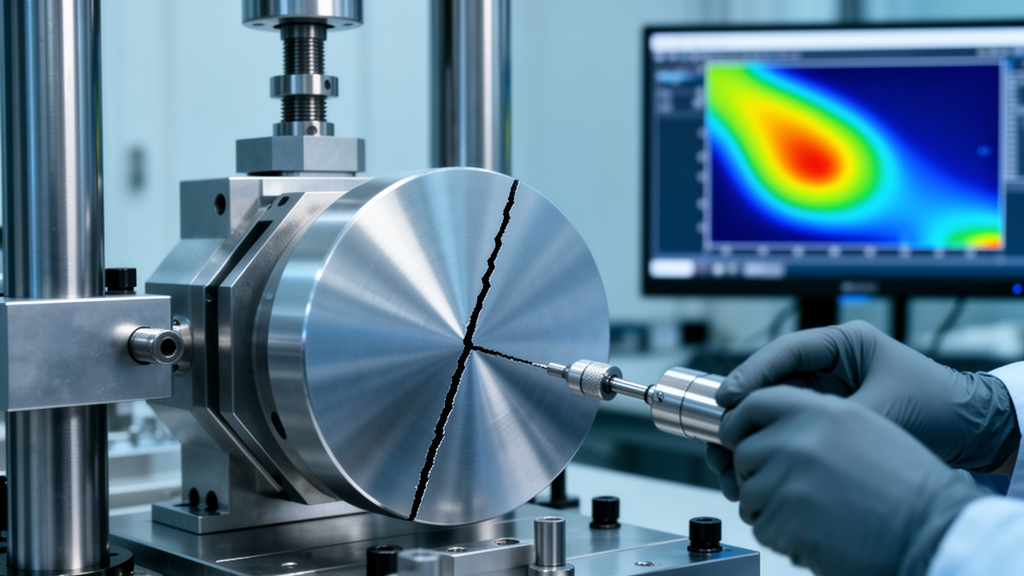
Engineers who assess whether a cracked component will survive can now draw on a more efficient mathematical tool. Researchers Mohammad Mokarrami and Javad Alizadeh Kaklar report in Scientific Reports a new representation of the one-dimensional weight function for edge cracks, and they demonstrate it on a classic problem in fracture mechanics: a radial edge crack in a solid circular disk pulled by tensile loading. Their approach is designed to make the evaluation of Mode I stress intensity factors, the quantities that govern crack growth under opening loads, both simpler and more computationally efficient.
The weight function method rests on a powerful idea in linear elastic fracture mechanics. This makes the method attractive for fatigue and fracture analyses where components face complex, changing loads. The challenge lies in constructing an accurate weight function in the first place, particularly when only a limited set of reference stress intensity factor solutions is available.
In the new study, the authors proposed a fresh representation of the one-dimensional weight function for edge cracks and tested it on the radial edge-cracked disk. Because several approximate weight function formulations and stress intensity factor solutions already exist for this geometry, it served as a demanding benchmark for judging how well the proposed representation performs. The team first calculated reference stress intensity factors for three tensile stress distributions using finite element analysis, and from these they determined the coefficients of the weight function.
A key step in the method was turning those coefficients into continuous functions of the relative crack length. The researchers developed fitting expressions that describe how each coefficient varies across the investigated range of crack sizes, allowing the weight function to be evaluated efficiently for any crack length within that range rather than only at the discrete points where finite element results were obtained. Validation followed with three independent, complex nonlinear stress distributions that had not been used in constructing the weight function.
Predictions from the new formulation showed good agreement with finite element results across these test cases, indicating that the representation captures the behavior of the cracked disk under loading conditions more complicated than the simple reference cases used to build it. The authors also compared their derived weight function with previously published formulations for radial edge cracks in disks. According to the study, these comparisons demonstrated the capability of the proposed representation to construct accurate one-dimensional approximate weight functions starting from reference stress intensity factor solutions, which is precisely the situation engineers often face when only a handful of numerical solutions exists for a new geometry.
The work is a computational and analytical study rather than an experimental one, and its scope is bounded by the geometries and loading ranges the authors investigated. The weight function was derived and validated for a radial edge crack in a solid circular disk under tensile loading, within the range of relative crack lengths covered by the reference finite element analyses. Even so, the practical significance is straightforward.
The article was published as an open-access paper in Scientific Reports, with the version shared carrying a permanent DOI and remaining subject to the journal's final editorial production process.
Subject of Research: A new weight function representation for evaluating Mode I stress intensity factors in radial edge-cracked solid circular disks
Article Title: A new weight function representation for one-dimensional edge cracks: application to mode I stress intensity factor evaluation for a radial edge-crack in a solid circular disk
Article References: Mokarrami, M., & Kaklar, J. A. (2026). A new weight function representation for one-dimensional edge cracks: application to mode I stress intensity factor evaluation for a radial edge-crack in a solid circular disk. Scientific Reports. https://doi.org/10.1038/s41598-026-77145-w
Image Credits: AI Generated
DOI: 10.1038/s41598-026-77145-w
Keywords: fracture mechanics, weight function method, stress intensity factor, edge crack, solid circular disk, finite element analysis, Mode I cracking, fatigue analysis, Scientific Reports, computational mechanics, weight, function
News Source: Denise Maddox. (October 26, 2026). New weight function method sharpens stress intensity predictions for cracked disks. Scienmag.