Credit: Lauren D. Quinn
URBANA, Ill. – Last summer, farmers in the Midwest got an unwelcome surprise after planting native seed on Conservation Reserve Program acres. Palmer amaranth, the aggressive and hard-to-kill weed, had established in droves. As a possible solution, some states declared Palmer a noxious weed, which prohibits its sale and transport.
"I've had seed growers call me," says Pat Tranel, molecular weed scientist in the crop sciences department at the University of Illinois. "Their businesses are up in the air because of this. Unless they have a way to certify their product is Palmer-free, they can't sell it."
The typical testing method involves growing a sample of seeds until the plants are large enough to be identified, but this is a slow and potentially unreliable process.
"It all takes a long time, and sometimes the seeds don't germinate during the test," Tranel says. "Alternatively, there's a company that will test individual seeds using DNA sequencing, but they're charging $100 per seed. It's not cost-effective."
Tranel and graduate student Brent Murphy developed a way around these issues. Their low-cost method can identify Palmer amaranth DNA from within a mixed sample without having to grow the plants. The assay, which uses a method known as quantitative PCR, can detect genetic variations unique to Palmer even when flooded with samples from closely related species, including waterhemp.
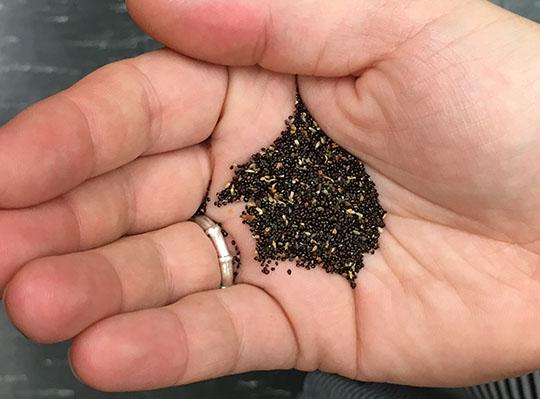
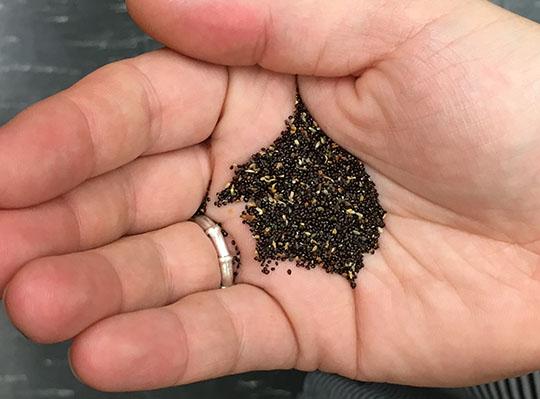
"Palmer, redroot pigweed, waterhemp – they all have tiny black seeds that basically look the same. We needed a way to efficiently extract DNA from pooled seed samples and, if it's present, identify Palmer," Tranel says.
Once Tranel and Murphy developed this assay, they worked with U of I Extension's Plant Clinic to optimize the test for mixed seed samples. Diagnostic outreach Extension specialist Diane Plewa and Plant Clinic technician Elizabeth Phillippi began trying different methods to extract DNA from seed. The assay is very sensitive, but if DNA is not correctly extracted from a lone Palmer amaranth seed in a mixed sample, it won't be detected.
"The trick," Plewa says, "is to make sure every seed is ground up during the extraction process."
The researchers were able to consistently detect a single Palmer amaranth seed when mixed with 99 waterhemp seeds, and they believe the assay could achieve even greater sensitivity with additional refinement.
The Plant Clinic has optimized a protocol for commercial testing of seed lots. "We have a test that we feel very confident in," Plewa says. "We are offering the service now, for $50 per sample." For more information, call 217-649-3941 or visit the Plant Clinic website.
###
The article, "A quantitative assay for Amaranthus palmeri identification," is published in Pest Management Science. Authors Brent Murphy and Pat Tranel are housed in the Department of Crop Sciences at U of I, and Diane Plewa, Elizabeth Phillippi, and Suzanne Bissonnette are from U of I Extension's Plant Clinic. The work was supported by a USDA National Institute of Food and Agriculture Hatch grant.
Media Contact
Lauren Quinn
[email protected]
217-300-2435
@ACESIllinois
http://aces.illinois.edu/
Related Journal Article
http://dx.doi.org/10.1002/ps.4632
############
Story Source: Materials provided by Scienmag