A dangerous variant of the deformed wing virus is on the rise worldwide. The virus infects honeybees, causing their wings to atrophy and the animals to die. The new variant, which has already replaced the original strain of the virus in Europe, is spreading to other regions of the world and causing entire bee colonies to collapse. This has been shown in a study by an international research team led by Martin Luther University Halle-Wittenberg (MLU), which analysed data on the spread of virus variants over the past 20 years. The paper appeared in the “International Journal for Parasitology: Parasites and Wildlife”.
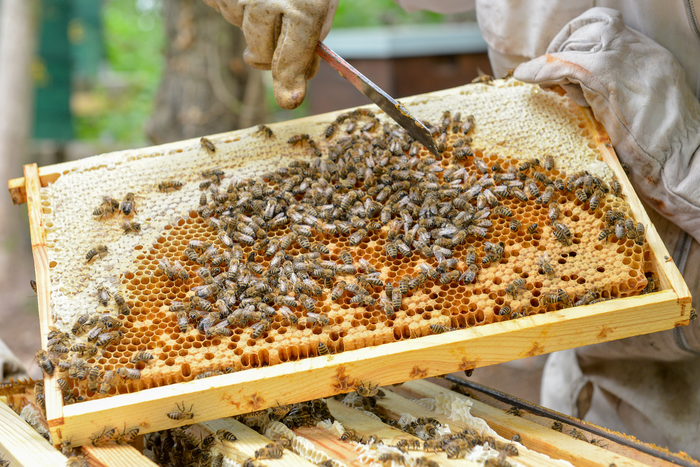
Credit: Uni Halle / Markus Scholz
A dangerous variant of the deformed wing virus is on the rise worldwide. The virus infects honeybees, causing their wings to atrophy and the animals to die. The new variant, which has already replaced the original strain of the virus in Europe, is spreading to other regions of the world and causing entire bee colonies to collapse. This has been shown in a study by an international research team led by Martin Luther University Halle-Wittenberg (MLU), which analysed data on the spread of virus variants over the past 20 years. The paper appeared in the “International Journal for Parasitology: Parasites and Wildlife”.
Deformed wing virus (DWV) is transmitted by the parasitic Varroa mite. “These mites not only transmit viruses between honeybees, they also eat the bees’ tissues,” explains Professor Robert Paxton, a bee researcher from MLU. He has been studying the spread of various pathogens in honeybees and wild bees for many years. “Deformed wing virus is definitely the biggest threat to honeybees,” adds Paxton. The original strain of the virus (“DWV-A”) was discovered in Japan in the early 1980s and the new variant “DWV-B” was first identified in the Netherlands in 2001. “Our laboratory studies have shown that the new variant kills bees faster and is more easily transmitted,” says Paxton.
The team led by the zoologist wanted to find out how widespread in nature the new variant has become. To figure this out the researchers evaluated roughly 3,000 datasets for honeybees, large earth bumblebees and Varroa mites from the database NCBI. The datasets contain clues about the genetic material of the viruses. They also investigated the first scientifically documented references to the “DWV-B” variant for numerous countries. “Our analyses show that the new variant has already gained a foothold in Europe and that it will only be a matter of time before it is the dominant form around the world,” says Paxton. In the 2000s, the new variant was mainly found in Europe and Africa, the homeland of the honeybee. It was discovered in North and South America in the early 2010s, and in Asia in 2015. The virus variant has now been detected on all major landmasses with the exception of Australia. According to the researchers, this could be because the Varroa mite has not yet been able to spread widely there.
Evidence of the virus was also found in samples taken from large earth bumblebees. “Whether the virus will have similarly devastating consequences in bumblebees and other wild bees remains uncertain. So far, commercial bumblebee colonies infected with the virus are not dying at a significantly higher rate,” says Paxton. There are various ways to protect honeybees from the Varroa mite and the virus: “The most important thing is to pay attention to hygiene in the hive. Here, simple measures can help to protect not only one’s own colony from Varroa, but also wild bees that no one else is looking after,” Paxton concludes.
As pollinators of many wild and cultivated plants, honeybees play a major role in fruit yields and in preserving biodiversity. The loss of honeybee colonies is therefore viewed with concern by experts around the world.
Study: Paxton et al. Epidemiology of a major honey bee pathogen, deformed wing virus: potential worldwide replacement of genotype A by genotype B. International Journal for Parasitology: Parasites and Wildlife (2022). doi: doi.org/10.1016/j.ijppaw.2022.04.013
DOI
10.1016/j.ijppaw.2022.04.013
Method of Research
Meta-analysis
Subject of Research
Not applicable
Article Title
Epidemiology of a major honey bee pathogen, deformed wing virus: potential worldwide replacement of genotype A by genotype B
Article Publication Date
13-May-2022